Structure of the digestive system
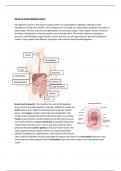
The digestive system is the group of organs which are responsible for digestion. Digestion is the
breakdown of food into nutrients. This is important so our body can absorb these nutrients to provide us
with energy. The liver, pancreas and gall bladder are accessory organs. These organs secrete chemicals
that help with digestion as food is unable to pass through them. The mouth, pharynx, oesophagus,
stomach, small intestine, large intestine, rectum and anus are all organs that are part of the digestive
system. These organs have different structures and functions that help with digestion.
mouth
Oesophagus
liver
pancreas
Gall bladder
Small intestine stomach
Large intestine
rectum
Anus
Buccal cavity (mouth) - The mouth is the start of the digestive
tract, and it is bounded together by the lips. Within the mouth are
teeth which are for biting and breaking down food into smaller
pieces. The tongue contains taste buds and soft platelets. The
tongue helps in pushing food down the throat when you swallow.
Tonsil's main function is to filter bacteria from the food we put in
our mouth. We have a mucus membrane around the lining of our
mouth which secretes mucus. This mucus mixes with the saliva
produced from the salivary glands to keep our mouth moist. The
salivary glands contain amylase which is an enzyme that helps
with the breakdown of carbohydrates. This mixture of mucus and
saliva contains hydrolytic enzymes and helps the tongue taste food. The hard palate keeps the nasal
cavity and oral cavity separate and the soft palate stops any food or water from entering the nasal
cavity.
, Pharynx is in the middle of the neck. The tongue pushes food
to the pharynx where the food is swallowed. The tongue raises
to the top of the mouth when muscles in the pharynx
contract, this is the process of how food is swallowed. The
pharynx can be divided into 3 sections: nasopharynx,
oropharynx, laryngopharynx. The nasopharynx is at the top of
the pharynx and connects to the nasal cavity. Its function is to
let air pass through when we breathe, and it has ciliated
epithelial cells which trap and destroy pathogens. The
oropharynx is underneath the nasopharynx, and it connects to
the oral cavity. It allows food and air to pass through the
mouth. The oropharynx has lingual tonsils and palatine tonsils which are a part of the immune system
and help in defending the body against foreign substances such as pathogens. The laryngopharynx is
below the oropharynx, and it connects to our larynx and oesophagus. It allows food to travel to the
oesophagus and air to travel to the lungs.
Oesophagus is located in your throat near the trachea. It is
roughly 25cm long and 2.5cm in diameter. It is a muscular
tube that carries swallowed food to the stomach. It also
contains smooth muscle. The walls are made up of 4 layers:
mucosa, submucosa, muscularis, adventitia. Mucosa is the
inner layer and has epithelial cells that secrete mucus to
lubricate the pathway for food. The mucus is also a form of
protection as it can trap any pathogens. The submucosa is
below the mucosa and contains lymphatic vessels, blood
vessels and nerves. The submucosa has a thick layer of muscle
and smooth muscle fibres. The muscularis has 2 layers of
smooth muscle. The inner and outer layer work together to
produce contractions of peristalsis. Peristalsis contracts which
push the food down towards the oesophagus. The adventitia is
the outer layer of the oesophagus and it is made up of connective tissue. The connective tissue
provides protection and support to the oesophagus. These 4 layers all work in sync to help the
oesophagus to carry out its function of transporting food and liquid to the stomach.
The digestive system is the group of organs which are responsible for digestion. Digestion is the
breakdown of food into nutrients. This is important so our body can absorb these nutrients to provide us
with energy. The liver, pancreas and gall bladder are accessory organs. These organs secrete chemicals
that help with digestion as food is unable to pass through them. The mouth, pharynx, oesophagus,
stomach, small intestine, large intestine, rectum and anus are all organs that are part of the digestive
system. These organs have different structures and functions that help with digestion.
mouth
Oesophagus
liver
pancreas
Gall bladder
Small intestine stomach
Large intestine
rectum
Anus
Buccal cavity (mouth) - The mouth is the start of the digestive
tract, and it is bounded together by the lips. Within the mouth are
teeth which are for biting and breaking down food into smaller
pieces. The tongue contains taste buds and soft platelets. The
tongue helps in pushing food down the throat when you swallow.
Tonsil's main function is to filter bacteria from the food we put in
our mouth. We have a mucus membrane around the lining of our
mouth which secretes mucus. This mucus mixes with the saliva
produced from the salivary glands to keep our mouth moist. The
salivary glands contain amylase which is an enzyme that helps
with the breakdown of carbohydrates. This mixture of mucus and
saliva contains hydrolytic enzymes and helps the tongue taste food. The hard palate keeps the nasal
cavity and oral cavity separate and the soft palate stops any food or water from entering the nasal
cavity.
, Pharynx is in the middle of the neck. The tongue pushes food
to the pharynx where the food is swallowed. The tongue raises
to the top of the mouth when muscles in the pharynx
contract, this is the process of how food is swallowed. The
pharynx can be divided into 3 sections: nasopharynx,
oropharynx, laryngopharynx. The nasopharynx is at the top of
the pharynx and connects to the nasal cavity. Its function is to
let air pass through when we breathe, and it has ciliated
epithelial cells which trap and destroy pathogens. The
oropharynx is underneath the nasopharynx, and it connects to
the oral cavity. It allows food and air to pass through the
mouth. The oropharynx has lingual tonsils and palatine tonsils which are a part of the immune system
and help in defending the body against foreign substances such as pathogens. The laryngopharynx is
below the oropharynx, and it connects to our larynx and oesophagus. It allows food to travel to the
oesophagus and air to travel to the lungs.
Oesophagus is located in your throat near the trachea. It is
roughly 25cm long and 2.5cm in diameter. It is a muscular
tube that carries swallowed food to the stomach. It also
contains smooth muscle. The walls are made up of 4 layers:
mucosa, submucosa, muscularis, adventitia. Mucosa is the
inner layer and has epithelial cells that secrete mucus to
lubricate the pathway for food. The mucus is also a form of
protection as it can trap any pathogens. The submucosa is
below the mucosa and contains lymphatic vessels, blood
vessels and nerves. The submucosa has a thick layer of muscle
and smooth muscle fibres. The muscularis has 2 layers of
smooth muscle. The inner and outer layer work together to
produce contractions of peristalsis. Peristalsis contracts which
push the food down towards the oesophagus. The adventitia is
the outer layer of the oesophagus and it is made up of connective tissue. The connective tissue
provides protection and support to the oesophagus. These 4 layers all work in sync to help the
oesophagus to carry out its function of transporting food and liquid to the stomach.