1. Structure of the skeletal system
2. Components and function of axial skeleton
3. All functions of the skeleton
The skeleton protects our internal organs and provides support for our body which allows us to move.
The skeletons' 5 main functions are support, protection, movement, blood cell production and mineral
store. 206 bones make up an adult human skeleton. Bones are organised into the axial skeleton and the
appendicular skeleton.
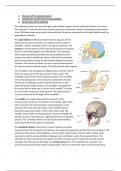
The axial skeleton is 80 bones which form the long axis of the
body from the head to the feet. It is made up of the cranium,
mandible, maxilla, vertebral column, rib cage and sternum. The
cranium is the top portion of the skull which consists of 22 bones
that are connected together by ossified joints. The braincase
(neurocranium) and facial skeleton (viscerocranium) are the 2
sections the skull is divided into. Most of the brain is protected
by the neurocranium except for the foramen magnum and other
foramina. The function of these is to act as entry and exit points
for cranial nerves and blood vessels. The skull provides facial support.
The mandible is the strongest and largest bone in the face which
forms the lower part of the jaw and part of the mouth. The
mandible is part of the viscerocranium structure. The mandible
is the only moving bone in the skull and is attached to muscles
which help in chewing and other mouth movements. It also
holds the bottom teeth in place. The mandible is composed of
the ramus and the body and is inferior to the maxilla. The body
is curved which creates the lower jawline. The body and the 2
rami are connected at the angle of the mandible.
The maxilla is the upper bone which is also part of the
viscerocranium structure. Its function is to hold the upper teeth
and is important for communication and mastication. It also
separates the nasal and oral cavities. Each maxillary bone is
pyramid shaped and its base is next to the nasal cavity. The
maxilla connects with surrounding facial structures through the
alveolar process, frontal process, zygomatic process and palatine
process. The 2 maxillary bones are fused at the intermaxillary
suture which forms the anterior nasal spine.
The vertebral column is the bones, muscles, tendons and other
tissues that go from the skull to the tailbone. It encloses the spinal cord and the fluid surrounding it. The
vertebrae, also known as the backbone, consists of the cervical spine, thoracic spine, lumbar spine,
sacral spine and the coccyx (tailbone). Between each vertebrae is a disc that separates them. The
vertebrae surround and protect the spinal cord which contains a pair of spinal nerves that transfer
messages from the brain to the body. The cervical spine (C1 to C7) is divided into 2 sections: the
craniocervical junction (CCJ) and the subaxial spine. The CCJ is where the skull connects to the spine,
2. Components and function of axial skeleton
3. All functions of the skeleton
The skeleton protects our internal organs and provides support for our body which allows us to move.
The skeletons' 5 main functions are support, protection, movement, blood cell production and mineral
store. 206 bones make up an adult human skeleton. Bones are organised into the axial skeleton and the
appendicular skeleton.
The axial skeleton is 80 bones which form the long axis of the
body from the head to the feet. It is made up of the cranium,
mandible, maxilla, vertebral column, rib cage and sternum. The
cranium is the top portion of the skull which consists of 22 bones
that are connected together by ossified joints. The braincase
(neurocranium) and facial skeleton (viscerocranium) are the 2
sections the skull is divided into. Most of the brain is protected
by the neurocranium except for the foramen magnum and other
foramina. The function of these is to act as entry and exit points
for cranial nerves and blood vessels. The skull provides facial support.
The mandible is the strongest and largest bone in the face which
forms the lower part of the jaw and part of the mouth. The
mandible is part of the viscerocranium structure. The mandible
is the only moving bone in the skull and is attached to muscles
which help in chewing and other mouth movements. It also
holds the bottom teeth in place. The mandible is composed of
the ramus and the body and is inferior to the maxilla. The body
is curved which creates the lower jawline. The body and the 2
rami are connected at the angle of the mandible.
The maxilla is the upper bone which is also part of the
viscerocranium structure. Its function is to hold the upper teeth
and is important for communication and mastication. It also
separates the nasal and oral cavities. Each maxillary bone is
pyramid shaped and its base is next to the nasal cavity. The
maxilla connects with surrounding facial structures through the
alveolar process, frontal process, zygomatic process and palatine
process. The 2 maxillary bones are fused at the intermaxillary
suture which forms the anterior nasal spine.
The vertebral column is the bones, muscles, tendons and other
tissues that go from the skull to the tailbone. It encloses the spinal cord and the fluid surrounding it. The
vertebrae, also known as the backbone, consists of the cervical spine, thoracic spine, lumbar spine,
sacral spine and the coccyx (tailbone). Between each vertebrae is a disc that separates them. The
vertebrae surround and protect the spinal cord which contains a pair of spinal nerves that transfer
messages from the brain to the body. The cervical spine (C1 to C7) is divided into 2 sections: the
craniocervical junction (CCJ) and the subaxial spine. The CCJ is where the skull connects to the spine,