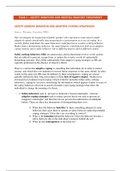
TASK 6 – SAFETY BEHAVIOR AND MENTAL IMAGERY TREATMENT
SAFETY-SEEKING BEHAVIOR AND ADAPTIVE COPING STRATEGIES
Source: Thwaites, Freeston (1999)
One can imagine an inexperienced public speaker who experiences some anxiety might
adaptively spend considerable time preparing for a presentation as a way of coping. In a
socially phobic individual, the same behaviour could function as a safety-seeking behavior.
Rather than a dichotomous behavior, the same behavior could function both as an adaptive
coping strategy and a safety behavior, but to differing degrees and in different context.
Safety-seeking behaviors (SBs) are unnecessary and dysfunctional overt or covert actions
that are utilized to prevent, escape from, or reduce the severity or risk of a potentially
threatening outcome. They differ substantially from adaptive coping strategies as SBs are
typically performed in the absence of objective threat.
There is a notion that adaptive coping is something that individuals do in order to reduce
anxiety, and which does not maintain or worsen future responses to the same stimuli. In other
words, in the same way SBs may be defined, by their consequences, coping are at least
partially defined by their long term impact or their lack of negative impact. Studies have
distinguished avoidance-based coping (which would be included within safety-seeking
behaviors), coping by excessive monitoring for information (which appears similar to some of
the safety behaviors observed in anxiety disorders) and coping strategies that allow the
individual to change the meaning of a threat.
Safety-behaviors seek to ‘prevent or minimize a feared catastrophe’, whereas
adaptive coping strategies seek to reduce anxiety but do not seek to prevent an
imagined ‘catastrophe’ and therefore do not prevent disconfirmation of unhelpful
beliefs. There are three key dimensions of distinguishing these two;
1) What does the behavior look like? Is there something inherent in some
behaviors that cause them to operate as safety behavior rather than helpful
coping strategies? Does this vary according to context?
2) What is the intention behind the behavior? Does the behavior become a
safety behavior due to the individual’s purpose behind the act?
3) What are the consequences of the behavior?
, Panic Disorder
Direct avoidance
Some of the most obvious safety-behaviors in panic are those that involve direct avoidance
of a situation of stimulus. In panic disorder, it appears relatively unlikely that direct avoidance
could be an adaptive coping strategy; it will maintain the anxiety cognition or even strengthen
it. Both the intention behind the behavior (prevent feared catastrophe from occurring) and the
outcome (maintain or strengthen belief) mark this type of avoidance as safety-behavior.
Might an individual want to avoid the unpleasant effects of panic without an associated
catastrophic belief? Salkovskis suggested that responses intended to avoid anxiety alone are
potentially adaptive coping strategies (not when person believes that anxiety is harmful).
Escape behavior
Escape behavior in PD is similar to direct avoidance. A clear example was exhibited by a
recent patient recovering from severe panic disorder, who expressed surprise that having
reduced direct avoidance, he was still extremely anxious leaving his house, despite no recent
panic attacks. Investigation revealed that whilst in the city centre, he would begin to notice an
increased heart rate, which would cause him to feel even more anxious due to fears of having
a panic attack. One safety behavior was to leave the situation and get home as quickly as
possible. He was aware that he had no idea what would actually happen if he stayed in town.
Examples such as fleeing a situation fulfil the definition of a safety behavior.
Subtle behaviors
Distinguishing between adaptive coping and safety-behaviors can be more difficult here. The
behaviors are often idiosyncratic, and so it is harder to identify them and determine their
function. Certain examples can be more easily identified as safety-behaviors based on the
frequency with which they are reported. Examples are sitting near exits in restaurants, only
going into situations with a companion, or sitting own when legs feel weak. However, most
people are likely to have sat near to an exit at some point in their lives, with a common sense
logic (e.g. waiting for a friend). So, the surface motivation cannot be used to distinguish.
Two individuals may both choose to sit next to the door to avoid the heat and to get more
fresh air; one may do this because he does not want to get too hot, whereas the other may
perform the same behavior due to a wish to avoid breathlessness and choking to death. The
key questions is; what was the worst thing that could have happened if you had sat in the
middle of the restaurant?
Social Anxiety Disorder
Cognitive models suggest that individuals with SAD hold dysfunctional beliefs about
themselves, and about themselves in relation to social situations. In SAD safety-seeking
behaviors are hypothesized to play a role in maintenance as well; people often belief that the
feared social catastrophe would have occurred if they had not performed the safety behavior.
SBs can lead to an accentuation of feared symptoms or ‘contaminate’ the situations. E.g.,
wearing a jacket to hide sweating can cause increased sweating, while excessive self-
monitoring can cause the individual to appear cold or disinterested.
SAFETY-SEEKING BEHAVIOR AND ADAPTIVE COPING STRATEGIES
Source: Thwaites, Freeston (1999)
One can imagine an inexperienced public speaker who experiences some anxiety might
adaptively spend considerable time preparing for a presentation as a way of coping. In a
socially phobic individual, the same behaviour could function as a safety-seeking behavior.
Rather than a dichotomous behavior, the same behavior could function both as an adaptive
coping strategy and a safety behavior, but to differing degrees and in different context.
Safety-seeking behaviors (SBs) are unnecessary and dysfunctional overt or covert actions
that are utilized to prevent, escape from, or reduce the severity or risk of a potentially
threatening outcome. They differ substantially from adaptive coping strategies as SBs are
typically performed in the absence of objective threat.
There is a notion that adaptive coping is something that individuals do in order to reduce
anxiety, and which does not maintain or worsen future responses to the same stimuli. In other
words, in the same way SBs may be defined, by their consequences, coping are at least
partially defined by their long term impact or their lack of negative impact. Studies have
distinguished avoidance-based coping (which would be included within safety-seeking
behaviors), coping by excessive monitoring for information (which appears similar to some of
the safety behaviors observed in anxiety disorders) and coping strategies that allow the
individual to change the meaning of a threat.
Safety-behaviors seek to ‘prevent or minimize a feared catastrophe’, whereas
adaptive coping strategies seek to reduce anxiety but do not seek to prevent an
imagined ‘catastrophe’ and therefore do not prevent disconfirmation of unhelpful
beliefs. There are three key dimensions of distinguishing these two;
1) What does the behavior look like? Is there something inherent in some
behaviors that cause them to operate as safety behavior rather than helpful
coping strategies? Does this vary according to context?
2) What is the intention behind the behavior? Does the behavior become a
safety behavior due to the individual’s purpose behind the act?
3) What are the consequences of the behavior?
, Panic Disorder
Direct avoidance
Some of the most obvious safety-behaviors in panic are those that involve direct avoidance
of a situation of stimulus. In panic disorder, it appears relatively unlikely that direct avoidance
could be an adaptive coping strategy; it will maintain the anxiety cognition or even strengthen
it. Both the intention behind the behavior (prevent feared catastrophe from occurring) and the
outcome (maintain or strengthen belief) mark this type of avoidance as safety-behavior.
Might an individual want to avoid the unpleasant effects of panic without an associated
catastrophic belief? Salkovskis suggested that responses intended to avoid anxiety alone are
potentially adaptive coping strategies (not when person believes that anxiety is harmful).
Escape behavior
Escape behavior in PD is similar to direct avoidance. A clear example was exhibited by a
recent patient recovering from severe panic disorder, who expressed surprise that having
reduced direct avoidance, he was still extremely anxious leaving his house, despite no recent
panic attacks. Investigation revealed that whilst in the city centre, he would begin to notice an
increased heart rate, which would cause him to feel even more anxious due to fears of having
a panic attack. One safety behavior was to leave the situation and get home as quickly as
possible. He was aware that he had no idea what would actually happen if he stayed in town.
Examples such as fleeing a situation fulfil the definition of a safety behavior.
Subtle behaviors
Distinguishing between adaptive coping and safety-behaviors can be more difficult here. The
behaviors are often idiosyncratic, and so it is harder to identify them and determine their
function. Certain examples can be more easily identified as safety-behaviors based on the
frequency with which they are reported. Examples are sitting near exits in restaurants, only
going into situations with a companion, or sitting own when legs feel weak. However, most
people are likely to have sat near to an exit at some point in their lives, with a common sense
logic (e.g. waiting for a friend). So, the surface motivation cannot be used to distinguish.
Two individuals may both choose to sit next to the door to avoid the heat and to get more
fresh air; one may do this because he does not want to get too hot, whereas the other may
perform the same behavior due to a wish to avoid breathlessness and choking to death. The
key questions is; what was the worst thing that could have happened if you had sat in the
middle of the restaurant?
Social Anxiety Disorder
Cognitive models suggest that individuals with SAD hold dysfunctional beliefs about
themselves, and about themselves in relation to social situations. In SAD safety-seeking
behaviors are hypothesized to play a role in maintenance as well; people often belief that the
feared social catastrophe would have occurred if they had not performed the safety behavior.
SBs can lead to an accentuation of feared symptoms or ‘contaminate’ the situations. E.g.,
wearing a jacket to hide sweating can cause increased sweating, while excessive self-
monitoring can cause the individual to appear cold or disinterested.