MY ADVENTIS FMC LEVEL 2 SG WITH 100% CORRECT ANSWERS 2025
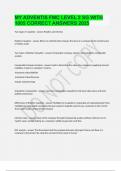
Two types of valuation Relative and Intrinsic Relative Valuation Refers to methods that compare the price of a company to the market value of similar assets Brainpower Read More Previous Play Next Rewind 10 seconds Move forward 10 seconds Unmute 0:01 / 0:15 Full screen Two Types of Relative Valuation Comparable company analysis and Acquisition comparable analysis Comparable Company Analysis Used to determine the value of a company by applying relevant multiples of peers to company's metrics. -Enterprise Value/EBITDA -Enterprise Value/Revenue -Equity Value/Earnings Acquisition comparables represent comparable acquisitions that have taken place and been publicly announced. Differences of Relative Valuation Multiples for acquisition comparable are typically greater than multiples for comparable companies because acquirers typically need to pay a premium to the current share price to gain control of the company Intrinsic Value Value of the company through fundamental analysis without reference to its market value, instead looking to a company's ability to generate cash flow DCF analysis The discounted cash flow analysis discounts all project future cash flow of a company to the present by using the concept of time value of money Unlevered Free Cash Flow projections Represents the cash flow available to all stakeholders in the business (i.e. it is not affected by capital structure and, accordingly, does not include interest expense Tax effected EBIT Used rather than net income because the valuation of a company should not be dependent on capital structure Apply a corporate tax rate directly to EBIT without subtracting interest expense eliminates the impact of capital structure to cash flow Terminal value Used to make assumptions about long-term growth and cash flow Two types of terminal value The perpetuity method and EBITDA exit multiple Perpetuity method o Assumes that the free cash flow flow in the last year of the projection period grows into perpetuity at an annual rate of growth (Typically 2-3%) EBITDA exit multiple o Assumes that the company is sold in the last year of the project period at a multiple of EBITDA. Discount Rate o Used in a DCF analysis should be the cost of capital for the business being valued o WACC usually used to determine the discount rate or a range of discount rates to be used in a DCF analysis. WACC (weighted average cost of capital) o The minimum return that a company must earn on an existing asset base (investors and creditors) to satisfy all capital providers. o represents the blended cost to both debt holders and equity holders of a company based on the cost of debt and the cost of equity for that company Hurdle Rate Minimum acceptable rate of return (set by management) for an investment. Capital Assets Pricing Model (CAPM) A model that describes the relationship between risk and expected return and that is used in the pricing of risky securities. Transaction value (LBO) o Purchase price typically assumes a premium to where the stock price is currently trading to incent a change in ownership o Premium typically ranges between 20%-40%. o Transaction value then determined by adding net debt currently on the balance sheet of the company being acquired Senior Debt § First claim in bankruptcy and is typically amortized over the life of the loan and therefore has a lower interest rate Subordinate debt § Typically requires interest payments only with the ability to voluntarily pay down principal with any excess cash flow § Higher interest rate due to the default risks Internal Rate of Return (IRR) The annualized effective compounded return rate that makes the net present value equal to zero Cash returned to sponsor / initial equity invested ^ (1/investment time horizon) - 1 Cash on Cash multiple How much an investor receives in proceeds upon exiting the investment compared to its initial investment; it is not dependent on when the exit actually occurs Cash returned to sponsor/initial equity investor Enterprise Value analogous to transaction value. Equity Value + Net Debt Equity value Analogous to purchase price -Enterprise value-net debt -Share price * # of shares outstanding DEBT/EBIDTA typically 2x-4x Total debt/EBTDA Typically 4.0x - 6.0x Financial sponsors equity investment § makes up any remaining capital required to finance the transaction value and typically represents between 20-40% of total sources Target investor returns 20-30% Type of Intrinsic Value Discounted Cash Flow
Written for
- Institution
- Adventis FMC 1
- Course
- Adventis FMC 1
Document information
- Uploaded on
- December 29, 2023
- Number of pages
- 4
- Written in
- 2023/2024
- Type
- Exam (elaborations)
- Contains
- Unknown
Subjects
-
my adventis fmc level 2 sg with

Also available in package deal