Molecular Principles of: Neurodegenerative Diseases
Lecture 4, general Mechanisms in Neurodegeneration
Learning objectives:
In relation to neurodegenerative disease, the student:
• Understands and can describe the involvement of protein misfolding/aggregation
(oligomers/fibrils, localisation, aetiology)
• Understands and can describe key pathways in protein quality control
(chaperones, Ubiquitin proteasome and autophagy)
• Understands the mechanism of proteostatic stress responses
(Heatshock response, unfolded protein response)
• Understands the involvement of the neuroinflammatory response
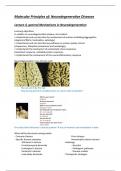
Neurodegeneration= loss of brain cells
- You can see it by the eye
- How do we get from a healthy brain to a brain with a disorder?
First described Alzheimer's disease patient → loss of memory and orientation in time
What will be discussed coming weeks:
- Common themes Prion disease
- Specific disease examples Amyotrophic lateral sclerosis
Alzheimer’s disease - Aetiology
Frontotemporal dementia - Genetics
Huntington’s disease - Pathogenic pathways
Parkinson’s disease - Disease models
Lewy Body dementia - Therapeutic strategies
,Neurodegenerative disorders
- The arrows point to the brain region that is primarily affected by a particular
neurodegenerative disease.
- What is common in all these diseases is that they have protein occlusions, but the
protein might be different as may the area where the occlusions occur.
Protein aggregates
If a protein wants to function it has to fold in a specific way. When they are misfolded the
beta sheets are exposed which are sticky, these can stick to other misfolded proteins with
beta-sheet exposures. This ends up as a very large rigid structure which hardly can come
apart.
,Alzheimer already knew and observed this phenoma
Protein aggregates
1. Loss of function (because misfolded proteins can’t function anymore→ this may
cause a different phenotype of a cell)
2. Gain of toxic function (e.g., they can damage membranes and organelles)
→Therefore: protein quality control
Protein synthesis
mRNA is translated into proteins by ribosomes in the cytosol or the ER. The ER is a
membranous compartment to which ribosomes are attached. When a protein is synthesized
in the ER is particularly done for proteins that need to be packaged in a membrane (also
transmembrane proteins are synthesized here)
In both compartments, after the synthesis of proteins, you want that protein to have a
particular functional conformation.
, Protein folding and quality control
Proteins can only function when they have a specific conformation. However, this goes wrong
all the time, 30% of protein synthesis goes wrong even in healthy young humans.
Chaperones bind to misfolded proteins and keep them in a folding-competent state. In
addition, when a chaperone is bound, the protein can’t bind to another protein and thus
cannot aggregate.
Chaperones (Heat-shock proteins, HSP): Chaperone facilitate protein folding and refolding by
keeping proteins in “a folding-competent state”
Two classes:
ATP dependent
- Hsp90
- Hsp70
- Hsp60
ATP independent
- Small Hsp
The Hsp70 cycle
Binding and release of substrate
(unfolded protein) is dependent on:
- co-chaperone
- ATP
There are two stages of the chaperone,
an ATP-bound state and ADP bound
state. Upon binding of ATP, it gets a
different structure, an open chaperone
state, in this state the misfolded protein
can bind. Then when ATP hydrolyzes
the chaperone closes and the misfolded
protein is trapped and bound to the
chaperone.
Lecture 4, general Mechanisms in Neurodegeneration
Learning objectives:
In relation to neurodegenerative disease, the student:
• Understands and can describe the involvement of protein misfolding/aggregation
(oligomers/fibrils, localisation, aetiology)
• Understands and can describe key pathways in protein quality control
(chaperones, Ubiquitin proteasome and autophagy)
• Understands the mechanism of proteostatic stress responses
(Heatshock response, unfolded protein response)
• Understands the involvement of the neuroinflammatory response
Neurodegeneration= loss of brain cells
- You can see it by the eye
- How do we get from a healthy brain to a brain with a disorder?
First described Alzheimer's disease patient → loss of memory and orientation in time
What will be discussed coming weeks:
- Common themes Prion disease
- Specific disease examples Amyotrophic lateral sclerosis
Alzheimer’s disease - Aetiology
Frontotemporal dementia - Genetics
Huntington’s disease - Pathogenic pathways
Parkinson’s disease - Disease models
Lewy Body dementia - Therapeutic strategies
,Neurodegenerative disorders
- The arrows point to the brain region that is primarily affected by a particular
neurodegenerative disease.
- What is common in all these diseases is that they have protein occlusions, but the
protein might be different as may the area where the occlusions occur.
Protein aggregates
If a protein wants to function it has to fold in a specific way. When they are misfolded the
beta sheets are exposed which are sticky, these can stick to other misfolded proteins with
beta-sheet exposures. This ends up as a very large rigid structure which hardly can come
apart.
,Alzheimer already knew and observed this phenoma
Protein aggregates
1. Loss of function (because misfolded proteins can’t function anymore→ this may
cause a different phenotype of a cell)
2. Gain of toxic function (e.g., they can damage membranes and organelles)
→Therefore: protein quality control
Protein synthesis
mRNA is translated into proteins by ribosomes in the cytosol or the ER. The ER is a
membranous compartment to which ribosomes are attached. When a protein is synthesized
in the ER is particularly done for proteins that need to be packaged in a membrane (also
transmembrane proteins are synthesized here)
In both compartments, after the synthesis of proteins, you want that protein to have a
particular functional conformation.
, Protein folding and quality control
Proteins can only function when they have a specific conformation. However, this goes wrong
all the time, 30% of protein synthesis goes wrong even in healthy young humans.
Chaperones bind to misfolded proteins and keep them in a folding-competent state. In
addition, when a chaperone is bound, the protein can’t bind to another protein and thus
cannot aggregate.
Chaperones (Heat-shock proteins, HSP): Chaperone facilitate protein folding and refolding by
keeping proteins in “a folding-competent state”
Two classes:
ATP dependent
- Hsp90
- Hsp70
- Hsp60
ATP independent
- Small Hsp
The Hsp70 cycle
Binding and release of substrate
(unfolded protein) is dependent on:
- co-chaperone
- ATP
There are two stages of the chaperone,
an ATP-bound state and ADP bound
state. Upon binding of ATP, it gets a
different structure, an open chaperone
state, in this state the misfolded protein
can bind. Then when ATP hydrolyzes
the chaperone closes and the misfolded
protein is trapped and bound to the
chaperone.