Medical Surgical Nursing- Integumentary 2023 EXAM
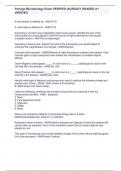
Medical Surgical Nursing- Integumentary 2023 EXAM Function of skin - CORRECT ANSWERS protection, prevents penetration, perception, temperature regulation, identification, communication, wound repair, absorption and excretion, production of vitamin D Epidermis - CORRECT ANSWERS The outer layer of skin that acts as a watertight protective covering. Dead Skin. Dermis - CORRECT ANSWERS Middle layer of skin that is composed of elastic fibers. Functions to provide strength, mechanical support and to protect muscle, bone, and organs. Nerve receptors produce feelings of heat, cold, pain, touch and pressure have ceruminous glands produce sebum Hypodermis (subcutaneous layer) - CORRECT ANSWERS Innermost layer of the skin. Composed of adipose tissue; functions as a site for storage, shock absorber, insulates deep tissue, and anchors skin to underlying tissues. Age related skin changes - CORRECT ANSWERS -Delayed Healing: skin repairs proceed more slowly -Epidermal and dermal thinning: slow repairs, decreased vvitamin D production, reduced number of langerhans cells (sagging and wrinkling due to fiber loss) -Increased risk of infection and sun damage -Decreased vitamin D synthesis -Decreased melanocyte activiey: pale skin and reduced tolerance for sun exposure -Diminished blood supple: slow healing, and reduced ability to lose heat -Decreased glandular acitivity: sweat glands tend to overheat - Decreased skin turgor, wrinkling, fragility, dryness, roughness, vascular lesions. Assessment: Objective Data - CORRECT ANSWERS Color, pigmentation, bruising, vascularity, lesions, discolorations, unusually odor, temperature, turgor, mobility, moisture, and texture. Assessment: Subjective Data - CORRECT ANSWERS Itching, burning, dry, irritated, pins and needles, pain scale, longevity, etiology. Topical Medications - CORRECT ANSWERS Lotions, creams, pastes, shampoos, and ointments that are applied to the surface of the skin and affect only that area; a medication delivery route. Slows the overactive epidermis without affecting other tissues and cause sloughing of the rapidly growing epidermal cells. Topical Corticosteroids - CORRECT ANSWERS Used for inflammatory effects; often limited to twice a day for a four week period. Used to treat dermatitis and psoriasis. Systemic Steroids - CORRECT ANSWERS Not generally used for skin conditions because it could possibly provoke a flare-up. Possibly used for hives. Can be used when topical measures are not effective. Phototherapy - CORRECT ANSWERS A therapy that involves repeated exposure to UV lights, which slows the rapid cell growth of skin cells. Cellulitis - CORRECT ANSWERS Inflammation of subcutaneous, loose connective tissue; causes swelling; possible skin infections. Symptoms: Hot to touch, tender, erythematous, edematous areas with diffused borders, chills, malaise, and fever. Eczema - CORRECT ANSWERS noninfectious, inflammatory skin disease characterized by redness, blisters, scabs, and itching. Long term inflammation of the skin; hypersensitivity of the skin with hyperactivity inflammation and hyperactivity Psoriasis - CORRECT ANSWERS A common skin disorder characterized by flare-ups in which red papules covered with silvery scales occur on the elbows, knees, scalp, back, or buttocks. Can be as little as a cosmetic annoyance, and can severe enough to be physically disabling. Sun Exposure - CORRECT ANSWERS Major factor in precancerous and cancerous lesions such as: Actinic keratoses, Basal cell carcinoma, Squamous cell carcinoma, and Malignant melanoma. Patient Teaching: Sunscreen with a minimum of 15 SPF, wearing hats, teaching on danger of burns on overcast days and the dangers of tanning beds. Avoid the sun between 11am and 3pm. Skin Cancer Prevention: ABCDE rule. - CORRECT ANSWERS A-Asymmetry B-Border Irregularity C-Color Change/Variation D-Diameter more than 6mm E-Evolving appearance Actinic Keratosis - CORRECT ANSWERS a precancerous skin growth that occurs on sun-damaged skin. Malignant Melanoma - CORRECT ANSWERS Most serious form of skin cancer; often characterized by black or dark brown patches on the skin that may appear uneven in texture, jagged, or raised.
Written for
- Institution
- Medical Surgical Nursing- Integumentary 2023
- Course
- Medical Surgical Nursing- Integumentary 2023
Document information
- Uploaded on
- December 28, 2023
- Number of pages
- 8
- Written in
- 2023/2024
- Type
- Exam (elaborations)
- Contains
- Questions & answers
Subjects
- medical surgical nursing
-
medical surgical nursing integumentary 2023 exam