Basics
● The probability of an outcome=
the number of ways the outcome can make/ total number of possible outcomes
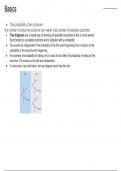
● Tree diagrams are a visual way of showing all possible outcomes of two or more events.
Each branch is a possible outcome and is labelled with a probability.
● Two events are independent if the probability of the first event happening has no impact on the
probability of the second event happening.
● For example, the probability of rolling a 6 on a dice will not affect the probability of rolling a 6 the
next time. The scores on the dice are independent.
● If a dice was to be rolled twice, the tree diagram would look like this:
,Starter
1) A bag contains 4 blue counters and 3 red counters. A box contains 5 blue counters and 2 red counters. Complete
the tree diagram and work out the probability of selecting two red counters.
2) A bag contains 10 red counters and 6 blue counters. Two counters are taken out and they are both different colours.
What is the probability that the next counter taken out is red?
,Events that are not independent…
● Two events are independent if the probability of the first event happening has no impact on the probability of the
second event happening.
1) A sock drawer contains 5 white socks and 4 black socks. A sock is taken at random and put on. Another sock is
taken and put on. What are the probabilities of the socks being different colours?
,Conditional probability
● Conditional probability occurs when it is given that something has happened. (Hint: look for the word “given” in the
question.)
● Conditional probability:
,Using Venn diagrams
1) 125 pupils were asked about their pets. 61 pupils said they had a cat and 68 pupils said they had a dog. 23 pupils said they
had neither a cat nor a dog.
Show this information on a Venn diagram. Find the probability that a pupil chosen at random has a cat, given that they have a
dog.
, Exam questions
1)
● The probability of an outcome=
the number of ways the outcome can make/ total number of possible outcomes
● Tree diagrams are a visual way of showing all possible outcomes of two or more events.
Each branch is a possible outcome and is labelled with a probability.
● Two events are independent if the probability of the first event happening has no impact on the
probability of the second event happening.
● For example, the probability of rolling a 6 on a dice will not affect the probability of rolling a 6 the
next time. The scores on the dice are independent.
● If a dice was to be rolled twice, the tree diagram would look like this:
,Starter
1) A bag contains 4 blue counters and 3 red counters. A box contains 5 blue counters and 2 red counters. Complete
the tree diagram and work out the probability of selecting two red counters.
2) A bag contains 10 red counters and 6 blue counters. Two counters are taken out and they are both different colours.
What is the probability that the next counter taken out is red?
,Events that are not independent…
● Two events are independent if the probability of the first event happening has no impact on the probability of the
second event happening.
1) A sock drawer contains 5 white socks and 4 black socks. A sock is taken at random and put on. Another sock is
taken and put on. What are the probabilities of the socks being different colours?
,Conditional probability
● Conditional probability occurs when it is given that something has happened. (Hint: look for the word “given” in the
question.)
● Conditional probability:
,Using Venn diagrams
1) 125 pupils were asked about their pets. 61 pupils said they had a cat and 68 pupils said they had a dog. 23 pupils said they
had neither a cat nor a dog.
Show this information on a Venn diagram. Find the probability that a pupil chosen at random has a cat, given that they have a
dog.
, Exam questions
1)