1 Which of the options is not a function of the liver?
A production of urea in the ornithine cycle
B removal of amino groups from amino acids
C storage of excess amino acids as protein
D storage of glucose as glycogen
Your answer [1]
2 Which of the statements about the control of blood glucose is correct?
A Pancreas cells increase their release of glucagon when blood glucose concentration rises above a set
level.
B Glucagon stimulates the conversion of glycogen to glucose by liver cells.
C Insulin increases blood glucose concentration by stimulating glycogenesis and gluconeogenesis.
D The interaction of insulin and glucagon keeps the blood glucose concentration constant.
Your answer [1]
3 Which of the options describes the path taken by proteins, such as digestive enzymes, that are exported from a
cell?
A Golgi apparatus → rough endoplasmic reticulum → secretory vesicle
B ribosome → smooth endoplasmic reticulum → Golgi apparatus
C rough endoplasmic reticulum → Golgi apparatus → secretory vesicle
D smooth endoplasmic reticulum → ribosome → Golgi apparatus
Your answer [1]
© OCR 2023. You may photocopy this page. 1 of 46 Created in ExamBuilder
, 4 Which of the statements about enzyme catalysed reactions is true?
A Binding of a substrate to the active site can weaken bonds in the substrate.
B Enzymes allow reactions to happen at a rate faster than the Vmax.
C Enzymes increase the rate of reactions by increasing the activation energy.
D Every 10 °C increase in temperature will approximately double the rate of all enzyme controlled reactions.
Your answer [1]
5 The figure shows the metabolic pathways leading to synthesis of five amino acids: aspartate, lysine, methionine,
threonine and isoleucine.
E1 to E8 represent different enzymes involved in these pathways.
Which of the options is an example of end-product inhibition?
A aspartate inhibits E3 and E4
B isoleucine inhibits E7
C lysine inhibits E1 and E6
D methionine inhibits E8
Your answer [1]
© OCR 2023. You may photocopy this page. 2 of 46 Created in ExamBuilder
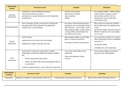
, 6 The table describes adaptations of three types of specialised cell.
Erythrocytes Neutrophils Palisade cells
A biconcave shape with a large, spherical nucleus thick cell walls to maintain
flattened nucleus to allow and cytoplasm that contains turgor
them to squeeze through many lysosomes
narrow capillaries
B biconcave shape with no a multi-lobed nucleus that thin cell walls allowing rapid
nucleus and flexible to allow makes it easier to squeeze diffusion of carbon dioxide
them to squeeze through through small gaps
narrow capillaries
C biconcave shape with no a large, spherical nucleus thick cell walls maintain turgor
nucleus and flexible to allow and cytoplasm that contains
them to squeeze through many lysosomes
narrow capillaries
D biconcave shape with a multi-lobed nucleus that thin cell walls allowing rapid
flattened nucleus to allow makes it easier to squeeze diffusion of carbon dioxide
them to squeeze through through small gaps
narrow capillaries
Which of the rows, A to D, is a correct description of the three cells?
Your answer [1]
© OCR 2023. You may photocopy this page. 3 of 46 Created in ExamBuilder
, 7 The graph represents the potential difference across the membrane of an axon during an action potential.
Which row in the table correctly describes the events occurring during the action potential?
Position on graph Na+/K+-pump is operating Voltage-gated Na+ channels Voltage-gated K+ channels
are open are open
A 1 yes no yes
B 2 yes yes no
C 3 no no yes
D 4 no yes no
Your answer [1]
© OCR 2023. You may photocopy this page. 4 of 46 Created in ExamBuilder
A production of urea in the ornithine cycle
B removal of amino groups from amino acids
C storage of excess amino acids as protein
D storage of glucose as glycogen
Your answer [1]
2 Which of the statements about the control of blood glucose is correct?
A Pancreas cells increase their release of glucagon when blood glucose concentration rises above a set
level.
B Glucagon stimulates the conversion of glycogen to glucose by liver cells.
C Insulin increases blood glucose concentration by stimulating glycogenesis and gluconeogenesis.
D The interaction of insulin and glucagon keeps the blood glucose concentration constant.
Your answer [1]
3 Which of the options describes the path taken by proteins, such as digestive enzymes, that are exported from a
cell?
A Golgi apparatus → rough endoplasmic reticulum → secretory vesicle
B ribosome → smooth endoplasmic reticulum → Golgi apparatus
C rough endoplasmic reticulum → Golgi apparatus → secretory vesicle
D smooth endoplasmic reticulum → ribosome → Golgi apparatus
Your answer [1]
© OCR 2023. You may photocopy this page. 1 of 46 Created in ExamBuilder
, 4 Which of the statements about enzyme catalysed reactions is true?
A Binding of a substrate to the active site can weaken bonds in the substrate.
B Enzymes allow reactions to happen at a rate faster than the Vmax.
C Enzymes increase the rate of reactions by increasing the activation energy.
D Every 10 °C increase in temperature will approximately double the rate of all enzyme controlled reactions.
Your answer [1]
5 The figure shows the metabolic pathways leading to synthesis of five amino acids: aspartate, lysine, methionine,
threonine and isoleucine.
E1 to E8 represent different enzymes involved in these pathways.
Which of the options is an example of end-product inhibition?
A aspartate inhibits E3 and E4
B isoleucine inhibits E7
C lysine inhibits E1 and E6
D methionine inhibits E8
Your answer [1]
© OCR 2023. You may photocopy this page. 2 of 46 Created in ExamBuilder
, 6 The table describes adaptations of three types of specialised cell.
Erythrocytes Neutrophils Palisade cells
A biconcave shape with a large, spherical nucleus thick cell walls to maintain
flattened nucleus to allow and cytoplasm that contains turgor
them to squeeze through many lysosomes
narrow capillaries
B biconcave shape with no a multi-lobed nucleus that thin cell walls allowing rapid
nucleus and flexible to allow makes it easier to squeeze diffusion of carbon dioxide
them to squeeze through through small gaps
narrow capillaries
C biconcave shape with no a large, spherical nucleus thick cell walls maintain turgor
nucleus and flexible to allow and cytoplasm that contains
them to squeeze through many lysosomes
narrow capillaries
D biconcave shape with a multi-lobed nucleus that thin cell walls allowing rapid
flattened nucleus to allow makes it easier to squeeze diffusion of carbon dioxide
them to squeeze through through small gaps
narrow capillaries
Which of the rows, A to D, is a correct description of the three cells?
Your answer [1]
© OCR 2023. You may photocopy this page. 3 of 46 Created in ExamBuilder
, 7 The graph represents the potential difference across the membrane of an axon during an action potential.
Which row in the table correctly describes the events occurring during the action potential?
Position on graph Na+/K+-pump is operating Voltage-gated Na+ channels Voltage-gated K+ channels
are open are open
A 1 yes no yes
B 2 yes yes no
C 3 no no yes
D 4 no yes no
Your answer [1]
© OCR 2023. You may photocopy this page. 4 of 46 Created in ExamBuilder