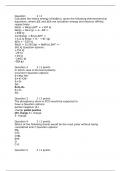
CHEM133 Week 16 Final Exam (Summer) Questions and Answers APU
1. Question: Calculate the lattice energy of NaBr(s), given the following thermochemical equations, where ΔIE and ΔEA are ionization energy and electron affinity, respectively. 2. Question: In which case is the bond polarity incorrect? 3. Question: The phosphorus atom in PCl3 would be expected to have a 4. Question: Which of the following bonds would be the most polar without being considered ionic? 5. Question: Calculate the standard enthalpy of formation (ΔHformation) for LiCl(s) given the following data using the Born-Haber cycle: 6. Question: The hybridization of the nitrogen atom in the cation NH2+ is: 7. Question: For which of these molecules does the best Lewis structure have two or more equivalent resonance structures? 8. Question: Each of the three resonance structures of NO3– has how many lone pairs of electrons? 9. Question: How many double and single bonds are in the resonance form for SO2 in which the formal charges on each atom are zero? 10. Question: The hybridization of the central atom in XeF5+ is: 11. Question: Silver crystallizes in a face-centered cubic structure. What is the edge length of the unit cell if the atomic radius of silver is 144 pm? 12. Question: The number of atoms in a body-centered cubic unit cell is: 13. Question: The radius of an indium atom is 0.163 nm. If indium crystallizes in a face-centered unit cell, what is the length of an edge of the unit cell? 14. Question: Cesium has a radius of 272 pm and crystallizes in a body-centered cubic structure. What is the edge length of the unit cell? 15. Question: Which one of the following crystallizes in a metallic lattice? 16. Question: Which of the following is not a state function? 17. Question: A 3.9 g sample of Colorado oil shale is burned in a bomb calorimeter, which causes the temperature of the calorimeter to increase by 5.0°C. The calorimeter contains 1.00 kg of water (heat capacity of H2O = 4.184 J/g°C) and the heat capacity of the empty calorimeter is 0.10 kJ/°C. How much heat is released per gram of oil shale when it is burned? 18. Question: Two metals of equal mass with different heat capacities are subjected to the same amount of heat. Which undergoes the smallest change in temperature? 19. Question: For most chemical reactions 20. Question: How much heat is transferred per mole of NH3(g) formed in the reaction shown below? 21. Question: Three 1.00-L flasks at 25°C and 725 torr contain the gases CH4 (flask A), CO2 (flask B), and C2H6 (flask C). In which flask is there 0.039 mol of gas? 22. Question: A physics experiment is conducted at a pressure of 14.0 kPa. What is this pressure in mmHg? 23. Question: Which gas has the highest density? 24. Question: For which gas do the molecules have the highest average velocity? 25. Question: 10.0 g of gaseous ammonia and 6.50 g of oxygen gas are introduced into a previously evacuated 5.50 L vessel. If the ammonia and oxygen then react to yield NO gas and water vapor, what is the final gas pressure inside the vessel at 23oC? 26. Question: For the electronic transition from n = 2 to n = 4 in the hydrogen atom. 27. Question: For the electronic transition from n = 3 to n = 5 in the hydrogen atom. 28. Question: Draw Lewis dot (electron) structure for SF6 and determine the following: 29. Question: Given C22-, using molecular orbital and valence bond theory; 30. Question: Substances with high lattice energies tend to be less soluble than substances with low lattice energies. On that basis predict the relative aqueous solubility at 20 °C, from highest to lowest, of the following ionic compounds: Ce2(SO4)3, K2SO4, KBr, NaCl. 31. Question: A metal crystallizes with a face-centered cubic lattice. The edge of the unit cell is 408 pm. Calculate the number of atoms in the unit cell and diameter of the metal atom. 32. Question: Question: A 25.0 g piece of aluminum (which has a molar heat capacity of 24.03 J/ °C.mol) is heated 82.4 °C and dropped into a calorimeter containing water (specific heat capacity of water is 4.18 J/g.oC) initially at 22.3 °C. The final temperature of the water is 24.9 °C. Calculate the mass of water in the calorimeter. 33. Question: Consider the following standard heats of formation: 34. Question: What volume of CO2(g) is produced at 27 °C and 778 torr from the combustion of 10.50 L of C2H6(g)? 35. Question: Calculate the temperature of 2.50 g CO2 gas occupies 5.60 liters at 789 torr in oC
Written for
- Institution
-
American Public University
- Course
-
CHEM133 (CHEM133)
Document information
- Uploaded on
- December 25, 2023
- Number of pages
- 11
- Written in
- 2022/2023
- Type
- Exam (elaborations)
- Contains
- Questions & answers
Subjects
-
chem133 week 16 final exam summer
-
chem133 week 16 final exam summer solution
-
chem133 week 16 final exam summer solved
-
chem133 week 16 final exam summer answers
-
chem133 week 16 final exam summer solved

Also available in package deal