NC - Health Insurance - Practice Exam Questions and Answers 2024
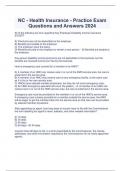
All of the following are true regarding Key Employee Disability Income insurance EXCEPT A) Premiums are not tax deductible for the employer. B) Benefits are taxable to the employer. C) The employer owns the policy. D) Benefits are paid to the employer to retrain a new person. - B) Benefits are taxable to the employer. Key person disability income premiums are not deductible to the business, but the benefits are received income tax free by the business. How is emergency care covered for a member of an HMO? A) A member of an HMO can receive care in or out of the HMO service area, but care is preferred in the service area. B) A member of an HMO may receive care at any emergency facility, at the same cost as if in his or her own service area. C) HMOs have salaried member physicians, but they do not cover emergency care. D) An HMO emergency specialist will cover the patient. - A. A member of an HMO can receive care in or out of the HMO service area, but care is preferred in the service area. Emergency care must be provided for the member in or out of the HMO's service area. If emergency care is being provided for a member outside the service area, the HMO will be eager to get the member back into the service area so that care can be provided by salaried member physicians. After appointing an agent, how long does an insurer have to file with the Commissioner the form detailing the agent's name, address, and other needed information? A) 15 days B) 30 days C) 45 days D) 60 days - B) 30 days Insurers have 30 days to file, in a form prescribed by the Commissioner, the names, addresses, and other information required by the Commissioner for its newly appointed agents. Bethany studies in England for a semester. While she is there, she is involved in a train accident that leaves her disabled. If Bethany owns a general disability policy, what will be the extent of benefits that she receives? - None Which of the following are the main factors taken into account when calculating residual disability benefits? a)Present earnings and earnings prior to disability b)Earnings prior to disability and the length of disability c)Employee's full-time status and length of disability d)Present earnings and standard cost of living - a)Present earnings and earnings prior to disability Residual disability will help pay for loss of earnings by making up the difference between the employee's present earnings and what they were earning prior to disability. How can a new physician be added to the PPO's approved list? a)Fill out the appropriate paperwork and wait the 12 month pre-certification period. b)Pay an annual fee for being on the PPO list. c)New physicians are only added once a year, and are selected by the PPO's Board of Directors. d)Agree to follow the PPO standards and charge the appropriate fees. - d)Agree to follow the PPO standards and charge the appropriate fees. Any physician or hospital that qualifies for and agrees to follow the PPO's standards and charges the established fees can be added to the PPO's approved list at any time. The providers may withdraw their name from the list at any time, as well. Under the uniform required provisions, proof of loss under a health insurance policy normally should be filed within a)90 days of a loss. b)20 days of a loss. c)30 days of a loss. d)60 days of a loss. - a)90 days of a loss. Under the Uniform Required Provisions, proof of loss under a health insurance policy normally should be filed within 90 days of a loss. Which of the following must an insurer obtain in order to transact insurance within a given state? a)Business entity license b)Insurer's license c)Certificate of authority d)Producer's certificate - c)Certificate of authority All insurers (domestic, foreign, or alien) must obtain a certificate of authority before transacting insurance within a given state. According to the Future Increase Option Rider (FIO), which of the following is NOT a qualifying event to increase an insured's benefit level? a)Death of a spouse b)Age 40 c)Marriage d)Birth of a child - a)Death of a spouse The FIO rider allows insureds to increase their benefit levels to certain amounts at specific times without proof of insurability. The following are the typical occasions when an insurer allows for a benefit increase: ages 25, 28, 31, 34, 37 and 40; marriage; and the birth of a child. If an insurer accepts premium payments by credit card, who is responsible for paying the fees charged by a credit card company? a)Policyowners, as part of their premium b)Insured making payment c)Credit card company d)Insurer accepting payment - d)Insurer accepting payment Credit card payment fees are the responsibility of the insurer. In fact, it is one of the conditions for permitting the insurer to accept payments by credit card. Which of the following is NOT true of a major-medical health insurance policy? a)It is designed to pay on a first dollar of expense basis. b)It usually has a maximum benefit amount. c)The benefits are subject to deductibles. d)It is designed to cover hospital and medical expenses of a catastrophic nature. - a)It is designed to pay on a first dollar of expense basis. A major medical policy usually has deductibles and a copayment requirement. Basic medical, but not major medical, expense policies pay on a first dollar basis. When is a child eligible for coverage on a parent's policy? a)From the moment of birth b)30 days after birth c)45 days after birth d)60 days after birth - a)From the moment of birth
Written for
- Institution
- NC - Health Insurance
- Course
- NC - Health Insurance
Document information
- Uploaded on
- December 23, 2023
- Number of pages
- 20
- Written in
- 2023/2024
- Type
- Exam (elaborations)
- Contains
- Questions & answers
Subjects
- nc health insurance
-
nc health insurance practice exam questions
-
nc health insurance practice exam

Also available in package deal