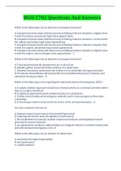
BIWS 400 Questions - Valuation Questions & Answers - Basic Questions And Answers
BIWS 400 Questions - Valuation Questions & Answers - Basic Questions And Answers What are the 3 major valuation methodologies? - ANS Comparable Companies, Precedent Transactions and Discounted Cash Flow Analysis. Rank the 3 valuation methodologies from highest to lowest expected value. - ANS Trick question - there is no ranking that always holds. In general, Precedent Transactions will be higher than Comparable Companies due to the Control Premium built into acquisitions. Beyond that, a DCF could go either way and it's best to say that it's more variable than other methodologies. Often it produces the highest value, but it can produce the lowest value as well depending on your assumptions. When would you not use a DCF in a Valuation? - ANS You do not use a DCF if the company has unstable or unpredictable cash flows (tech or biotech startup) or when debt and working capital serve a fundamentally different role. For example, banks and financial institutions do not re-invest debt and working capital is a huge part of their Balance Sheets - so you wouldn't use a DCF for such companies. What other Valuation methodologies are there? - ANS Other methodologies include: • Liquidation Valuation - Valuing a company's assets, assuming they are sold off and then subtracting liabilities to determine how much capital, if any, equity investors receive • Replacement Value - Valuing a company based on the cost of replacing its assets • LBO Analysis - Determining how much a PE firm could pay for a company to hit a "target" IRR, usually in the 20-25% range • Sum of the Parts - Valuing each division of a company separately and adding them together at the end • M&A Premiums Analysis - Analyzing M&A deals and figuring out the premium that each buyer paid, and using this to establish what your company is worth • Future Share Price Analysis - Projecting a company's share price based on the P / E multiples of the public company comparables, then discounting it back to its present value When would you use a Liquidation Valuation? - ANS This is most common in bankruptcy scenarios and is used to see whether equity shareholders will receive any capital after the company's debts have been paid off. It is often used to advise struggling businesses on whether it's better to sell off assets separately or to try and sell the entire company. When would you use Sum of the Parts? - ANS This is most often used when a company has completely different, unrelated divisions - a conglomerate like General Electric, for example. If you have a plastics division, a TV and entertainment division, an energy division, a consumer financing division and a technology division, you should not use the same set of Comparable Companies and Precedent Transactions for the entire company. Instead, you should use different sets for each division, value each one separately, and then add them together to get the Combined Value. When do you use an LBO Analysis as part of your Valuation? - ANS Obviously you use this whenever you're looking at a Leveraged Buyout - but it is also used to establish how much a private equity firm could pay, which is usually lower than what companies will pay. It is often used to set a "floor" on a possible Valuation for the company you're looking at. What are the most common multiples used in Valuation? - ANS The most common multiples are EV/Revenue, EV/EBITDA, EV/EBIT, P/E (Share Price / Earnings per Share), and P/BV (Share Price / Book Value). What are some examples of industry-speci
Written for
- Institution
- Wall Street Prep
- Course
- Wall Street Prep
Document information
- Uploaded on
- December 23, 2023
- Number of pages
- 8
- Written in
- 2023/2024
- Type
- Exam (elaborations)
- Contains
- Questions & answers
Subjects
-
biws 400 questions valuation questions answers

Also available in package deal