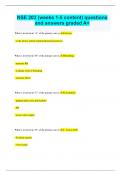
NSE 203 (weeks 1-5 content) questions and answers graded A+
NSE 203 (weeks 1-5 content) questions and answers graded A+ What is involved in "A" of the primary survey Airway: - is the airway patent (open/unobstructed airway) What is involved in "B" of the primary survey Breathing: - measure RR - evaluate work of breathing - measure O2sat What is involved in "C" of the primary survey Circulation: - palpate pulse (rate and rhythm) - BP - assess urine output What is involved in "D" of the primary survey - Assess LOC - Evaluate speech - Assess pain - Assess facial symmetry - Assess sudden change in vision What is involved in "E" of the primary survey Exposure: - measure body temp - inspect skin integrity - inspect/palpate skin for signs of pressure injury - observe any wounds, dressings, drains, invasive lines - assess bowel movements What is included in the physical assessment (body systems) 1. skin 2. cardiac 3. respiratory 4. abdomenal/gastrointestinal Low O2 sat and low systolic BP are considered to be what in relation to the primary survery signs associated with death A 75 year old hospitalized patient with limited mobility, activity and nutrition scores a 7 on the braden risk assessment scale. what does this indicate? The patient is at very high risk for skin tears, skin breakdown and/or the development of pressure ulcers/sores When completing a health assessment of an older adult with mobility problems, how should you set up the assessment? arrange to minimize the number of position changes for the patient What assessment should be performed last on a 4-week old infant? 1. Palpation of fontanelles and suture lines 2. Auscultation of breath sounds 3. Otoscopic examination of the tympanic membrane 4. Weight, length, and head circumference Otoscopic examination of tympanic membrane (most invasive last) What test would be used to screen a young child for hip stability? Ortolani manoeuvre To gain the trust of a young child, what should the examiner do? First focus on the parent while the child plays with a toy Which approach to a complete physical assessment should be used for an adolescent? Head to toe approach When assessing the extraocular muscles. which of test would be inappropriate? 1. six cardinal positions of gaze 2. corneal light reflex 3. cranial nerves III, IV, VI testing 4. confrontation test Confrontation test (this assesses cranial nerve II and visual fields) When should the examiner/nurse auscultate for carotid bruits if the patient is middle aged or older The nurse is completing a blood pressure (BP) assessment as part of the first complete physical examination of a 25-year-old male patient. The nurse knows the protocol for accurately assessing a BP baseline is to take the BP: (SATA) 1. in the left arm 2. three times with 2 minute intervals 3. two times with 3 minute intervals 4. in both arms three times with 2 minute intervals and in both arms The hospitalized patient does not require a full neurological examination during every shift assessment. Which of the following may be a way of assessing the neurological status of the hospitalized patient? 1. Palpating the carotid pulse 2. Looking at the significant other throughout the examinat
Written for
- Institution
- NSE 203
- Course
- NSE 203
Document information
- Uploaded on
- December 21, 2023
- Number of pages
- 30
- Written in
- 2023/2024
- Type
- Exam (elaborations)
- Contains
- Questions & answers
Subjects
-
nse 203 weeks 1 5 content questions and answers

Also available in package deal