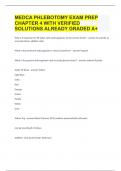
MEDCA PHLEBOTOMY EXAM PREP CHAPTER 4 WITH VERIFIED SOLUTIONS ALREADY GRADED A+
Why is it important to fill tubes with anticoagulants to the correct levels? to provide an accurate blood- additive ratio What is the preferred anticoagulant in clinical chemistry? heparin What is the general anticoagulant used to study glucose levels? sodium fluoride Order Of Draw Yellow Light Blue Gold Red Orange Green Purple White Grey Yellow Top Blood Cultures (SPS) (sodium polyanethold sulfonate) mix by inverting 8-10 times Additive- ACD (acid-citrate- dextrose) Mode of Action- complement inactivation Uses- paternity testing, DNA studies, HLA tissue testing Light Blue Top Citrate Mix by inverting 3-4 times Additive- Sodium Citrate Mode of Action- forms calcium salts to remove calcium Uses- coagulation tests, full draw required Dark Blue Top Additive- Sodium EDTA Mode of Action- contain no contaminating metals Uses- trace element (lead, zinc) testing and toxicology Gold Top Gel Separator Mix by inverting 5 times Additive- none (will clot) Mode of Action- serum separator - contains gel at the bottom to separate blood from serum via centrifugation Uses- immunology, serology, chemistries Red Top Serum Mix by inverting 5 times (plastic) - glass tubes require no mixing Additive- none (will clot) Mode of Action- blood clots - serum is separated via centrifugation Orange Top Rapid Serum Mix by inverting 5-6 times Green Top Heparin Mix by inverting 8-10 times Light Green Top Additive- plasma separating tube w/ lithium heparin Mode of Action- anticoagulants w/ lithium heparin plasma is separated Uses- chemistries Dark Green Top Additive- sodium heparin of lithium heparin Mode of Action- inactivates thrombin and thromboplastin Uses- ammonia level use sodium or lithium heparin; for lithium level use sodium heparin Purple Top EDTA Mix by inverting 8-10 times Additive- EDTA liquid Mode of Action- forms calcium salts to remove calcium Uses- blood bank (cross match) and hematology (CBC); requires full draw White Top Separator Tube w/ Gel Mix by inverting 8-10 times Additive- Potassium EDTA Mode of Action- forms calcium salts Uses- molecular/ PCR and bDNA testing Grey Top Fluoride (glucose) Mix by inverting 8-10 times Additive- potassium oxalate and sodium fluoride Mode of Action- antiglycolytic agent: preserves glucose levels for up to 5 days Uses- glucoses require full draw; short draw may lead to hemolysis Pink Top Additive- Potassium EDTA Mode of Action- forms calcium salts Uses- immunohematology Light Brown Top Additive- Sodium heparin Mode of Action- inactivates thrombin and thromboplastin: contains virtually no lead Uses- serum leads determination Black Top Additive- buffered sodium citrate Mode of Action- forms calcium salts to remove calcium Uses- sedimentation rate: requires full draw Yellow/Black Top Additive- broth mixture Mode of Action- preserves viability of microorganisms Uses- microbiology A common way of keeping specimens cold curing transport is? using icy water Specimens that are required cold/chilled are? -blood gases -gastrin -ammonia -lactic acid -catecholamine -renin -parathyroid hormone determination Light sensitive specimens need to be? wrapped in aluminum foil Is a patient faints, the procedure (blood draw) should be stopped or continued? stopped What is a hematoma? blood that pools in tissues around the veins is collected Hemolysis is? complication that occurs in the collected blood sample Hemoconcentration? increased amount of large molecules and formed elements What is Phlebitis? inflammation of the walls of veins To prevent infection of this draw site? skin must be properly clean. sterilized, and gloves should always be used How long can a tourniquet remain on a patient? no more than 1 minute
Written for
- Institution
- Medca phlebotomy
- Course
- Medca phlebotomy
Document information
- Uploaded on
- December 18, 2023
- Number of pages
- 7
- Written in
- 2023/2024
- Type
- Exam (elaborations)
- Contains
- Unknown
Subjects
-
medca phlebotomy exam prep chapter 4

Also available in package deal