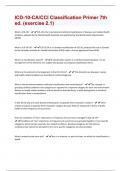
ICD-10-CA/CCI Classification Primer 7th ed. (exercise 2.1) Questions With 100% Correct Answers.
What is ICD-10? - ICD-10 is the international statistical classification of diseases and related health problems adopted by the World Health Assembly and published by the World Health Organization (WHO). What is ICD-10-CA? - ICD-10-CA is a Canadian modification of ICD-10, produced for use in Canada by the Canadian Institute for Health Information (CIHI) under a license agreement from WHO. What is a classification system? - A classification system is a method of generalization. It is an arrangement of the elements of a subject into groups according to established criteria. What are the elements of arrangement in the ICD-10-CA? - The elements are diseases, injuries and health-related problems as described in medical diagnosis. What is the distinction between statistical classification and nomenclature? - The concept of grouping related conditions into categories as opposed to a separate category for each and every known disease or health-related problem, and the words to describe them, is what distinguishes a statistical classification from a nomenclature. In ICD-10-CA why are some disease entities given a separate three-character number? - Some entities are given a separate three-character category because they are important in terms of public health or their frequency of occurrence. How are conditions of "less" importance or frequency of occurrence managed in ICD-10-CA? - Conditions of "less" importance or frequency of occurrence are grouped together in less specific categories which contain separate, but related conditions. Residual categories for the leftover conditions that cannot be allocated to the more specific categories are also provided. What is meant by the term axis? - Axis is a criterion, or point of view, on which the classification is based.How are the categories identified in ICD-10-CA? - The ICD-10-CA uses multiple axes and is described as a variable-axis classification. The primary axes on which this classification is based are epidemic diseases, constitutional or general diseases, local diseases arranged by site, developmental diseases and injuries. How are the categories identified in ICD-10-CA? - Three-character alphanumeric codes represent the categories in ICD-10-CA. These alphanumeric designations are used to represent a particular disease or group of diseases which describe the content of the categories and subcategories. The four-character and five-character codes indicate further specificity of their three-character category designation. When can a three-character category be assigned as a code? - A three-character category be assigned as a code only when it has not been further subdivided (i.e. N40 Hyperplasia of prostate). Explain the meaning and significance of "residual categories"? - Residual categories exist at the three, four, and five-category levels of the classification. They are provided for rare and miscellaneous or nondescript conditions that cannot be classified to a more specific category. At the four-character and five-character levels, ".8" is generally used for other conditions and .9 is generally used to represent conditions for which further specification is unknown or not documented. Residual categories ensure that every disease or condition has a place in the classification. Why is it important for coders to refer to the beginning of a chapter block or three-category before confirming their code selection? - At the beginning of all chapters, blocks, or three-character categories, there is important information and instructions provided which apply to the entire chapter, block or category. Coders must review these instructions prior to confirming their selection of a code from the chapter, block or category to ensure accurate code assignment.
Written for
- Institution
- ICD-10-CA/CCI Classification Primer 7th ed. (exerc
- Course
- ICD-10-CA/CCI Classification Primer 7th ed. (exerc
Document information
- Uploaded on
- December 18, 2023
- Number of pages
- 2
- Written in
- 2023/2024
- Type
- Exam (elaborations)
- Contains
- Questions & answers
Subjects
-
icd 10 cacci classification primer 7th ed exerc

Also available in package deal