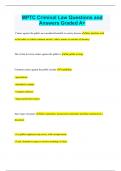
MPTC Criminal Law Questions and Answers Graded A+ Crimes against the public are considered harmful to society because ✔✔they interfere with social order or violate common morals, values, norms or customs of decency The victim for most crime s against the public is ✔✔the public at large Common crimes against the public include ✔✔• gambling • prostitution • disorderly conduct • weapons offenses • drug and alcohol crimes three types of perjury ✔✔false statements, inconsistent statements and false statement in a document (1) a public employee may never, with corrupt intent; (2) ask, demand or agree to receive anything of value; (3) in exchange for an official favor, fraud on a public agency or promising to take any action or official inaction ✔✔accepting a bribe a direct or indirect offer to provide something of value for official action or inaction. Commonwealth v. Qualter, 19 Mass. App. Ct. 970 (1985) ✔✔corrupt intent directly links a person to a crime and without the need of any additional evidence or inference. For example, a video recording of offender robbing the convenience store while holding a gun. ✔✔direct evidence relies on an inference to connect a conclusio n of fact ✔✔Circumstantial evidence tangible and may be direct or circumstantial includes objects, property or items seized at crime scenes or during searches ✔✔physical evidence evidence that may be direct or circumstantial. It includes first -hand stat ements made by victims, witnesses, suspects or police. ✔✔testimonial evidence Examples of testimonial evidence can include ✔✔• statements made directly to police • spontaneous utterances overheard by witnesses • written statements • interview and interrogation recordings when a victim, suspect or witness makes a statement about what he or she saw, heard or felt "firsthand" using his or her own senses. ✔✔Direct (Testimonial) Evidence evidence that suggests other facts from which re asonable inferences can be drawn. ✔✔circumstantial testimonial evidence "second -hand" knowledge repeated about what another person said about what he or she saw, heard or felt. ✔✔hearsay testimony
Exam (elaborations)
MPTC Criminal Law Questions and Answers Graded A+
Rating
Sold
-
Pages
17
Grade
A+
Uploaded on
17-12-2023
Written in
2023/2024
MPTC Criminal Law Questions and Answers Graded A+ Crimes against the public are considered harmful to society because they interfere with social order or violate common morals, values, norms or customs of decency The victim for most crimes against the public is the public at large Common crimes against the public include • gambling • prostitution • disorderly conduct • weapons offenses • drug and alcohol crimes three types of perjury false statements, inconsistent statements and false statement in a document (1) a public employee may never, with corrupt intent; (2) ask, demand or agree to receive anything of value; (3) in exchange for an official favor, fraud on a public agency or promising to take any action or official inaction accepting a bribe a direct or indirect offer to provide something of value for official action or inaction. Commonwealth v. Qualter, 19 Mass. App. Ct. 970 (1985) corrupt intent directly links a person to a crime and without the need of any additional evidence or inference. For example, a video recording of offender robbing the convenience store while holding a gun. direct evidence relies on an inference to connect a conclusion of fact Circumstantial evidence tangible and may be direct or circumstantial includes objects, property or items seized at crime scenes or during searches physical evidence evidence that may be direct or circumstantial. It includes first-hand statements made by victims, witnesses, suspects or police. testimonial evidence Examples of testimonial evidence can include • statements made directly to police • spontaneous utterances overheard by witnesses • written statements • interview and interrogation recordings when a victim, suspect or witness makes a statement about what he or she saw, heard or felt "firsthand" using his or her own senses. Direct (Testimonial) Evidence evidence that suggests other facts from which reasonable inferences can be drawn. circumstantial testimonial evidence "second-hand" knowledge repeated about what another person said about what he or she saw, heard or felt. hearsay testimony
Show more
Read less
Institution
MPTC Criminal Law
Course
MPTC Criminal Law
Whoops! We can’t load your doc right now. Try again or contact support.
Written for
- Institution
- MPTC Criminal Law
- Course
- MPTC Criminal Law
Document information
- Uploaded on
- December 17, 2023
- Number of pages
- 17
- Written in
- 2023/2024
- Type
- Exam (elaborations)
- Contains
- Questions & answers
Subjects
-
mptc criminal law questions and answers graded a
Content preview
$9.99
Get access to the full document:
100% satisfaction guarantee
Immediately available after payment
Both online and in PDF
No strings attached

Also available in package deal
Package deal
MPTC Bundled Exams Questions and Answers Multiple Versions (2023/2024) (Complete and Accurate)
23
2023
$ 227.77
More info