Comparison of Chapter 1 of The Handmaid's Tale, and Chapter 1 of 1984.
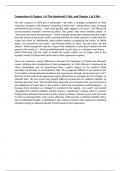
The first chapters of 1984 and A Handmaid’s Tale offer a nostalgic perspective on their
respective dystopias, with Winston wondering if there were “always these vistas of rotting
nineteenth-century houses … their crazy garden walls sagging in all areas?” and Offred (an
as-yet-unnamed narrator) reminiscing about “the games that were formally played” in
“what had once been the gymnasium”. These nostalgic perspectives disassociate the reader
from the events of the novels whilst ensuring that they are both rooted in a reality that the
reader can relate to. Additionally, both authors explore a longing for the future, as Offred
states “we yearned for the future” and Winston writes his diary “For the future, for the
unborn”. Both protagonists long for a future that resembles a ‘past’ that is better than the
present they reside in – firmly establishing both novels’ basis in a dystopic near-future –
whilst illustrating that the ‘past’ in which the reader resides can no longer exist in the
dystopic worlds of Gilead and Oceania due to their oppressive regimes.
There are, however, various differences between the beginning of Orwell and Atwood’s
novels, including the introductions of their protagonists. In 1984, Winston is referenced by
name immediately and his experiences have a direct impact on the reader’s initial
perception of Oceania. In A Handmaid’s Tale, the protagonist (Offred) is not named in the
first chapter; instead Atwood introduces her experiences through plural pronouns (“we”)
that hint at the scale of the oppressive regime Offred lives in and gives the first chapter an
intimate tone. The two novels also present different perspectives on collective identity, as
Winston describes how “The horrible thing about the Two Minutes Hate was not that one
was obliged to act a part, but, on the contrary, that it was impossible to avoid joining in” – in
Oceania, Party members are “obliged” to conform to the regime, “act a part” and commit
“thoughtcrime” without rebellion. On the contrary, “Handmaid’s” actively rebel as a cohort,
finding solace between themselves as they “learn to whisper without sound” and “lip-read”
in order to exchange their ‘real’ names. Whereas 1984 presents a collective identity with a
lack of individual thought, A Handmaid’s Tale presents women with suppressed individual
identities forging a collective identity characterised by their oppression.
The first chapters of 1984 and A Handmaid’s Tale offer a nostalgic perspective on their
respective dystopias, with Winston wondering if there were “always these vistas of rotting
nineteenth-century houses … their crazy garden walls sagging in all areas?” and Offred (an
as-yet-unnamed narrator) reminiscing about “the games that were formally played” in
“what had once been the gymnasium”. These nostalgic perspectives disassociate the reader
from the events of the novels whilst ensuring that they are both rooted in a reality that the
reader can relate to. Additionally, both authors explore a longing for the future, as Offred
states “we yearned for the future” and Winston writes his diary “For the future, for the
unborn”. Both protagonists long for a future that resembles a ‘past’ that is better than the
present they reside in – firmly establishing both novels’ basis in a dystopic near-future –
whilst illustrating that the ‘past’ in which the reader resides can no longer exist in the
dystopic worlds of Gilead and Oceania due to their oppressive regimes.
There are, however, various differences between the beginning of Orwell and Atwood’s
novels, including the introductions of their protagonists. In 1984, Winston is referenced by
name immediately and his experiences have a direct impact on the reader’s initial
perception of Oceania. In A Handmaid’s Tale, the protagonist (Offred) is not named in the
first chapter; instead Atwood introduces her experiences through plural pronouns (“we”)
that hint at the scale of the oppressive regime Offred lives in and gives the first chapter an
intimate tone. The two novels also present different perspectives on collective identity, as
Winston describes how “The horrible thing about the Two Minutes Hate was not that one
was obliged to act a part, but, on the contrary, that it was impossible to avoid joining in” – in
Oceania, Party members are “obliged” to conform to the regime, “act a part” and commit
“thoughtcrime” without rebellion. On the contrary, “Handmaid’s” actively rebel as a cohort,
finding solace between themselves as they “learn to whisper without sound” and “lip-read”
in order to exchange their ‘real’ names. Whereas 1984 presents a collective identity with a
lack of individual thought, A Handmaid’s Tale presents women with suppressed individual
identities forging a collective identity characterised by their oppression.