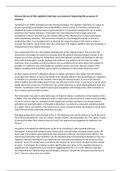
Discuss the use of the cognitive interview as a means of improving the accuracy of
memory
Geiselman et al (1984) developed an interviewing technique, the cognitive interview (CI), based on
proven psychological principles concerning effective memory recall as it became clear that the
standard interview techniques weren’t good enough. It is a procedure designed for use in police
interviews that involve witnesses. There were two main influences that brought about the
introduction of the CI. The first was the need to improve the effectiveness of police interviewers
when questioning witnesses. The second was to apply the psychological research to this area,
particularly Loftus’. It encourages them to recreate the original context of the event in order to
increase the witness’ recall of the crime they witnessed. The original cognitive interview technique is
characterised as four distinct processes.
One component of the CI is the mental reinstatement of the original context. This is where the
interviewer encourages the witness to recreate both the physical and psychological context of the
original occurrence, perhaps by asking them about their general activities and feelings on the day.
This could include sights, sounds, feelings and emotions, the weather etc. The aim is to make
memories more accessible so that the witness can accurately recall as much about the incident as
possible. It is often the case that people are unable to access memories that are present. They
require contextual and emotional cues to aid the recollection of information about the event.
Another aspect of the CI is asking the witness to repeat and report every detail. The interviewers
encourages the witness to report any details of the incident without missing anything out, regardless
of whether it is unrelated to the incident. Memories are interconnected, so even if the witness
doesn’t believe the information doesn’t have any relevancy to the event, it may act as a cue for more
details about the occurrence. Furthermore, the partial memories or small details gathered from one
witness’ recollection of the incident may be pieced together with findings from other witnesses’ to
form a clearer picture of the occasion.
The interviewer may also try alternative ways to help the witness’ recollection of the timeline of the
incident. This may include recalling the order in which each event occurred in reverse order. Recalling
events in reverse order, or starting from the middle and working backwards, can disrupt schema
activation (an expected pattern of thought or behaviour e.g. going to a restaurant and being seated
at a table), which can influence the memory of an event. Doing this allows the witness to recall more
about the event thus improving eyewitness accuracy.
Changing perspective is also involved in the CI. The interview may ask the witness to recall the event
from various perspectives, such as a victim, another witness, the perpetrator, etc. This, again, is done
to disrupt the effect that schemas have on recall. This approach was suggested by Anderson and
Pichert.
Gieselman et al tested the effectiveness of the CI by comparing it with standard interview
techniques. A group of 89 students were shown police training videos involving violent crimes. 48
hours later, the students were individually interviewed by American law enforcement officers. The
interviewers had either been trained to use the standard police interviewing techniques or the new
cognitive interview techniques. Each interview was recorded and analysed for the accuracy of the
students’ recall. The results were recorded as the number of correct items recalled and the number
of errors. Conclusively, the students recalled significantly more items in the cognitive interview as
opposed to the standard interview, therefore suggesting that the CI is a more effective interview
technique than the standard interview techniques. However, despite the increased accuracy due to
the CI, the error rates were very similar.
memory
Geiselman et al (1984) developed an interviewing technique, the cognitive interview (CI), based on
proven psychological principles concerning effective memory recall as it became clear that the
standard interview techniques weren’t good enough. It is a procedure designed for use in police
interviews that involve witnesses. There were two main influences that brought about the
introduction of the CI. The first was the need to improve the effectiveness of police interviewers
when questioning witnesses. The second was to apply the psychological research to this area,
particularly Loftus’. It encourages them to recreate the original context of the event in order to
increase the witness’ recall of the crime they witnessed. The original cognitive interview technique is
characterised as four distinct processes.
One component of the CI is the mental reinstatement of the original context. This is where the
interviewer encourages the witness to recreate both the physical and psychological context of the
original occurrence, perhaps by asking them about their general activities and feelings on the day.
This could include sights, sounds, feelings and emotions, the weather etc. The aim is to make
memories more accessible so that the witness can accurately recall as much about the incident as
possible. It is often the case that people are unable to access memories that are present. They
require contextual and emotional cues to aid the recollection of information about the event.
Another aspect of the CI is asking the witness to repeat and report every detail. The interviewers
encourages the witness to report any details of the incident without missing anything out, regardless
of whether it is unrelated to the incident. Memories are interconnected, so even if the witness
doesn’t believe the information doesn’t have any relevancy to the event, it may act as a cue for more
details about the occurrence. Furthermore, the partial memories or small details gathered from one
witness’ recollection of the incident may be pieced together with findings from other witnesses’ to
form a clearer picture of the occasion.
The interviewer may also try alternative ways to help the witness’ recollection of the timeline of the
incident. This may include recalling the order in which each event occurred in reverse order. Recalling
events in reverse order, or starting from the middle and working backwards, can disrupt schema
activation (an expected pattern of thought or behaviour e.g. going to a restaurant and being seated
at a table), which can influence the memory of an event. Doing this allows the witness to recall more
about the event thus improving eyewitness accuracy.
Changing perspective is also involved in the CI. The interview may ask the witness to recall the event
from various perspectives, such as a victim, another witness, the perpetrator, etc. This, again, is done
to disrupt the effect that schemas have on recall. This approach was suggested by Anderson and
Pichert.
Gieselman et al tested the effectiveness of the CI by comparing it with standard interview
techniques. A group of 89 students were shown police training videos involving violent crimes. 48
hours later, the students were individually interviewed by American law enforcement officers. The
interviewers had either been trained to use the standard police interviewing techniques or the new
cognitive interview techniques. Each interview was recorded and analysed for the accuracy of the
students’ recall. The results were recorded as the number of correct items recalled and the number
of errors. Conclusively, the students recalled significantly more items in the cognitive interview as
opposed to the standard interview, therefore suggesting that the CI is a more effective interview
technique than the standard interview techniques. However, despite the increased accuracy due to
the CI, the error rates were very similar.