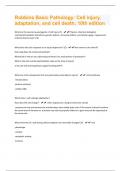
Robbins Basic Pathology: Cell injury, adaptation, and cell death; 10th edition Questions & Answers Solved 100% Correct!!
What are the several causes/agents of cell injury (7) - Physical, chemical, biological, nutritional/metabolic alterations, genetic defects, immunity defects, and cellular aging , hypoxia and ischemia (can be part of 4) What does the cells response to an injury depend on? (5) - How severe is the stimuli? How long does the stimuli persist/last? What kind of cell are you observing and what is its mechanisms of protection? What is the cells nutritional/metabolic state at the time of injury? Is the cell still receiving blood supply? (making ATP?) What are 4 cell components that are particularly vulnerable to injury? - -cell membrane -mitochondria -protein synthesis -cellular DNA When does a cell undergo adaptation? How does the cell change? - -when exposed to a long term/chronic stimuli -response to new environment by maintaining a new steady state even if this means it doesn't perform the same level of function ex. a protein may not be properly folded or a gene may not be expressed at the same rate What elements of a cell during cellular adaption are reversible changes? (5) - -size -phenotype -number -metabolic activity -functionWhats the difference between growth adaptations and autonomous growth (cancer)? - -in growth adaptations once the stimulus is removed the cell will go back to it's resting state Whats the difference between dysplasia and all other forms of cellular adaptions ? - -dysplasia is always pathogenic NEVER physiologic What are the 2 types of cellular adaptation? Give a brief summary. - Physiological- cells are responding to hormonal or endogenous chemical signals. Pathological- respond to stress by changing their structure and functions thus escaping cell injury at the expense of normal function. Cell adaptations include changes in what characteristics, in terms of the known types. (3) Which category do each fall under? - -Size (atrophy, hypotrophy) -number (hyperplasia) -organization (metaplasia, dysplasia) What is hypotrophy? Give an example of physiological and pathological hypotrophy. - -increase in size of the existing cell 1) enlargement of the uterus during pregnancy (cells respond to increased levels of estrogen), also increased workload of the striated muscles of the heart and skeletal 2)Hypertension or aortic valve disease caused by enlargement of cardiac cells in order to generate a higher contractile force because there is blockage of blood flowWhat leads to hypotrophy? - -increase in synthesis of cellular proteins (more things inside and the cell swells)
Written for
- Institution
- Robbins Basic Pathology: Cell injury, adaptation,
- Course
- Robbins Basic Pathology: Cell injury, adaptation,
Document information
- Uploaded on
- December 13, 2023
- Number of pages
- 11
- Written in
- 2023/2024
- Type
- Exam (elaborations)
- Contains
- Questions & answers
Subjects
-
robbins basic pathology cell injury adaptation

Also available in package deal