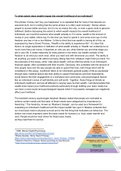
Discuss the multi-store model of memory. Refer to research in your answer.
The multi-store model, proposed by Atkinson and Shiffrin in 1968, is a model of memory
that characterises memory as a flow of information passing from one store to the next in a in
a sequential way. The model suggests that there are three separate components or stores:
sensory memory, short term memory and long term memory. The process highlighted in the
model is as follows: an external stimuli is briefly registered by the sensory memory for
fractions of a second before decaying, unless a conscious effort is made to retain it so it can
be passed on to short term memory. If STM memory traces are not rehearsed, they can
decay or be displaced. If STM memory traces are rehearsed, they are then passed on to long
term memory, where they can potentially stay for a lifetime. When information is needed,
the STM retrieves it from the LTM so it can be used. However, decay, retrieval failure or
interference can occur.
Sensory memory, sometimes referred to as sensory register, is a temporary storage system
where sensory information enters the memory via our senses. Sperling (1960) demonstrated
that the duration of SR is approximately half a second. The capacity of the sensory register,
specifically the iconic store, has a large capacity. Information in the sensory register is
encoded and stored in separate sensory stores for each of the senses: echoic (auditory),
iconic (visual), haptic (tactic), gustatory (taste) and olfactory (smell).
Short term memory is your memory for the present or immediate past. It stores memory for
short periods of time. The capacity for STM can be assessed using digit span. Miller’s Magic
Number revealed that the average IDS is 7 ± 2. The duration of STM is approximately 18-
20 seconds, when not being rehearsed, shown by Peterson and Peterson’s research (1959).
STM is usually encoded acoustically.
Long term memory functions in a more complex way compared to STM. The capacity of LTM
is impossible to quantify although psychologists could argue that there is no upper limit. It is
only assumed to be limitless due to the lack of evidence that suggests otherwise. The
duration of LTM is longer than in STM as memories in LTM can potentially last a lifetime. The
main type of encoding in LTM is semantic.
Biological evidence to support the model comes from medical technology such as MRI and
PET scans which show different brain patterns when participants perform STM or LTM tasks.
One example includes the research of Squire et al. PET scans and FMRI scans were used on
participants when asked to perform different memory tasks. He found that the hippocampus
was active during LTM tasks whereas areas in the pre-frontal cortex were active during STM
tasks, suggesting that the STM and LTM operate independently and, therefore, supports the
model.
One case study that supports the multi-store model is Clive Wearing. He was left with an
impaired STM due to brain damage. He has not been able to transfer any new long term
memories since his illness and has difficulty retrieving his existing long term memories.
However, he is able to remember procedural memories (e.g. how to drive a car, play the
piano). This demonstrates how the STM and LTM are different stores as one is more
impaired than the other, alluding to the suggestion that they must be independent of one
another. Therefore, this case study supports the multi-store model.
The multi-store model, proposed by Atkinson and Shiffrin in 1968, is a model of memory
that characterises memory as a flow of information passing from one store to the next in a in
a sequential way. The model suggests that there are three separate components or stores:
sensory memory, short term memory and long term memory. The process highlighted in the
model is as follows: an external stimuli is briefly registered by the sensory memory for
fractions of a second before decaying, unless a conscious effort is made to retain it so it can
be passed on to short term memory. If STM memory traces are not rehearsed, they can
decay or be displaced. If STM memory traces are rehearsed, they are then passed on to long
term memory, where they can potentially stay for a lifetime. When information is needed,
the STM retrieves it from the LTM so it can be used. However, decay, retrieval failure or
interference can occur.
Sensory memory, sometimes referred to as sensory register, is a temporary storage system
where sensory information enters the memory via our senses. Sperling (1960) demonstrated
that the duration of SR is approximately half a second. The capacity of the sensory register,
specifically the iconic store, has a large capacity. Information in the sensory register is
encoded and stored in separate sensory stores for each of the senses: echoic (auditory),
iconic (visual), haptic (tactic), gustatory (taste) and olfactory (smell).
Short term memory is your memory for the present or immediate past. It stores memory for
short periods of time. The capacity for STM can be assessed using digit span. Miller’s Magic
Number revealed that the average IDS is 7 ± 2. The duration of STM is approximately 18-
20 seconds, when not being rehearsed, shown by Peterson and Peterson’s research (1959).
STM is usually encoded acoustically.
Long term memory functions in a more complex way compared to STM. The capacity of LTM
is impossible to quantify although psychologists could argue that there is no upper limit. It is
only assumed to be limitless due to the lack of evidence that suggests otherwise. The
duration of LTM is longer than in STM as memories in LTM can potentially last a lifetime. The
main type of encoding in LTM is semantic.
Biological evidence to support the model comes from medical technology such as MRI and
PET scans which show different brain patterns when participants perform STM or LTM tasks.
One example includes the research of Squire et al. PET scans and FMRI scans were used on
participants when asked to perform different memory tasks. He found that the hippocampus
was active during LTM tasks whereas areas in the pre-frontal cortex were active during STM
tasks, suggesting that the STM and LTM operate independently and, therefore, supports the
model.
One case study that supports the multi-store model is Clive Wearing. He was left with an
impaired STM due to brain damage. He has not been able to transfer any new long term
memories since his illness and has difficulty retrieving his existing long term memories.
However, he is able to remember procedural memories (e.g. how to drive a car, play the
piano). This demonstrates how the STM and LTM are different stores as one is more
impaired than the other, alluding to the suggestion that they must be independent of one
another. Therefore, this case study supports the multi-store model.