

SPEA V184 Exam 1 Questions With Complete Answers.
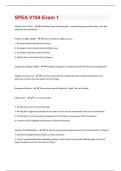
Magna Carta (1215) - Established idea of limited gov't, required king to consult nobles, this idea morphed into parliament Petition of Right (1628) - Gave commoners rights such as... 1. No taxes without parliament consent 2. No subject may be imprisoned without cause 3. No soldiers quartered upon citizenry 4. Martial law is not used in time of peace English Bill of Rights (1689) - Freedom of speech in parliament and free elections to parliament English Common Law - Law that is derived from judicial decisions instead of statutes (early american common law was taken from this idea) Reception Statutes - The common law of England is "good" law in the state Indiana Law - 1-1-2-1 law of state 1. Constitution of U.S. and of this state 2. All statutes of general assembly of the state in force and not inconsistent with such constitutions 3. All statutes of U.S. has power to legislate for the states, in consistency with Constitution 4. Common law of England and Statutes of British Parliament Articles of Confederation - The lack of strong national government in the articles led to confusion 1. Economic disorganization (trade, currency, taxation) 2. Lack of central leadership (individual judiciary, states could not override federal power, army had power to declare war but not raise an army)3. Legislative Inefficiencies (1 state, 1 vote, cumbersome administrative procedure required every state to agree) Federalism - Form of gov't in which there is a division of powers between 2 levels of gov't of (usually) equal status US Federalism - Compromise meant to eliminate the disadvantages of confederation and a unitary government Bill of Rights - 1st 10 amendments to the constitution, guaranteeing such rights as freedom of speech, assembly, and religion *we have these as laws of protective measure Positivist Theory - Superior gov't theory that isn't subject to question Sociological Theory - doctrine that follows the principle that government should adopt laws to reflect society's current needs and beliefs Naturalist Theory - Natural rights such as freedom of speechp 14th Amendment - Declares that all persons born in the U.S. are citizens cannot deny life, liberty, or property without due process of law Selective Incorporation - The process by which provisions of the Bill of Rights are brought within the scope of the Fourteenth Amendment and so applied to state and local governments Ex: Gitlow v. NY: states must protect freedom of speech International Law - Has no defined area or governing body, but refers to the many laws, rules/customs that govern/impact + deal with interactions between nations
Document information
- Uploaded on
- December 12, 2023
- Number of pages
- 7
- Written in
- 2023/2024
- Type
- Exam (elaborations)
- Contains
- Questions & answers


