

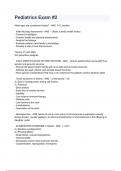
Pediatrics Exam #2 Questions With Correct Answers.
Pediatrics Exam #2 What ages are considered infants? - ANS 0-12 months Infant Nursing Assessment - ANS - Obtain a family health history - Construct a pedigree - Conduct health and physical assessments - Analyze the findings - Evaluate patient's (and family's) knowledge - Develop a plan of care that involved Trisomy 21 with AMA 3rd generation pedigree Infant: IDENTIFICATION OF RISK FACTORS - ANS - Screen patients that may benefit from genetic and genomic services - Provide the patient and/or family with up-to-date and accurate resources - Address the legal, ethical, and societal issues that arise - Have special considerations that may or do undermine the patient's (and/or family's) rights Turner syndrome in Infants - ANS 1.) Monosomy - XO 2.) Due to nondisjunction during cell division 3.) Features: - Short stature - Early loss of ovarian function - Infertility - Can receive hormonal therapy - Webbed neck - Low hairline at the neck - Lumphedema - Coarctation of the aorta Nondisjunction - ANS failure of one or more pairs of chromosomes to separate normally during division, usually leading to an abnormal distribution of chromosomes in the offspring or daughter nuclei KLINEFELTER SYNDROME in Infants - ANS 1.) XXY 2.) Random nondisjunction 3.) Physical effects - Small testes, reduced testosterone - Gynecomastia - Decreased muscle mass and bone density - Cryptorchidism, hypospadias, micropenis - 5th finger clinodactyly 4.) Cognitive delay 5.) Anxiety, depression, impaired social skills, ADHD, limited executive functioning 6.) Higher risk of autism spectrum disorder 7.) Risk for autoimmune d/o DOWN SYNDROME (TRISOMY 21) in Infants - ANS 1.) Extra copy, Translocation (can be inherited), mosaic Risk with maternal age 35 and increases exponentially after 35 y/o 2.) Testing can be screening and/or diagnostic. Typically with T21, there is fetal echo and other testing to eval for known associations 3.) Mental - Mild to moderately lower than average IQ 4.) Physical - Congenital heart defects - Flattened midface - Upslanting palpebral fissures - Short neck - Small, posteriorly rotated ears - Protruding tongue - Palmar crease - 5th finger clinodactyly - Hypotonia - short stature MENDELIAN INHERITANCE: Autosomal Dominant - ANS - 50% chance of passing condition to offspring - Examples: Huntington Disease Marfan syndrome - Whole shading only. If the offspring inherits the gene, they are affected MENDELIAN INHERITANCE: Autosomal recessive - ANS - 25% chance for condition with each offspring - Examples: Cystic fibrosis Sickle cell disease Phenylketonuria Galactosemia - PKU and galactosemia typically present normally at birth and then within days of consuming a milk diet high in lactose (BM or routine, commercial formula) PKU and galactosemia present typically early with signs of feeding intolerance and abnormal NBS X-LINKED DOMINANT - ANS - Mutations on X chromosome - Only need one copy to produce symptoms - Fathers cannot pass to their male offspring - Males usually have more sx than females - Examples: Fragile X X LINKED RECESSIVE - ANS - Change in gene on X chromosome - One altered copy can cause condition for males - Females would need 2 copies of the altered gene - Males Females - Fathers cannot pass to their sons - Hemophilia - Fathers can't pass to sons because male offspring inherit X only from their mothers and Y from fathers - Females either unaffected or mildly affected MITOCHONDRIAL DISORDERS - ANS - Mitochondria are the structures in every cell that produce energy - Mutations in mitochondrial DNA: maternal inheritance - Mutations in nuclear DNA can be autosomal dominant, autosomal recessive, or X-linked Growth in Infants - ANS - Weight: doubles by 6 months and triples by 12 months - Length: 0.5x length at birth by 12 months of life - Head Circumference (HC): 0.33x birth HC @ 12 mo - Generally the most rapid growth and development in a lifespan - 1st 2-3 months = should gain 1oz/Day - Head circumference should increase by 5cm by 6 months
Document information
- Uploaded on
- December 12, 2023
- Number of pages
- 49
- Written in
- 2023/2024
- Type
- Exam (elaborations)
- Contains
- Questions & answers


