ECCO Caring for Patients with Renal Disorders: Part 2 (2023/2024) Graded A
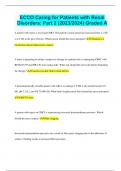
ECCO Caring for Patients with Renal Disorders: Part 2 (2023/2024) Graded A A patient with sepsis is receiving CRRT. The patient's serum lactate has increased from 4.1 (H) to 6.2 (H) in the past 24 hours. Which action should the nurse anticipate? Changing to a bicarbonate-based replacement solution A nurse is preparing to initiate vasopressor therapy in a patient who is undergoing CRRT with BP 86/45 (59) and HR 120 sinus tachycardia. What step should the nurse take before beginning the therapy? Consider possible fluid volume deficit. A hemodynamically unstable patient with AKI is to undergo CVVH. Labs include lactate 8.0 (H), pH 7.2 (L), and CK 79,000 (H). What kind of replacement fluid should the nurse anticipate? NaHCO3- base A patient with sepsis on CRRT is experiencing increased transmembrane pressures. Which should the nurse suspect? Filter clogging Increased transmembrane pressures are a result of filter pores clogging due to the adherence of solutes. Clothing results in increased filter pressures. A patient is undergoing CRRT with citrate infused in the pre-filter side and calcium levels routinely monitored. What assessments would arouse suspicion that the filter is clotting? Maroon streaking in the filter; Filter pressures >100 mm Hg from baseline; Return pressures that steadily increase A patient with hyperkalemia needs CVVH. The nurse considers running replacement fluid pre-filter to prevent clogging. What is the disadvantage of running it pre-filter? Reduces clearance by as much as one-third when dialysate is not used A nurse observes dark maroon streaks on a patient's CRRT filter and notes that filter pressure has risen from 79 mm Hg to 160 mm Hg. What step should the nurse take? Moving the replacement fluid to pre-filter increases the predilution rate, can decrease the hematocrit in the filter, and decrease the incidence of clotting from hemoconcentration in the fibers. Patient is on CVVHDF and dark red streaks are assessed on the filter. The filter pressure is 150 mm Hg greater than when initiated and the high filter pressure alarms. Which action is indicated? If assessment of the CRRT circuit indicates the filter is clotting, it's time to rinse back the blood to the patient. Rinsing back is not done if the filter is completely clotted. A patient on CVVHDF is receiving post-filter replacement solution. Which of the following should the nurse anticipate? Post-filter replacement solution requires higher doses of anticoagulation. A nurse is infusing citrate for anticoagulation into the pre-filter side of a patient's CRRT circuit. What step should the nurse anticipate to reduce the patient's risk of hypocalcemia? Infuse calcium into the return line on the post-filter side of the circuit. A patient has been receiving CRRT for the past week. Citrate is being used as the anticoagulant. For which of the following should the nurse observe? Hypocalcemia A patient on CRRT had 1,200 mL of ultrafiltrate in the past 24 hours; 2 L was anticipated. Presence of which sign/symptom should the nurse anticipate? Assess for fluid volume overload if the expected ultrafiltrate is less than what is ordered. Use the net fluid removal formula to calculate this hour's net fluid removal for this patient: IV fl 80 mL/hr; O: chest tube 60 mL/hr; NG tube 40 mL/hr; remove 50 mL/hr. [(net intake) - (net output) + ordered fluid removal] = fluid removal rate Do not include dialysate or replacement solution in your calculation, as most machines calculate to remove those fluids automatically.
Written for
- Institution
- ECCO Caring for Patients with Renal Disorders:
- Course
- ECCO Caring for Patients with Renal Disorders:
Document information
- Uploaded on
- December 12, 2023
- Number of pages
- 4
- Written in
- 2023/2024
- Type
- Exam (elaborations)
- Contains
- Questions & answers
Subjects
-
ecco caring for patients with renal disorders par

Also available in package deal