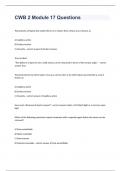
CWB 2 Module 17 Questions with correct answers rated A+ 2023/2024
CWB 2 Module 17 Questions The property of liquids that makes them try to reduce their surface area is known as: A) Capillary action B) Surface tension C) Viscosity - correct answer B) Surface tension True or False? "The ability of a liquid to wet a solid surface can be measured in terms of the contact angle." - correct answer True The phenomenon by which water rises up a narrow tube or by which liquid can penetrate a crack is known as: A) Capillary action B) Surface tension C) Viscosity - correct answer A) Capillary action How must a fluorescent dye be viewed? - correct answer Under a UV (black) light or a mercury vapor light Which of the following penetrants require treatment with a separate agent before the excess can be removed? A) Post-emulsifiable B) Water-washable C) Post-remover D) Solvent-removable - correct answer A) Post-emulsifiable What type of developer is normally used with the solvent-removal process to spot check welds? - correct answer Non-aqueous True or False? "The fluorescent post-emulsified penetrant process is often recommended for high sensitivity applications such as detection of fatigue cracks.: - correct answer True Does the liquid penetrant process work on stainless steel and aluminum? - correct answer Yes Give one way in which a change to a liquid penetrant procedure could be qualified. - correct answer Use a comparator block to prove you can find the indications True or False? "When using liquid penetrant inspection, the surface must be ground smooth to remove all irregularities before applying the penetrant." - correct answer False According to ASTM E-165, the surface temperature for liquid penetrant inspection should not be outside the range: A) 12°C to 52°C (60°F to 125°F) B) 21°C to 24°C (70°F to 75°F) C) -18°C to 38°C (0°F to 100°F) - correct answer A) 12°C to 52°C (60°F to 125°F) When using the solvent-removeable method, why should the solvent not be sprayed directly on the surface to remove the penetrant? - correct answer It may push penetrant out of discontinuities True or False? "When using post-emulsifiable penetrants, the emulsifier must remain in contact with the surface long enough to mix the excess penetrant but not long enough to reach penetrant in the discontinuities." - correct answer True What could be the effect of spraying on too much developer? - correct answer It could cover up indications What is the difference a false indications and a non-relevant indication? - correct answer False indications are not associated with discontinuities, non-relevant indications are. What is the most likely cause of false indications? - correct answer inadequate pre cleaning or use of lint cloths Which of the following indications is most likely to be cause by a crack? A) Rounded B) Diffused or weak C) Continuous line - correct answer C) Continuous line Which of the following indications is most likely to be cause by porosity? A) Rounded B) Diffused or weak C) Continuous line - correct answer A) Rounded According to CSA W59, the criteria used for evaluating liquid penetrant testing are the same as those for: A) Ultrasonic inspection B) Visual inspection
Written for
- Institution
- CWB
- Course
- CWB
Document information
- Uploaded on
- December 11, 2023
- Number of pages
- 8
- Written in
- 2023/2024
- Type
- Exam (elaborations)
- Contains
- Questions & answers
Subjects

Also available in package deal