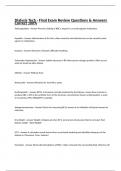
Dialysis Tech - Final Exam Review Questions & Answers Correct 100%
Anticoagulation - Answer Prevents clotting of RBC's; heparin is an anticoagulant medication. Hepatitis - Answer Inflammation of the liver, often caused by viral infection but can be caused by toxic agents or medications. Dyspnea - Answer Shortness of breath, difficulty breathing. Orthostatic Hypotension - Answer Sudden decrease in BP when person changes position. Often occurs when pt stands up after dialysis. Afebrile - Answer Without fever. Bradycardia - Answer HR below 60, slow HR or pulse. Erythropoietin - Answer (EPO). A hormone normally produced by the kidneys, causes bone marrow to produce RBC's. EPO is the synthetic form of the hormone. (recombinant human erythropoietin, is used to tx anemia.) EPO, ARANESP for example. Sphygmomanometer - Answer Device for measuring BP by means of an inflatable cuff placed around an extremity. Dry Weight - Answer Weight of dialysis pt when BP is normal and all excessive fluid is removed. Post-dialysis weight. "Ideal Weight". KT/V - Answer A calculation result derived from urea kinetic modeling and identified adequacy of the dialysis tx. (Clearance, Time, Volume.) Hemolysis - Answer Destruction/breakdown of RBC's, Hgb is released into surrounding fluid. Chlorine will cause hemolysis. High temp of dialysate fluid will also cause hemolysis. Edema - Answer Collection of fluid in the body tissues. Swelling. Often soft and compressible. Reprocessing - Answer Re-use. Cleaning and disinfecting dialyzers and in some cases, blood lines, to be used again by the same pt. ACE inhibitors - Answer BP medication. Blocks an enzyme in the body that causes blood vessels to narrow, when the vessels relax the BP decreases. Anemia - Answer Too few RBC's. RBC's carry oxygen. If the RBC's decrease, not enough oxygen in the body. Patients will be pale, tired, and fatigued. Common with CKD patients. Treated with EPO or ARANESP. Severe anemia may require a blood transfusion. Type 1 Diabetes - Answer Insulin-dependent diabetes. Pancreas doesn't produce insulin anymore. With diabetes, characterized by increased blood sugar resulting from the body's inability to use glucose effectively. Extracorporeal Circuit - Answer Circuit = arterial bloodline, dialyzer, venous bloodline, and extracorporeal blood circuit monitors. Extension of patient's blood vessels outside the body, bringing blood back from the access to the dialyzer and back to the patient. ( Extracorporeal = Outside to body.) Atherosclerosis - Answer Type of arteriosclerosis (hardening of the arteries) caused by degeneration and fatty changes in the walls of the arteries. (Plaque builds up) ESRD - Answer End Stage Renal Disease Aneurysm - Answer A blood-filled sac formed by the stretching and dilation of the wall of an artery. A ballooning or bulging of a weak spot in a vessel. Infiltration - Answer When the needle passes through a vessel wall or access and causes bleeding into the tissues, resulting in hematoma. Febrile - Answer Feverish. Having an elevated temperature. Bolus - Answer A single relatively large amount of something. In dialysis, HEPARIN can be given by BOLUS. A bolus is given ALL at ONCE. Albumin - Answer A blood protein. Found in many body tissues. Gives an indication how well nourished a patient is. Indicates NUTRITIONAL STATUS. Air Embolism - Answer Air bubble carried by the bloodstream. Can be life threatening. Hyperkalemia - Answer Serum potassium level higher than normal. Normal range is 3-5 mEq/L Neuropathy - Answer Damage to or disease of the nerves. Ex: Carpal tunnel in diabetics. Peripheral neuropathy) Nephron - Answer Functional unit of the kidney. Access - Answer In dialysis, point on the body where a needle or catheter is inserted. AKI - Answer Acute Kidney Injury Pre-weight - Answer The patient's wt upon arrival to the dialysis clinic for tx. Gain - Answer The difference between the pt's wt after the last tx and pt's wt before the current tx begins. Estimated Dry Weight (EDW) - Answer The lowest wt a pt can tolerate without developing adverse symptoms or hypotension. Available weight (AW) - Answer The amount of fluid the patient has available to remove; the difference between the patient's pre-weight and EDW. Goal - Answer The goal for fluid removal during tx; Usually will include AW plus any fluids that might be administered to the pt during tx, including any saline used for blood return, saline rinses, or medication. Lost - Answer The amount of fluid lost during a dialysis tx; calculated by subtracting the patient's pre-weight after the dialysis treatment, or post-weight. 1 kg = ______________ lbs - Answer 2.2 lbs 1 ounce (oz) = ___________mL - Answer 30 mLs Peritoneal dialysis is a process during which the __________ ______________ acts as the reservoir for the dialysate and the peritoneum serves as the _____________. - Answer abdominal cavity; semipermeable membrane CAPD - Answer A continuous method of peritoneal dialysis that does not require a machine and is self-administered. CCPD - Answer A type of peritoneal dialysis usually performed with cycler (machine) at night. IPD - Answer A type of peritoneal dialysis usually performed at the hospital, a machine administers and drains the dialysis solution. The catheter generally used for chronic peritoneal dialysis are usually made of _______, __________, or _____________. - Answer silicon, rubber, polyurethane In renal transplant, __________ _________ are blood tests that are designed to identify genetic markers to identify matching donor organs. - Answer Tissue Typing TRUE or FALSE: When a kidney transplant is performed the diseased kidneys are removed and the donor kidney attached in its place usually on the left side of the abdominal cavity. - Answer FALSE. The deceased kidney(s) may be removed or left in place. The donor kidney is typically placed in the Right or Left Iliac fossa. Hyperacute Rejection - Answer This rejection occurs within minutes to hours after transplantation. Acute Rejection - Answer Usually occurs weeks to months after transplantation. Chronic Rejection - Answer A slow humoral rejection process that occurs over a period of months to years. The 3 stages of pyschosocial adjustment to dialysis have been identified as: - Answer 1) "honeymoon period" - May last a few weeks to 6 months or more. Characterized by renewed feelings of hope and confidence. May respond more positively initally because they feel better than they did before the initiation of dialysis. 2) Period of disenchantment and discouragement. May last from 3-12 months. Triggered when pt is forced to confront the limitations dialysis has placed on their lives/activities/employment/etc. 3) Period of long-term adaptation. Characterized by the pt's arrival at some degree of acceptance of the limitations, shortcomings, and complications that dialysis brings into his or her life. Note: These are general guidelines. Pts may go between stages, it is not a linear progression , pts may shift back and forth between them. Acute renal failure in children usually results from _______________of the kidneys due to septic shock, hypotension, and severe hydration. - Answer Hypoperfusion Describe CQI: - Answer Continuous Quality Improvement. R/t quality and costs. Continually evaluating performance with the goal of improving care and outcomes. Prerenal ARF - Answer Inadequate blood circulation (perfusion) to the kidneys. Postrenal ARF - Answer Acute obstruction that affects the normal flow of urine out of both kidneys. Intrarenal ARF - Answer Damage or injury within both kidneys. Complications associated with isolated ultrafiltration (UF) are__________________and ______________________ - Answer hypotension, muscle cramps CVVH - Answer Continuous Venovenous Hemofiltration - Convective type, slow and continuous. Acute, never chronic situation. Seen in teaching facilities. CVVHD - Answer Continuous Venous Venous Hemodialysis CVVHDF - Answer Continuous Venous Venous Hemodiafiltration. Combines convective and diffusive Acute renal failure differs from chronic renal failure in that acute renal failure: - Answer Acute renal failure (ARF) is sudden onset with reversible damage.
Written for
- Institution
- Dialysis technician
- Course
- Dialysis technician
Document information
- Uploaded on
- December 11, 2023
- Number of pages
- 21
- Written in
- 2023/2024
- Type
- Exam (elaborations)
- Contains
- Questions & answers
Subjects
- dialysis tech stuvia
-
dialysis tech final exam review questions answ
-
anticoagulation prevents clotting of rbcs hepari
-
hepatitis inflammation of the liver often caused

Also available in package deal