HRM
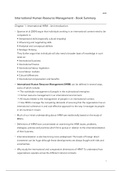
International Human Resource Management - Book Summary
Chapter 1: International HRM - An Introduction
- Sparrow et al (2004) argue that individuals working in an international context need to be
competent in:
• Interpersonal skills (especially cultural empathy)
• Influencing and negotiating skills
• Analytical and conceptual abilities
• Strategic thinking
They further argue that individuals will also need a broader base of knowledge in such
areas as:
• International business
• International finance
• International labour legislation
• Local labour markets
• Cultural differences
• International compensation and benefits
- International Human Resource Management (IHRM) can be defined in several ways,
some of which include:
→ The worldwide management of people in the multinational enterprise.
→ Human resource management in an international environment.
→ All issues related to the management of people in an international context.
→ How MNCs manage the competing demands of ensuring that the organization has an
international coherence in and cost-effective approach to the way it manages its people
in all countries it covers.
- Much of our initial understanding about IHRM was traditionally based on the study of
MNCs.
- Definitions of IHRM have concentrated on examining the HRM issues, problems,
strategies, policies and practices which firms pursue in relation to the internationalisation
of their business.
- Internationalisation is also becoming more widespread. The levels of foreign direct
investment can be huge although these developments are always fraught with risks and
uncertainties.
- Why study the international and comparative dimensions of HRM? To understand how
organisations operate across the different national contexts.
!1
, HRM
- Two fundamental paradigms in the exploration of HRM: the universalists and the
contextual. Comparative HRM is intrinsically contextual, generally focused at the national
level. IHRM, however, is often universalist, assuming that the same things will work in
every context.
- The Universalist Paradigm assumes that the purpose of the study of HRM, and in
particular strategic human resource management (SHRM), is to improve the way that
human resources are managed strategically within organization. Where, the ultimate aim
is to improve organizational performance.
- The Contextual Paradigm searches for an overall understanding of what is contextually
unique and why. In HRM, it is focused on understand what is different between and within
HRM in various contexts, and what the antecedents of those areas are.
- An linked debate is between those who believe in globalisation, arguing that all aspects
of management, including HRM, are becoming more alike; and those who believe that
each country continues to have its own approach to management in general and HRM in
particular.
- Mayrhoffer et al (2004) differentiated a number of forms of change - convergence or
divergence?:
• Directional Convergence
When comparing changes in HRM practices between two countries directional
convergence exists when the trend (developmental tendency) goes in the same direction.
• Final Convergence
When changes in the use of an HRM practice in two different countries mean that the two
countries' practices get more similar (the differences in use of the practice between the
countries decreases in magnitude over time) then there is convergence to some final
point.
• Statis
When there is no change over time in the proportion of organisations using an HRM
practice and a state of stability thus exists.
• Divergence
When the changes in the use of an HRM practice in two different countries are
progressing in truly different directions, one increasing and the other decreasing.
- Internationally operating organisations may want to standardise practices wherever
possible. But in many areas of management, and particularly HRM, they also have to be
aware of and respond to or even utilise national difference. This standardisation/
localisation debate is a central issue in HRM.
!2
, HRM
- There is little empirical data on the issue of convergence versus divergence, and that is
largely the result of the difficulties of researching this issue.
- Mayrhofer et al (2011) carried out statistical analyses and summarised their findings on
convergence and divergence as follows → "The results support the notion that
converging and non-converging occur simultaneously. While no final convergence can be
observed for HRM in Europe... directional similarity is visible in a majority of the areas of
HRM analysed."
- To understand IHRM it must be structured under three headings:
1. National institutional and cultural differences
2. Aspects of comparative HRM
3. International HRM
- IHRM has evolved in three directions, with a growing influence of an institutional
perspective; the development of a critical perspective; and a problem-solving perspective
on IHRM.
- The critical view of IHRM is an acknowledgement that we are examining organizational
issues that are of high complexity, in an environment of changing context, and with
questionable assumptions about the existence of rules of the past that can be
generalised to future actions.
- The evolutionary view of IHRM is that IHRM has moved not through a haphazard and
opportunistic expansion, but through a sequential development of thinking that has
captured the successively evolving cultural, geographical and institutional challenges
faced by the multinational corporation.
- Björkman and Welch (2015) characterise IHRM as covering four different levels of analysis:
• Macro (ie., countries, regions, industries..)
• MNC (i.e., HQ, parent country)
• Unit (i.e., subsidiary, production unit, sales office..)
• Individual (i.e., teams, employees..)
- The expansion of IHRM concerns knowledge management, change management, the
management of joint-ventures, transfer of management practices, implementation of
strategy, etc.
- We are witnessing the global transfer of work - either in terms of the creation of new jobs
or through the global sourcing of certain parts of an individual's or unit's work. This is
having a major impact on the type of organisations and nature of work that remain viable
in different parts of the world.
!3
International Human Resource Management - Book Summary
Chapter 1: International HRM - An Introduction
- Sparrow et al (2004) argue that individuals working in an international context need to be
competent in:
• Interpersonal skills (especially cultural empathy)
• Influencing and negotiating skills
• Analytical and conceptual abilities
• Strategic thinking
They further argue that individuals will also need a broader base of knowledge in such
areas as:
• International business
• International finance
• International labour legislation
• Local labour markets
• Cultural differences
• International compensation and benefits
- International Human Resource Management (IHRM) can be defined in several ways,
some of which include:
→ The worldwide management of people in the multinational enterprise.
→ Human resource management in an international environment.
→ All issues related to the management of people in an international context.
→ How MNCs manage the competing demands of ensuring that the organization has an
international coherence in and cost-effective approach to the way it manages its people
in all countries it covers.
- Much of our initial understanding about IHRM was traditionally based on the study of
MNCs.
- Definitions of IHRM have concentrated on examining the HRM issues, problems,
strategies, policies and practices which firms pursue in relation to the internationalisation
of their business.
- Internationalisation is also becoming more widespread. The levels of foreign direct
investment can be huge although these developments are always fraught with risks and
uncertainties.
- Why study the international and comparative dimensions of HRM? To understand how
organisations operate across the different national contexts.
!1
, HRM
- Two fundamental paradigms in the exploration of HRM: the universalists and the
contextual. Comparative HRM is intrinsically contextual, generally focused at the national
level. IHRM, however, is often universalist, assuming that the same things will work in
every context.
- The Universalist Paradigm assumes that the purpose of the study of HRM, and in
particular strategic human resource management (SHRM), is to improve the way that
human resources are managed strategically within organization. Where, the ultimate aim
is to improve organizational performance.
- The Contextual Paradigm searches for an overall understanding of what is contextually
unique and why. In HRM, it is focused on understand what is different between and within
HRM in various contexts, and what the antecedents of those areas are.
- An linked debate is between those who believe in globalisation, arguing that all aspects
of management, including HRM, are becoming more alike; and those who believe that
each country continues to have its own approach to management in general and HRM in
particular.
- Mayrhoffer et al (2004) differentiated a number of forms of change - convergence or
divergence?:
• Directional Convergence
When comparing changes in HRM practices between two countries directional
convergence exists when the trend (developmental tendency) goes in the same direction.
• Final Convergence
When changes in the use of an HRM practice in two different countries mean that the two
countries' practices get more similar (the differences in use of the practice between the
countries decreases in magnitude over time) then there is convergence to some final
point.
• Statis
When there is no change over time in the proportion of organisations using an HRM
practice and a state of stability thus exists.
• Divergence
When the changes in the use of an HRM practice in two different countries are
progressing in truly different directions, one increasing and the other decreasing.
- Internationally operating organisations may want to standardise practices wherever
possible. But in many areas of management, and particularly HRM, they also have to be
aware of and respond to or even utilise national difference. This standardisation/
localisation debate is a central issue in HRM.
!2
, HRM
- There is little empirical data on the issue of convergence versus divergence, and that is
largely the result of the difficulties of researching this issue.
- Mayrhofer et al (2011) carried out statistical analyses and summarised their findings on
convergence and divergence as follows → "The results support the notion that
converging and non-converging occur simultaneously. While no final convergence can be
observed for HRM in Europe... directional similarity is visible in a majority of the areas of
HRM analysed."
- To understand IHRM it must be structured under three headings:
1. National institutional and cultural differences
2. Aspects of comparative HRM
3. International HRM
- IHRM has evolved in three directions, with a growing influence of an institutional
perspective; the development of a critical perspective; and a problem-solving perspective
on IHRM.
- The critical view of IHRM is an acknowledgement that we are examining organizational
issues that are of high complexity, in an environment of changing context, and with
questionable assumptions about the existence of rules of the past that can be
generalised to future actions.
- The evolutionary view of IHRM is that IHRM has moved not through a haphazard and
opportunistic expansion, but through a sequential development of thinking that has
captured the successively evolving cultural, geographical and institutional challenges
faced by the multinational corporation.
- Björkman and Welch (2015) characterise IHRM as covering four different levels of analysis:
• Macro (ie., countries, regions, industries..)
• MNC (i.e., HQ, parent country)
• Unit (i.e., subsidiary, production unit, sales office..)
• Individual (i.e., teams, employees..)
- The expansion of IHRM concerns knowledge management, change management, the
management of joint-ventures, transfer of management practices, implementation of
strategy, etc.
- We are witnessing the global transfer of work - either in terms of the creation of new jobs
or through the global sourcing of certain parts of an individual's or unit's work. This is
having a major impact on the type of organisations and nature of work that remain viable
in different parts of the world.
!3