Structure and Function of Biological
Membranes
Biological Membranes
Importance of biological membranes
Human genome contains around 25000 genes ~25% of these genes are expected to
be membrane proteins
Important because many are interface of cell and its external environment and
dictate how cell interacts with its environment
Important target for drugs ~60% of currently marketed drugs target membrane
proteins
Serves as energy storage and information transduction – dictated by proteins
Role of membrane proteins in disease
Cystic Fibrosis- Cl- channel
Malignant hyperthermia- Ca2+ channel
Long-QT syndrome K+ channel
Darier Disease- Ca2+ pump
Becker’s myotonia- Cl- channel
Congenital myasthenic syndrome- acetylcholine receptor
Where are cellular membranes found?
All cells are enveloped by membranes
Eukaryotic all have internal membranes- delineate organelles- mitochondria,
chloroplasts, peroxisomes and lysosomes
What are Cell Membranes composed of?
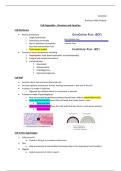
Lipid Bilayer
Three major classes of lipids
Phospholipids
Cholesterol
Sphingolipids
Phospholipids
Abundant in all biological membranes
Fatty acid components provide hydrophobic barrier
Remainder of molecule has hydrophilic properties- enable interaction with aqueous environment
Phosphoglycerides- phospholipids derived from glycerol
o Consists of glycerol backbone- attached to two fatty acid
chains and phosphorylated alcohol
o Hydroxyl groups at C1 and C2 of glycerol esterified to
Carboxyl groups of two fatty acid chains
o C3 hydroxyl group of glycerol backbone esterified to
phosphoric acid
, With no further additions made- resulting compound phosphatide (diacylglycerol 3-phosphate) – simplest
phosphoglyceride
Basic architecture of phospholipid
Glycerol backbone- 3 Carbon alcohol
or Sphingosine- more complex alcohol
Phosphate on sn-3 position
Two fatty acid chains on sn-1 and sn-2 positions
Headgroup attached to phosphate
Variation lies in chains and in headgroup
- Major phosphoglycerides derived from phosphatide by formation of ESTER bond between phosphate group of
phosphatide and Hydroxyl group of one of several alcohols- serine ethanolamine, choline, glycerol and inositol
Sphingolipids
Second major class of membrane lipids- Glycolipids- sugar-containing lipids
Sphingolipids found extensively in neuronal membrane
In other cells- found in plasma membrane and lot lower concentrations in intracellular
compartments – added to membrane as membranes are synthesised as they proceed through ER/ Golgi
- Causes different phase behaviour membrane include formation of local domains
Structurally phosphoglycerides and sphingolipids are SIMILAR
More-complex glycolipids- Gangliosides- contain branched chain of as many as Seven sugar residues
Glycolipids are oriented in asymmetric fashion with sugar residue always on extracellular side of membrane
Sphingomyelin
Phospholipid found in membranes – not derived from Glycerol
Glycolipids in animal cells derived from Sphingosine
o Amino group of sphingosine is acylated by Fatty acid as in Sphingomyelin
Glycolipids differ from sphingomyelin in identity of unit that is linked to primary
Hydroxyl group of Sphingosine backbone
Sphingosine
Amino alcohol that contains long, unsaturated hydrocarbon chain
Amino group of sphingosine backbone is linked to fatty acid by amide bond
Primary Hydroxyl group is esterified to Phosphorylcholine
Sterols- Cholesterol
Cholesterol- third major type of membrane lipid- has structure that is quite different
from phospholipids
- Steroid- built from 4 linked hydrocarbon rings
Present in humans- other forms exist in yeast/plants/ bacterial
e.g. fungal system have ergosterol
Hydrocarbon tail is linked to Steroid end
Hydroxyl group interacts with CO groups of phospholipids
Membranes
Biological Membranes
Importance of biological membranes
Human genome contains around 25000 genes ~25% of these genes are expected to
be membrane proteins
Important because many are interface of cell and its external environment and
dictate how cell interacts with its environment
Important target for drugs ~60% of currently marketed drugs target membrane
proteins
Serves as energy storage and information transduction – dictated by proteins
Role of membrane proteins in disease
Cystic Fibrosis- Cl- channel
Malignant hyperthermia- Ca2+ channel
Long-QT syndrome K+ channel
Darier Disease- Ca2+ pump
Becker’s myotonia- Cl- channel
Congenital myasthenic syndrome- acetylcholine receptor
Where are cellular membranes found?
All cells are enveloped by membranes
Eukaryotic all have internal membranes- delineate organelles- mitochondria,
chloroplasts, peroxisomes and lysosomes
What are Cell Membranes composed of?
Lipid Bilayer
Three major classes of lipids
Phospholipids
Cholesterol
Sphingolipids
Phospholipids
Abundant in all biological membranes
Fatty acid components provide hydrophobic barrier
Remainder of molecule has hydrophilic properties- enable interaction with aqueous environment
Phosphoglycerides- phospholipids derived from glycerol
o Consists of glycerol backbone- attached to two fatty acid
chains and phosphorylated alcohol
o Hydroxyl groups at C1 and C2 of glycerol esterified to
Carboxyl groups of two fatty acid chains
o C3 hydroxyl group of glycerol backbone esterified to
phosphoric acid
, With no further additions made- resulting compound phosphatide (diacylglycerol 3-phosphate) – simplest
phosphoglyceride
Basic architecture of phospholipid
Glycerol backbone- 3 Carbon alcohol
or Sphingosine- more complex alcohol
Phosphate on sn-3 position
Two fatty acid chains on sn-1 and sn-2 positions
Headgroup attached to phosphate
Variation lies in chains and in headgroup
- Major phosphoglycerides derived from phosphatide by formation of ESTER bond between phosphate group of
phosphatide and Hydroxyl group of one of several alcohols- serine ethanolamine, choline, glycerol and inositol
Sphingolipids
Second major class of membrane lipids- Glycolipids- sugar-containing lipids
Sphingolipids found extensively in neuronal membrane
In other cells- found in plasma membrane and lot lower concentrations in intracellular
compartments – added to membrane as membranes are synthesised as they proceed through ER/ Golgi
- Causes different phase behaviour membrane include formation of local domains
Structurally phosphoglycerides and sphingolipids are SIMILAR
More-complex glycolipids- Gangliosides- contain branched chain of as many as Seven sugar residues
Glycolipids are oriented in asymmetric fashion with sugar residue always on extracellular side of membrane
Sphingomyelin
Phospholipid found in membranes – not derived from Glycerol
Glycolipids in animal cells derived from Sphingosine
o Amino group of sphingosine is acylated by Fatty acid as in Sphingomyelin
Glycolipids differ from sphingomyelin in identity of unit that is linked to primary
Hydroxyl group of Sphingosine backbone
Sphingosine
Amino alcohol that contains long, unsaturated hydrocarbon chain
Amino group of sphingosine backbone is linked to fatty acid by amide bond
Primary Hydroxyl group is esterified to Phosphorylcholine
Sterols- Cholesterol
Cholesterol- third major type of membrane lipid- has structure that is quite different
from phospholipids
- Steroid- built from 4 linked hydrocarbon rings
Present in humans- other forms exist in yeast/plants/ bacterial
e.g. fungal system have ergosterol
Hydrocarbon tail is linked to Steroid end
Hydroxyl group interacts with CO groups of phospholipids