Solution and Answer Guide: Collier/Evans, Operations and Supply Chain Management 2024, 9780357901649;
Chapter 1: Operations Management and Value Chains
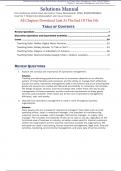
Solutions Manual
COLLIER/EVANS, OPERATIONS AND SUPPLY CHAIN MANAGEMENT 2024, 9780357901649;
CHAPTER 1: OPERATIONS MANAGEMENT AND VALUE CHAINS
All Chapters Download Link At The End Of This File
TABLE OF CONTENTS
Review Questions ................................................................................................................1
Discussion Questions and Experiental Activities ............................................................. 8
Cases ................................................................................................................................. 20
Teaching Note: Walker Digital Music Services .................................................................. 20
Teaching Note: Mickey Mouse: To Talk or Not?................................................................ 24
Teaching Note: Zappos, A Subsidiary of Amazon ............................................................. 26
Teaching Note: Diamond Global Supply Chain—Hudson Jewelers................................ 31
REVIEW QUESTIONS
1. Explain the concept and importance of operations management.
Solution
Creating and delivering goods and services to customers depends on an effective
system of linked facilities and processes, and the ability to manage them effectively
around the world. Operations management (OM) is the science and art of ensuring that
goods and services are created and delivered successfully to customers. OM includes
the design of goods, services, and the processes that create them; the day-to-day
management of those processes; and the continual improvement of these goods,
services, and processes. Three issues are at the core of operations management:
efficiency, cost, and quality.
2. Describe how operations management is used in work throughout business
organizations.
Solution
Many people who are considered “operations managers” have titles such as chief
operating officer, hotel or restaurant manager, vice president of manufacturing,
customer service manager, plant manager, field service manager, or supply chain
manager. The concepts and methods of OM can be used in any job, regardless of the
functional area of business or industry, to better create value for internal customers
(within the organization) and for external customers (outside the organization). OM
principles are used in accounting, human resources management, legal work, financial
activities, marketing, environmental management, and every type of service activity.
© 2024 Cengage. All Rights Reserved. May not be scanned, copied or duplicated, or posted to a publicly accessible 1
website, in whole or in part.
, Solution and Answer Guide: Collier/Evans, Operations and Supply Chain Management 2024, 9780357901649;
Chapter 1: Operations Management and Value Chains
3. What are Industry 4.0 and Service 4.0? Give an example in manufacturing and health
care or other service industries.
Solution
Industry 4.0 is the information-intensive transformation of manufacturing in a
connected environment of big data, people, processes, services, systems, and IoT-
enabled industrial assets. In manufacturing, autonomous robots can quickly pick
products at a warehouse to reduce costs and optimize floor space. Other
manufacturing examples are 3D printing, computer-aided design software and three-
dimensional displays of the part or product, and a multitude of welding, materials
moving, and assembly robots tied to an automated or semi-automated control system.
Smart appliances tied electronically to home comfort systems, automated truck
routing and dispatching systems are other examples.
Service 4.0 is applying digitization to services that create higher productivity,
innovation, and value chain advantages in service industries. Service 4.0 devices
include cell phones, automated banking machines, CT and MRI scanners, electronic
hotel keys and security systems, home security systems, surgical robots assistants,
online banking, digital health care systems, electronic restaurant menus, and so on.
4. State three of the key activities that operations managers perform and briefly explain
them.
Solution
Students should describe three of the following in their own words.
• Forecasting: Predict the future demand for raw materials, finished goods, and
services.
• Supply chain management: manage the flow of materials, information, people, and
money from suppliers to customers.
• Facility layout and design: determine the best configuration of machines, storage,
offices, and departments to provide the highest levels of efficiency and customer
satisfaction.
• Technology selection: use technology to improve productivity and respond faster to
customers.
• Quality management: ensure that goods, services, and processes will meet
customer expectations and requirements.
• Purchasing: coordinate the acquisition of materials, supplies, and services.
• Resource and capacity management: ensure that the right amount of resources
(labor, equipment, materials, and information) is available when needed.
• Process design: select the right equipment, information, and work methods to
produce high-quality goods and services efficiently.
• Job design: decide the best way to assign people to work tasks and job
responsibilities.
© 2024 Cengage. All Rights Reserved. May not be scanned, copied or duplicated, or posted to a publicly accessible 2
website, in whole or in part.
, Solution and Answer Guide: Collier/Evans, Operations and Supply Chain Management 2024, 9780357901649;
Chapter 1: Operations Management and Value Chains
• Service encounter design: determine the best types of interactions between service
providers and customers, and how to recover from service upsets.
• Scheduling: determine when resources such as employees and equipment should
be assigned to work.
• Sustainability: decide the best way to manage the risks associated with products
and operations to preserve resources for future generations.
5. Define a good and a service.
Solution
Companies design, produce, and deliver a wide variety of goods and services that
consumers purchase. A good is a physical product that you can see, touch, or possibly
consume. A service is any primary or complementary activity that does not directly
produce a physical product. See the key terms below for the difference between
durable and nondurable goods.
6. Explain how goods differ from services.
Solution
See Section 1-3:
• Goods are tangible, services are intangible.
• Customers participate in many service processes, activities, and transactions.
• Service demand is normally more difficult to predict than for goods due to
weather, human behavior, etc.
• Services cannot be stored as inventory. Service capacity is the substitute for goods
inventory.
• Services require service management skills whereas the production of physical
goods requires only backroom skills (not front room, high customer contact skills).
• Service facilities are typically close to the customer. Convenience has value.
• Patents do not protect services.
7. Define the concept of value.
Solution
See Section 1-4. The underlying purpose of every organization is to provide value to its
customers and stakeholders. The decision to purchase a good or service or a customer
benefit package is based on an assessment by the customer of the perceived benefits
in relation to its price. The customer’s cumulative judgment of the perceived benefits
leads to either satisfaction or dissatisfaction. One of the simplest functional forms of
value is:
Value = Perceived benefits/Price (cost) to the customer
© 2024 Cengage. All Rights Reserved. May not be scanned, copied or duplicated, or posted to a publicly accessible 3
website, in whole or in part.
, Solution and Answer Guide: Collier/Evans, Operations and Supply Chain Management 2024, 9780357901649;
Chapter 1: Operations Management and Value Chains
8. How can an organization increase value to its customers?
Solution
See Section 1-4. To increase value, an organization must
(a) increase perceived benefits while holding price or cost constant;
(b) increase perceived benefits while reducing price or cost; or
(c) decrease price or cost while holding perceived benefits constant.
In addition, proportional increases or decreases in perceived benefits as well as price
result in no net change in value. Management must determine how to maximize value
by designing processes and systems that create and deliver the appropriate goods and
services customers want to use, pay for, and experience.
9. Describe a customer benefit package.
Solution
“Bundling” goods, services, and digital content in a certain way to provide value to
customers not only enhances what customers receive but can also differentiate the
product from competitors. A customer benefit package consists of a primary good or
service coupled with peripheral goods and/or services, and sometimes variants.
10. What is a peripheral good or service? Provide some examples.
Solution
Peripheral goods or services are those that are not essential to the primary good or
service but enhance it. Examples: auto leasing package, designer checks, fast delivery
service, airline baggage service and in-cabin food service, hotel exercise room, and so on.
11. Define “biztainment” and provide an example.
Solution
Biztainment is the practice of adding entertainment content to a bundle of goods and
services in order to gain competitive advantage. Student will find examples
everywhere.
• Manufacturing—old and new factory tours, showrooms, customer training and
education courses, virtual tours, short films on how things are made, driving
schools, history lessons on the design and development of a physical good
• Retail— on-line shopping with entertaining graphics (emoji), simulators, product
demonstrations, climbing walls, music, games, contests, holiday decorations and
walk-around characters, blogs, interactive store designs, aquariums, movie
theaters, makeovers
• Restaurants—toys, themes, electronic menus, contests, games, characters,
playgrounds, live music
• Agriculture—pick-your-own food, mazes, make-your-own wine, grape-stomping,
petting zoos, farm tours
© 2024 Cengage. All Rights Reserved. May not be scanned, copied or duplicated, or posted to a publicly accessible 4
website, in whole or in part.
Chapter 1: Operations Management and Value Chains
Solutions Manual
COLLIER/EVANS, OPERATIONS AND SUPPLY CHAIN MANAGEMENT 2024, 9780357901649;
CHAPTER 1: OPERATIONS MANAGEMENT AND VALUE CHAINS
All Chapters Download Link At The End Of This File
TABLE OF CONTENTS
Review Questions ................................................................................................................1
Discussion Questions and Experiental Activities ............................................................. 8
Cases ................................................................................................................................. 20
Teaching Note: Walker Digital Music Services .................................................................. 20
Teaching Note: Mickey Mouse: To Talk or Not?................................................................ 24
Teaching Note: Zappos, A Subsidiary of Amazon ............................................................. 26
Teaching Note: Diamond Global Supply Chain—Hudson Jewelers................................ 31
REVIEW QUESTIONS
1. Explain the concept and importance of operations management.
Solution
Creating and delivering goods and services to customers depends on an effective
system of linked facilities and processes, and the ability to manage them effectively
around the world. Operations management (OM) is the science and art of ensuring that
goods and services are created and delivered successfully to customers. OM includes
the design of goods, services, and the processes that create them; the day-to-day
management of those processes; and the continual improvement of these goods,
services, and processes. Three issues are at the core of operations management:
efficiency, cost, and quality.
2. Describe how operations management is used in work throughout business
organizations.
Solution
Many people who are considered “operations managers” have titles such as chief
operating officer, hotel or restaurant manager, vice president of manufacturing,
customer service manager, plant manager, field service manager, or supply chain
manager. The concepts and methods of OM can be used in any job, regardless of the
functional area of business or industry, to better create value for internal customers
(within the organization) and for external customers (outside the organization). OM
principles are used in accounting, human resources management, legal work, financial
activities, marketing, environmental management, and every type of service activity.
© 2024 Cengage. All Rights Reserved. May not be scanned, copied or duplicated, or posted to a publicly accessible 1
website, in whole or in part.
, Solution and Answer Guide: Collier/Evans, Operations and Supply Chain Management 2024, 9780357901649;
Chapter 1: Operations Management and Value Chains
3. What are Industry 4.0 and Service 4.0? Give an example in manufacturing and health
care or other service industries.
Solution
Industry 4.0 is the information-intensive transformation of manufacturing in a
connected environment of big data, people, processes, services, systems, and IoT-
enabled industrial assets. In manufacturing, autonomous robots can quickly pick
products at a warehouse to reduce costs and optimize floor space. Other
manufacturing examples are 3D printing, computer-aided design software and three-
dimensional displays of the part or product, and a multitude of welding, materials
moving, and assembly robots tied to an automated or semi-automated control system.
Smart appliances tied electronically to home comfort systems, automated truck
routing and dispatching systems are other examples.
Service 4.0 is applying digitization to services that create higher productivity,
innovation, and value chain advantages in service industries. Service 4.0 devices
include cell phones, automated banking machines, CT and MRI scanners, electronic
hotel keys and security systems, home security systems, surgical robots assistants,
online banking, digital health care systems, electronic restaurant menus, and so on.
4. State three of the key activities that operations managers perform and briefly explain
them.
Solution
Students should describe three of the following in their own words.
• Forecasting: Predict the future demand for raw materials, finished goods, and
services.
• Supply chain management: manage the flow of materials, information, people, and
money from suppliers to customers.
• Facility layout and design: determine the best configuration of machines, storage,
offices, and departments to provide the highest levels of efficiency and customer
satisfaction.
• Technology selection: use technology to improve productivity and respond faster to
customers.
• Quality management: ensure that goods, services, and processes will meet
customer expectations and requirements.
• Purchasing: coordinate the acquisition of materials, supplies, and services.
• Resource and capacity management: ensure that the right amount of resources
(labor, equipment, materials, and information) is available when needed.
• Process design: select the right equipment, information, and work methods to
produce high-quality goods and services efficiently.
• Job design: decide the best way to assign people to work tasks and job
responsibilities.
© 2024 Cengage. All Rights Reserved. May not be scanned, copied or duplicated, or posted to a publicly accessible 2
website, in whole or in part.
, Solution and Answer Guide: Collier/Evans, Operations and Supply Chain Management 2024, 9780357901649;
Chapter 1: Operations Management and Value Chains
• Service encounter design: determine the best types of interactions between service
providers and customers, and how to recover from service upsets.
• Scheduling: determine when resources such as employees and equipment should
be assigned to work.
• Sustainability: decide the best way to manage the risks associated with products
and operations to preserve resources for future generations.
5. Define a good and a service.
Solution
Companies design, produce, and deliver a wide variety of goods and services that
consumers purchase. A good is a physical product that you can see, touch, or possibly
consume. A service is any primary or complementary activity that does not directly
produce a physical product. See the key terms below for the difference between
durable and nondurable goods.
6. Explain how goods differ from services.
Solution
See Section 1-3:
• Goods are tangible, services are intangible.
• Customers participate in many service processes, activities, and transactions.
• Service demand is normally more difficult to predict than for goods due to
weather, human behavior, etc.
• Services cannot be stored as inventory. Service capacity is the substitute for goods
inventory.
• Services require service management skills whereas the production of physical
goods requires only backroom skills (not front room, high customer contact skills).
• Service facilities are typically close to the customer. Convenience has value.
• Patents do not protect services.
7. Define the concept of value.
Solution
See Section 1-4. The underlying purpose of every organization is to provide value to its
customers and stakeholders. The decision to purchase a good or service or a customer
benefit package is based on an assessment by the customer of the perceived benefits
in relation to its price. The customer’s cumulative judgment of the perceived benefits
leads to either satisfaction or dissatisfaction. One of the simplest functional forms of
value is:
Value = Perceived benefits/Price (cost) to the customer
© 2024 Cengage. All Rights Reserved. May not be scanned, copied or duplicated, or posted to a publicly accessible 3
website, in whole or in part.
, Solution and Answer Guide: Collier/Evans, Operations and Supply Chain Management 2024, 9780357901649;
Chapter 1: Operations Management and Value Chains
8. How can an organization increase value to its customers?
Solution
See Section 1-4. To increase value, an organization must
(a) increase perceived benefits while holding price or cost constant;
(b) increase perceived benefits while reducing price or cost; or
(c) decrease price or cost while holding perceived benefits constant.
In addition, proportional increases or decreases in perceived benefits as well as price
result in no net change in value. Management must determine how to maximize value
by designing processes and systems that create and deliver the appropriate goods and
services customers want to use, pay for, and experience.
9. Describe a customer benefit package.
Solution
“Bundling” goods, services, and digital content in a certain way to provide value to
customers not only enhances what customers receive but can also differentiate the
product from competitors. A customer benefit package consists of a primary good or
service coupled with peripheral goods and/or services, and sometimes variants.
10. What is a peripheral good or service? Provide some examples.
Solution
Peripheral goods or services are those that are not essential to the primary good or
service but enhance it. Examples: auto leasing package, designer checks, fast delivery
service, airline baggage service and in-cabin food service, hotel exercise room, and so on.
11. Define “biztainment” and provide an example.
Solution
Biztainment is the practice of adding entertainment content to a bundle of goods and
services in order to gain competitive advantage. Student will find examples
everywhere.
• Manufacturing—old and new factory tours, showrooms, customer training and
education courses, virtual tours, short films on how things are made, driving
schools, history lessons on the design and development of a physical good
• Retail— on-line shopping with entertaining graphics (emoji), simulators, product
demonstrations, climbing walls, music, games, contests, holiday decorations and
walk-around characters, blogs, interactive store designs, aquariums, movie
theaters, makeovers
• Restaurants—toys, themes, electronic menus, contests, games, characters,
playgrounds, live music
• Agriculture—pick-your-own food, mazes, make-your-own wine, grape-stomping,
petting zoos, farm tours
© 2024 Cengage. All Rights Reserved. May not be scanned, copied or duplicated, or posted to a publicly accessible 4
website, in whole or in part.