APES Chapter 3 questions with answers graded A+ 2023/2024
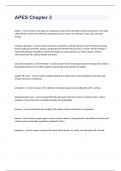
APES Chapter 3abiotic - correct answer Two types of components make up the biosphere and its ecosystems: One type, called abiotic, consists of nonliving components such as water, air, nutrients, rocks, heat, and solar energy. aerobic respiration - correct answer Producers, consumers, and decomposers use the chemical energy stored in glucose and other organic compounds to fuel their life processes. In most cells this energy is released by aerobic respiration, which uses oxygen to convert glucose (or other organic nutrient molecules) back into carbon dioxide and water. anaerobic respiration, or fermentation - correct answer Some decomposers get the energy they need by breaking down glucose (or other organic compounds) in the absence of oxygen aquatic life zones - correct answer Scientists divide the watery parts of the biosphere areas that each contain numerous ecosystems. atmosphere - correct answer a thin spherical envelope of gases surrounding the earth's surface. biogeochemical cycle - correct answer (literally, life-earth-chemical cycles) or nutrient cycles—prime examples of one of the four scientific principles of sustainability biomass - correct answer the dry weight of all organic matter contained in its organisms. biomes - correct answer large regions such as forests, deserts, and grasslands, with distinct climates and certain species (especially vegetation) adapted to them. biosphere - correct answer consists of the parts of the earth's air, water, and soil where life is found. biotic - correct answer Two types of components make up the biosphere and its ecosystems: The other type, called biotic, consists of living and once living biological components—plants, animals, and microbes. carbon cycle - correct answer Carbon is the basic building block of the carbohydrates, fats, proteins, DNA, and other organic compounds necessary for life. It circulates through the biosphere, the atmosphere, and parts of the hydrosphere, in the carbon cycle. cell theory - correct answer The idea that all living things are composed of cells is called the cell theory and it is the most widely accepted scientific theory in biology. cells - correct answer the smallest and most fundamental structural and functional units of life chemosynthesis - correct answer A few producers, mostly specialized bacteria, can convert simple inorganic compounds from their environment into more complex nutrient compounds without using sunlight, through a process called chemosynthesis. community, or biological community - correct answer consists of all the populations of different species that live in a particular place. consumers - correct answer All other organisms in an ecosystem are consumers, or heterotrophs ("other-feeders"), that cannot produce the nutrients they need through photosynthesis or other processes and must obtain their nutrients by feeding on other organisms (producers or other consumers) or their remains. decomposers - correct answer primarily certain types of bacteria and fungi, are consumers that release nutrients from the dead bodies of plants and animals and return them to the soil, water, and air for reuse by producers. They feed by secreting enzymes that speed up the break down of bodies of dead organisms into nutrient compounds such as water, carbon dioxide, minerals, and simpler organic compounds. detritus - correct answer Detritus feeders, or detritivores, feed on the wastes or dead bodies of other organisms, called detritus ("di-TRI-tus," meaning debris).
Written for
- Institution
- Apes
- Course
- Apes
Document information
- Uploaded on
- December 8, 2023
- Number of pages
- 6
- Written in
- 2023/2024
- Type
- Exam (elaborations)
- Contains
- Questions & answers
Subjects

Also available in package deal