ATI Book-safety and infection control (ch.10-15)Correct 100%
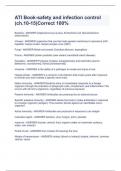
Bacteria - ANSWER (staphylococcus aureus, Escherichia coli, Mycobacterium tuberculosis) Viruses - ANSWER organisms that use the hosts genetic machinery to reproduce (HIV, hepatitis, herpes zoster, herpes simplex virus (HSV) Fungi - ANSWER Molds and yeasts (Candida albicans, aspergillus) Prions - ANSWER protein particles (new variant creutzfeldt-Jakob disease) Parasites - ANSWER Protozoa (malaria, toxoplasmosis) and helminths (worms [flatworms, roundworms], flukes [schistosomal]) Viruence - ANSWER is the ability of a pathogen to invade and injure a host Herpes Zoster - ANSWER is a common viral infection that erupts years after exposure to chicken pox and invades a specific nerve tract. Native immunity - ANSWER Restricts entry or immediately responds to a foreign organism through the activation of phagocytic cells, complement, and inflammation.This occurs with all micro-organisms, regardless of previous exposure Passive immunity - ANSWER Antibodies are produced by an external source Specific adaptive immunity - ANSWER allows the body to make antibodies in response to a foreign organism (antigen). This reaction directs against an identifiable micro-organism. Active immunity - ANSWER Antibodies are produced in response to an antigen Causative agent - ANSWER bacteria, virus, fungus, prion, parasite
Written for
- Institution
- ATI safety and infection control
- Course
- ATI safety and infection control
Document information
- Uploaded on
- December 7, 2023
- Number of pages
- 5
- Written in
- 2023/2024
- Type
- Exam (elaborations)
- Contains
- Questions & answers
Subjects
-
ati book safety and infection control ch10 15co
-
ati book safety and infection control
-
bacteria answer staphylococcus aureus escheric
-
viruses answer organisms that use the hosts gene

Also available in package deal