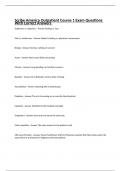
Scribe America Outpatient Course 4 Exam Questions With Correct Answers
Auscultation - Answer listening with a stethoscope palpation - Answer the act of pressing on an area of the body Cachectic - Answer emaciated, malnourished Anterior - Answer located towards the front of the body posterior - Answer towards the back of the body Medial - Answer closer to the midline of the body Lateral - Answer further from the midline of the body Diffuse - Answer widespread (opposite of localized) objective information comes directly from (2) - Answer 1. Healthcare provider 2. Diagnostic test (vital signs, labs, or imaging) Objective observations include symptoms that can be (6) - Answer 1. measured 2. seen 3. heard 4. touched 5. felt 6. smelled MSHTFS my High School TFS Objective information includes (3) - Answer 1. vital signs: HR, RR, T, BP, O2 Sat 2. PE 3. orders/results What are the three items that are included in the objective evaluation? - Answer 1. vital signs 2. PE 3. orders and results T/F: The objective evaluation should be documented immediately after the plan - Answer false Is information coming from the provider is subjective or objective? - Answer objective Vital signs - Answer BP, RR, T, HR, O2 Sat Vital signs are typically obtained by the - Answer nurse/MA upon patient check in (meaningful use) It is the scribe's responsibility to make sure they are documented in the chart Vital signs may change throughout a visit, and the physician may want to have more than one set of vital signs recorded, particularly if one is abnormal - Answer Ex: Initial BP 150/100 Repeat BP: 140/90 vitals signs are the - Answer objective evaluation for patient's subjective complaints 3 important things about vital signs - Answer 1. it is important to get a temperature for a patient complaining of a fever 2. a patient with an appointment for HTN management should have BP taken on arrival 3. If the pt has severe COPD, O2 saturation is a requirement pt c/o fever, should get - Answer temperature A patient with an appointment for HTN management would - Answer have a BP taken on arrival If the patient has severe COPD - Answer Oxygen saturation is a requirement Vital signs often help a physician determine (2) - Answer 1. how severe a problem is 2. treatment plan will adjusted accordingly What are the 5 vital signs? - Answer RR, T, BP, HR, O2 Sat Who typically records the vital signs? - Answer nurse/Ma T/F A scribe can take vital signs for a patient if the nurse is too busy and asks for help - Answer F T/F vital signs are important because they indicate how severe a problem is and how it should be treated - Answer T The physician is performing his PE from - Answer the moment he walks into the room In fact, much of a physical exam can be completed within the - Answer first 30 seconds of talking to the pt 6 body systems of PE - Answer 1. General: Do they look like they are in pain? 2. eyes: Are the sclera yellow? PERRL and EOMI 3. Pulmonary: Are they breathing comfortably? 4. skin: is their skin a normal color? 5. Neurological: are they answering questions appropriately? 6. psychiatric: are they acting normally? NTTP - Answer non tender to palpation A typical physical exam consists of (4) - Answer 1. Looking at the patient's external appearance 2. Auscultating the heart and lungs 3. palpating the abdomen 4. palpating the pt's legs Basic Physical exam ( 5) - Answer 1. Looking at the patient: General appearance, eyes, skin 2. Auscultating the heart: heart rate and rhythm, murmur 3. Auscultating the lungs: breath sounds 4. Palpating the abdomen: abdominal tenderness, soft 5. examining the legs: Edema, distal, pulses, tenderness Sometimes a more detailed physical exam is required: - Answer 1. Detailed eye exam 2. hearing/vision assessment 3. GYN exam 4. Neurological exam 5. Gait Assessment Name 5 body systems the physician can examine by simply observing the patient - Answer 1. general 2. eye 3. pulmonary 4. skin 5. neurological 6. psychiatric what does a typical exam entail in addition to the external exam? - Answer 1. looking at the patient's external appearance 2. auscultating the heart and lungs 3. palpating the abdomen 4. palpating the patient's legs If the physician listens to the patient's chest, what is he looking for? - Answer heart rate and rhythm, murmur If the physician palpates the pt's lower extremity, what is he looking for? - Answer 1. edema 2. distal pulses 3. tenderness Give an example of a detailed exam system that is not typically included in a basic exam - Answer 1. detailed eye exam 2. hearing/ vision assessment 3. GYN exam 4. Neurological exam 5. gait assessment Benign exam-external : Normal General - Answer well developed, well nourished. No acute distress Benign exam-external : Normal Eyes - Answer PERRL: pupils are equal round and reactive to light Benign exam-external : Normal ENT - Answer moist mucosa Benign exam-external : Normal Neck - Answer supple (flexible) Benign exam-external : Normal Cardiovascular - Answer well perfused Benign exam-external : Normal respiratory - Answer no respiratory distress Benign exam-external : Normal extremities - Answer no edema Benign exam-external : Normal skin - Answer warm, dry Benign exam-external : Normal Neurological - Answer Alert and Oriented, Normal speech Benign exam-external : Normal Psychiatric - Answer Normal affect Benign exam-complete : Normal constitutional - Answer well developed, well nourished. No Acute distress Benign exam-complete : Normal eyes - Answer PERRL, EOMI Benign exam-complete : Normal ENT - Answer moist mucous membranes Benign exam-complete : Normal Neck - Answer Supple, no lymphadenopathy lymphadenopathy - Answer enlarged lymph nodes Benign exam-complete : Normal cardiovascular - Answer Regular rate and rhythm (RRR); No murmurs, rubs, or gallops (fast pace). Distal pulses intact Benign exam-complete : Normal Respiratory - Answer No respiratory distress. Clear to auscultation bilaterally. No wheezes, rales, or rhonchi Benign exam-complete : Normal Abdominal - Answer soft. Non-tender. No guarding, rebound, or rigidity Benign exam-complete : Normal Extremities - Answer no edema, Full ROM Benign exam-complete : Normal skin - Answer warm, dry Benign Exam- complete neurological - Answer alert and oriented. normal speech Benign exam: complete psychiatric - Answer normal affect
Written for
- Institution
- Scribe America outpatient
- Course
- Scribe America outpatient
Document information
- Uploaded on
- December 7, 2023
- Number of pages
- 28
- Written in
- 2023/2024
- Type
- Exam (elaborations)
- Contains
- Questions & answers
Subjects
-
scribe america outpatient stuvia
-
scribe america outpatient course 4 exam questions
-
auscultation listening with a stethoscope
-
palpation the act of pressing on an area of the bo

Also available in package deal