D1 Kojar Ahmed
When it comes to motivation there are many methods a company can use to encourage and
motivate their employees. There are four main theories relating to the workplace which have been
compiled after experiments and rigorous research, these are:
Maslow's Hierarchy of Needs:
A theory in psychology proposed by Abraham Maslow in his 1943 paper “A Theory of Human
Motivation” in Psychological Review. Maslow subsequently extended the idea to include his
observations of humans' innate curiosity. His theories parallel many other theories of
human developmental psychology, some of which focus on describing the stages of growth in
humans. Maslow used the terms "physiological", "safety", "belonging" and "love", "esteem", "self-
actualization", and "self-transcendence" to describe the pattern that human motivations generally
move through. The goal of Maslow's Theory is to attain the sixth level of stage: self-transcendent
needs.
Source: https://en.wikipedia.org/wiki/Maslow%27s_hierarchy_of_needs
Herzberg’s Theory of Motivation:
Frederick Herzberg's Two-Factor Theory, also known as Motivation-Hygiene Theory or intrinsic vs.
extrinsic motivation, concludes that there are certain factors in the workplace that can cause job
satisfaction and a separate set of factors that can cause dissatisfaction.
Source: https://courses.lumenlearning.com/boundless.../chapter/employee-needs-and-motivation/
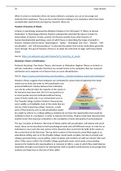
Maslow’s theory suggests that employees are motivated by various factors beginning from basic
needs such as food and water to self-actualisation and
personal fulfilment. Maslow believes that motivation
can only be achieved when the majority of the needs on
his hierarchy have been met, this isn’t necessarily true
as some people may feel motivated without having
some of these needs met. In an environment such as
The Cheadle College I believe Maslow’s hierarchy has
some validity as it highlights most of the needs that are
met by a fully functioning college. However, certain
parts of the hierarchy such as self-actualisation would
be unable to achieve in a college setting as students do not have the opportunities that would be
available to them in a workplace. In order to improve this theory, Maslow could have theorised that
another factor that improves motivation is the completion of work and quality of work produced.
The top 3 sections of Maslow’s Hierarchy of Needs outline self-actualisation, self-esteem and social
needs, these can be described as both psychological needs and self-fulfilment needs. In order for an
individual to move onto the next section of the hierarchy they must first fully fulfil all the needs on
the current level of the hierarchy. The top three sections of the hierarchy would likely apply in an
educational setting such as at The Cheadle College. Social needs are likely met due to schools and
colleges generally being a social setting, where students and members of staff can interact with each
other. Other ways in which The Cheadle College specifically meets social needs is by providing
resources for students who need guidance or someone to talk to, a way in which they could improve
motivation through social needs is by training their staff on positive reinforcement to encourage their
students and help them to the best of their ability.
When it comes to motivation there are many methods a company can use to encourage and
motivate their employees. There are four main theories relating to the workplace which have been
compiled after experiments and rigorous research, these are:
Maslow's Hierarchy of Needs:
A theory in psychology proposed by Abraham Maslow in his 1943 paper “A Theory of Human
Motivation” in Psychological Review. Maslow subsequently extended the idea to include his
observations of humans' innate curiosity. His theories parallel many other theories of
human developmental psychology, some of which focus on describing the stages of growth in
humans. Maslow used the terms "physiological", "safety", "belonging" and "love", "esteem", "self-
actualization", and "self-transcendence" to describe the pattern that human motivations generally
move through. The goal of Maslow's Theory is to attain the sixth level of stage: self-transcendent
needs.
Source: https://en.wikipedia.org/wiki/Maslow%27s_hierarchy_of_needs
Herzberg’s Theory of Motivation:
Frederick Herzberg's Two-Factor Theory, also known as Motivation-Hygiene Theory or intrinsic vs.
extrinsic motivation, concludes that there are certain factors in the workplace that can cause job
satisfaction and a separate set of factors that can cause dissatisfaction.
Source: https://courses.lumenlearning.com/boundless.../chapter/employee-needs-and-motivation/
Maslow’s theory suggests that employees are motivated by various factors beginning from basic
needs such as food and water to self-actualisation and
personal fulfilment. Maslow believes that motivation
can only be achieved when the majority of the needs on
his hierarchy have been met, this isn’t necessarily true
as some people may feel motivated without having
some of these needs met. In an environment such as
The Cheadle College I believe Maslow’s hierarchy has
some validity as it highlights most of the needs that are
met by a fully functioning college. However, certain
parts of the hierarchy such as self-actualisation would
be unable to achieve in a college setting as students do not have the opportunities that would be
available to them in a workplace. In order to improve this theory, Maslow could have theorised that
another factor that improves motivation is the completion of work and quality of work produced.
The top 3 sections of Maslow’s Hierarchy of Needs outline self-actualisation, self-esteem and social
needs, these can be described as both psychological needs and self-fulfilment needs. In order for an
individual to move onto the next section of the hierarchy they must first fully fulfil all the needs on
the current level of the hierarchy. The top three sections of the hierarchy would likely apply in an
educational setting such as at The Cheadle College. Social needs are likely met due to schools and
colleges generally being a social setting, where students and members of staff can interact with each
other. Other ways in which The Cheadle College specifically meets social needs is by providing
resources for students who need guidance or someone to talk to, a way in which they could improve
motivation through social needs is by training their staff on positive reinforcement to encourage their
students and help them to the best of their ability.