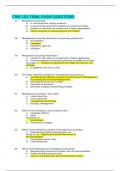
CRM 101 FINAL EXAM QUESTIONS
CRM 101 FINAL EXAM QUESTIONS 37. Managerial accounting a. is concerned with costing products. b. is governed by generally accepted accounting principles. c. pertains to the entity as a whole and is highly aggregated. d. places emphasis on special-purpose information. 38. Managerial accounting information is generally prepared for a. stockholders. b. managers. c. regulatory agencies. d. investors. 39. Managerial accounting information a. pertains to the entity as a whole and is highly aggregated. b. must be prepared according to generally accepted accounting principles. c. pertains to subunits of the entity and may be very detailed. d. is prepared only once a year. 40. The major reporting standard for management accounting is a. the Standards of Ethical Conduct for Practitioners of Management Accounting and Financial Management. b. the Sarbanes-Oxley Act of 2002. c. relevance to decisions. d. generally accepted accounting principles. 41. Managerial accounting is also called a. inside reporting. b. cost accounting. c. management accounting. d. strategic management. 42. Which of the following is not an internal user? a. Corporate officers b. Staff employees c. Stockholders d. Department manager 43. Which of the following is not part of managerial accounting? a. Determining whether planned goals are being met b. Reporting financial information to the shareholders c. Calculating product costs d. Controlling costs 44. Which of the following uses managerial accounting? a. Manufacturing and service entities, but not merchandising b. Profit-oriented businesses only c. Service, manufacturing, and merchandising entities d. Only manufacturing entities 45. Which one of the following tasks would not be performed by a management accountant? a. Being concerned with the impact of cost and volume on profits b. Strategic cost management c. Assisting in budget planning d. Preparing reports primarily for external users 46. How often are internal managerial reports communicated? a. As frequently as needed b. Annually c. During every audit by the company’s CA d. Monthly 47. Which description identifies financial statements that are prepared for external users? a. External reports b. Special-purpose c. User-specific d. General-purpose 48. Which term describes managerial accounting reports? a. GAAP reports b. Special-purpose c. General-purpose d. Regulatory reports 49. Which of the following statements about internal reports is true? a. Most internal reports are summarized rather than detailed. b. Internal reports focus on general purpose needs of users. c. The content of internal reports extends beyond the double-entry accounting system. d. Internal reports are often very general. 50. Which one of the following describes internal reports? a. They are often audited by CAs. b. They must be prepared according to GAAP. c. They are aggregated. d. They are detailed. 51. Which of the following reports would management find useful in decision making? a. Monthly reports on activities to the Board of Directors b. Quarterly reporting to the Toronto Stock Exchange c. Specific purpose statements on services delivered d. Audited financial information in the annual report to shareholders 52. How often should management receive or prepare reports on its internal process activities? a. On a fixed time basis b. As often as is necessary c. Never more than monthly d. Weekly 53. How often should management receive or prepare reports on its external business process activities? a. As they correspond to external financial reporting b. Never more than monthly c. According to the company’s business cycle d. As often as is necessary 54. A company must inform readers of its annual report of: a. All changes in financial accounting policies. b. Results of any overseas activities. c. All changes in internal accounting information. b. Changes to management’s bonus system. 55. How could management information assist in motivating its employees? a. Keeping track of quality improvements b. Showing the company’s percent of market share c. Showing statistics on plant safety d. All areas would benefit from providing internal management information 56. In establishing a good internal reporting system, a company should: a. Ensure that these reports agree to generally accepted accounting principles. b. Have the Board of Directors agree to the information provided. c. Establish clearly understood standards of performance. d. All of the above are valid reasons. 57. What broad functions do the management of an organization perform? a. Directing, manufacturing, and controlling b. Planning, directing, and controlling c. Planning, directing, and selling d. Planning, manufacturing and controlling 58. Which one of the following involves coordinating a company’s activities to produce a smooth- running operation? a. Auditing b. Controlling c. Planning d. Directing 59. Which one of the following does the planning function involve? a. Analyzing financial statements b. Setting goals and objectives for an entity c. Hiring the right people for a particular job d. Coordinating the accounting information system 60. Which one of the following is true concerning the managerial function of controlling? a. It includes performance evaluation by management. b. It is concerned mainly with operating a manufacturing segment. c. It is performed only by the controller of a company. d. It includes hiring and training employees. 61. Which of the following represents two management functions? a. Regulating and directing b. Controlling and directing c. Controlling and auditing d. Auditing and planning 62. Which management function is a manager performing when objectives are being established? a. Regulating b. Planning c. Motivating d. Directing 63. The organization chart of a company shows: a. the interrelationships of activities within a company. b. the delegation of authority within a company. c. the delegation of responsibility within a company. d. all of the above. 64. Which function is achieved when a manager is determining whether planned goals are being met? a. Controlling b. Motivating c. Planning d. Directing 65. What activities and responsibilities are not associated with management’s functions? a. Planning b. Accountability c. Controlling d. Directing 66. Directing includes a. providing a framework for management to have criteria to terminate employees when needed. b. running a department under quality control standards universally accepted. c. coordinating a company’s diverse activities and human resources to produce a smooth- running operation. d. developing a performance ranking system to give certain high performers good raises. 67. Which of the following is true? a. Managerial accountants are the employees who are principally responsible for ethical behaviour. b. Investment losses have been precipitated by lax ethical standards. c. Corporate fraud was found to have decreased between the years 1998 and 2003. d. Expense account abuse has been cited as one of the rarest forms of unethical employee behaviour. 68. Choose the incorrect answer. a. While generally not encouraged, lapses in ethical behaviour are irrelevant to a company’s operating income. b. Proper incentives need to be implemented to foster an ethical business environment. c. Manufacturing companies need to establish effective and realistic production goals for their processes. d. As a result of the Sarbanes-Oxley Act, companies now pay more attention to the composition of the board of directors. 69. Which is the best definition of fraud? a. Unknowingly misrepresenting the facts b. Using business supplies for personal use c. The intentional misstatement of facts d. Misappropriating funds for personal financial gain 70. Which of the following is true? a. Dissatisfied employees cite a decline in ethical behaviour is a result of a change in corporate culture. b. Unethical corporate behaviour occurs only in the United States because of its capitalistic environment. c. Unethical behaviour rarely causes a decline in investor confidence. d. Unethical actions are reasonable in an environment wherein unreasonable budgets and targets have been set. 71. The production manager at ABC Inc. is responsible for formulating the budget for his department. He will be evaluated on his ability to control costs. After considerable thought, he arrives at his best estimate of costs, and then adds a further 10% to the projections. Chances are he has inflated the cost projections because a. that is the way it has always been done. b. conservative accounting practise requires that he not under report expenses. c. by overestimating expenses, it will make it easier for him to come in under budget and receive a favourable evaluation. d. none of the above. 72. In Canada, which of the following professional accounting organizations play an important role in promoting high standards of ethics in the accounting profession? a. The Society of Management Accountants of Canada b. The Canadian Institute of Chartered Accountants c. The Certified General Accountants Association of Canada d. All of the above 73. The Ontario Securities Commission introduced regulations governing the composition and duties of audit committees, as well as their members’ behaviour. The new rules: a. are as robust as parallel rules required by the U.S. Sarbanes-Oxley Act. b. were adopted by all provincial and territorial securities regulators, except for British Columbia’s. c. were introduced in conjunction with the Canadian Securities Administrators. d. all of the above. 74. A company acting ethically must adapt its external reports to any changes required: a. Instantly. b. As it is appropriate for its business cycle. c. As stipulated by the CICA. d. If they are considered pertinent to its business activities. 75. A company acting ethically must adapt its internal reports to any changes required: a. Instantly. b. As it is appropriate for its business cycle. c. As stipulated by the CICA. d. If they are considered pertinent to its business activities. 76. Which one of the following managerial accounting approaches attempts to allocate manufacturing overhead in a more meaningful fashion? a. Theory of constraints b. Just-in-time inventory c. Activity-based costing d. Total-quality management 77. Which one of the following is not a main component of the value chain sequence? a. ERP b. Sales and marketing c. Production d. Customer relations 78. What is one primary benefit of an enterprise resource planning (ERP) system? a. It reduces inventory levels. b. It permits companies to be more streamlined in production. c. It replaces research and development in a company. d. It requires an increased emphasis on product quality. 79. One of the advantages of a just in time inventory system is that it reduces inventory quantities. Why is this considered to be a benefit? a. Carrying inventory incurs storage costs, hence reducing inventory quantities reduces costs. b. Carrying large inventory raises the risk that customers will want an item that you do not have. c. Carrying large inventory reduces the risk that customers will want an item that you do not have. d. None of the above. 80. What is “balanced” in the balanced scorecard approach? a. The number of products produced b. The emphasis on financial and non-financial performance measurements c. The amount of costs allocated to products d. The number of defects found on each product 81. For what purpose is the theory of constraints used? a. To reduce product defects b. To balance performance measurement c. To identify and manage constraints that bottle-neck operations d. To reduce inventory levels 82. In Canada the three different professional accounting designations are a. CPA, CA, CMA b. CMA, CGA, CPA c. CA, CMA, CGA d. MA, CPA, CA 83. Which of the following is not required to become a CMA? a. Completion of a university degree b. Candidates must pass an entrance exam into the CMA program c. Completion of a two-year strategic leadership program concurrently with gaining industry experience d. Completion of a national exit exam. 84. Choose the correct statement. a. CGA stands for Certified Generic Accountant. b. CMA stands for Certified Managing Accountant. c. CA stands for Chartered Accountant. d. CPA stands for Certified Professional Accountant.
Written for
- Institution
- CRM 101
- Course
- CRM 101
Document information
- Uploaded on
- December 6, 2023
- Number of pages
- 120
- Written in
- 2023/2024
- Type
- Exam (elaborations)
- Contains
- Questions & answers
Subjects
-
crm 101 final exam questions 37managerial accou