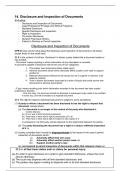
14. Disclosure and Inspection of Documents
Includes:
- Disclosure and Inspection of Documents;
- Legal Professional Privilege and Without Prejudice;
- Standard Disclosure;
- Specific Disclosure and Inspection;
- Right to Inspection;
- Pre-Action Disclosure;
- Norwich Pharmacal Orders;
- Failure to Disclose or Permit Inspection.
Disclosure and Inspection of Documents
CPR 31 lays out the rules about the disclosure and inspection of documents in all claims,
except those on the small track.
31.2 In the context of civil law, ‘disclosure’ is where a party states that a document exists or
has existed.
- ‘Document’ means anything in which information of any description is recorded.
A document capable of disclosure will fall into one of four categories:
1. The parties' own documents (those relied upon);
2. Adverse document (those which adversely affect a party’s own case or support
another’s);
3. Relevant documents (relevant to the issues but not in support or adverse, may
relate to context);
4. Train of inquiry documents (may lead to a train of inquiry that could source own
documents or adverse documents)
- ‘Copy’ means anything onto which information recorded in the document has been copied
(indirectly or directly).
- Only one copy of a document should be disclosed. A subsequent copy needs to be modified
in some way, and will be treated as a separate document.
31.3 The right to inspect a disclosed document is subject to some exceptions.
(1) A party to whom a document has been disclosed to has the right to inspect that
document, except where:
(a) The document is no longer in the control of the party who disclosed it;
- Control refers to:
(a) It is or was in their physical possession;
(b) They have or have had a right to possession of it; all
(c) They have or have had a right to inspect or take copies of it.
In possession of a third party entirely depends on the relationship between the parties.
(b) The party disclosing the document has a right or a duty to withhold inspection
of it; or
(2) A party considers that it would be disproportionate to the issues in the case to permit
inspection of documents which:
(i). Adversely affect their own case;
(ii). Adversely affect another party’s case; or
(iii). Support another party’s case.
are not required to permit inspection of documents within that category/ class but
they
31.5 In must state
all fast in their
track disclosure
claims and/ or statement
claims forthat inspection
personal of those documents
injury:
will not be permitted on the grounds to do so would be disproportionate.
(a) An order to give disclosure is in order to give standard disclosure, unless the court
directs otherwise;
(b) The court may dispense with all limit standard disclosure; and
(c) The parties may agree in writing to dispense with or to limit standard disclosure.
, Unless the courts directs otherwise, the following applies to all multi-track claims (except
personal injury):
(d) No less than 14 days before the first case management conference, each party must file
and serve a report verified by a statement of truth which:
(1) Describes briefly what documents exist or may exist, that are all may be relevant to the
matters in issue;
(2) Describe where and with whom those documents are or maybe located;
(3) In the case of electronic documents, describe how these documents are stored;
(4) Estimates of costs involved in giving standard disclosure; and
(5) States which (7) and (8) directions are sought.*
(5) No less than seven days before the first case management conference, and on any other
occasion the court might direct, the parties must discuss and seek to agree a proposal on the
scope of disclosure.
(6) If the parties agree proposals for the scope of disclosure and the court considers that
the proposals are appropriate, the court may approve them without a hearing and give
directions.
*(7) The orders the court can consider are:
(a) An order dispensing with disclosure;
(b) An order that a party disclose the documents on which it relies, and request any
specific disclosure it requires from any other party;
(c) An order that directs that disclosure be given by each party on an issue-by-issue
basis;
(d) An order that each party disclose any documents which it is reasonable to suppose
may contain information which enables that party to advance its own case or
damage the case of any other party, or which leads to winning enquiry that could lead to
the same effect;
(e) And order that a party give standard disclosure;**
(f) Any other order that the court considers appropriate.
*(8) at any point, the court may give directions as to how disclosure is to be given, in particular:
(i). What searches are to be undertaken, where, what, by whom, and the
extent of any search for electronically stored documents;
(ii). Whether lists of documents are required;
(iii). How and when the disclosure statement is to be given;
(iv). In what format the documents are to be disclosed;
(v). What is required where documents once existed but no longer exist; and
Legal
(vi).Professional Privilege
Whether disclosure and
should Without
take place in Prejudice
stages. (ADR 15)
Includes:
- Disclosure and Inspection of Documents;
- Legal Professional Privilege and Without Prejudice;
- Standard Disclosure;
- Specific Disclosure and Inspection;
- Right to Inspection;
- Pre-Action Disclosure;
- Norwich Pharmacal Orders;
- Failure to Disclose or Permit Inspection.
Disclosure and Inspection of Documents
CPR 31 lays out the rules about the disclosure and inspection of documents in all claims,
except those on the small track.
31.2 In the context of civil law, ‘disclosure’ is where a party states that a document exists or
has existed.
- ‘Document’ means anything in which information of any description is recorded.
A document capable of disclosure will fall into one of four categories:
1. The parties' own documents (those relied upon);
2. Adverse document (those which adversely affect a party’s own case or support
another’s);
3. Relevant documents (relevant to the issues but not in support or adverse, may
relate to context);
4. Train of inquiry documents (may lead to a train of inquiry that could source own
documents or adverse documents)
- ‘Copy’ means anything onto which information recorded in the document has been copied
(indirectly or directly).
- Only one copy of a document should be disclosed. A subsequent copy needs to be modified
in some way, and will be treated as a separate document.
31.3 The right to inspect a disclosed document is subject to some exceptions.
(1) A party to whom a document has been disclosed to has the right to inspect that
document, except where:
(a) The document is no longer in the control of the party who disclosed it;
- Control refers to:
(a) It is or was in their physical possession;
(b) They have or have had a right to possession of it; all
(c) They have or have had a right to inspect or take copies of it.
In possession of a third party entirely depends on the relationship between the parties.
(b) The party disclosing the document has a right or a duty to withhold inspection
of it; or
(2) A party considers that it would be disproportionate to the issues in the case to permit
inspection of documents which:
(i). Adversely affect their own case;
(ii). Adversely affect another party’s case; or
(iii). Support another party’s case.
are not required to permit inspection of documents within that category/ class but
they
31.5 In must state
all fast in their
track disclosure
claims and/ or statement
claims forthat inspection
personal of those documents
injury:
will not be permitted on the grounds to do so would be disproportionate.
(a) An order to give disclosure is in order to give standard disclosure, unless the court
directs otherwise;
(b) The court may dispense with all limit standard disclosure; and
(c) The parties may agree in writing to dispense with or to limit standard disclosure.
, Unless the courts directs otherwise, the following applies to all multi-track claims (except
personal injury):
(d) No less than 14 days before the first case management conference, each party must file
and serve a report verified by a statement of truth which:
(1) Describes briefly what documents exist or may exist, that are all may be relevant to the
matters in issue;
(2) Describe where and with whom those documents are or maybe located;
(3) In the case of electronic documents, describe how these documents are stored;
(4) Estimates of costs involved in giving standard disclosure; and
(5) States which (7) and (8) directions are sought.*
(5) No less than seven days before the first case management conference, and on any other
occasion the court might direct, the parties must discuss and seek to agree a proposal on the
scope of disclosure.
(6) If the parties agree proposals for the scope of disclosure and the court considers that
the proposals are appropriate, the court may approve them without a hearing and give
directions.
*(7) The orders the court can consider are:
(a) An order dispensing with disclosure;
(b) An order that a party disclose the documents on which it relies, and request any
specific disclosure it requires from any other party;
(c) An order that directs that disclosure be given by each party on an issue-by-issue
basis;
(d) An order that each party disclose any documents which it is reasonable to suppose
may contain information which enables that party to advance its own case or
damage the case of any other party, or which leads to winning enquiry that could lead to
the same effect;
(e) And order that a party give standard disclosure;**
(f) Any other order that the court considers appropriate.
*(8) at any point, the court may give directions as to how disclosure is to be given, in particular:
(i). What searches are to be undertaken, where, what, by whom, and the
extent of any search for electronically stored documents;
(ii). Whether lists of documents are required;
(iii). How and when the disclosure statement is to be given;
(iv). In what format the documents are to be disclosed;
(v). What is required where documents once existed but no longer exist; and
Legal
(vi).Professional Privilege
Whether disclosure and
should Without
take place in Prejudice
stages. (ADR 15)