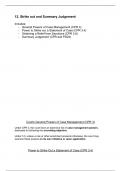
12. Strike out and Summary Judgement
Includes:
- General Powers of Case Management (CPR 3)
- Power to Strike our a Statement of Case (CPR 3.4)
- Obtaining a Relief from Sanctions (CPR 3.8)
- Summary Judgement (CPR and PD24)
Courts General Powers of Case Management (CPR 3)
Under CPR 3, the court have an extensive list of case management powers,
dedicated to furthering the overriding objective.
Under 3.3, unless a rule or other enactment presents otherwise, the court may
exercise these powers on its own initiative or upon application.
Power to Strike Out a Statement of Case (CPR 3.4)
, CPR 3.4 affords the court the power to strike out statements of case, under certain
circumstances.
- For the purposes of clarity ‘statement of case’ refers to a claim form, particulars of claim not
included in the claim form, defence, Pt 20 claim, or a reply to a defence .
‘Striking out’ is when the court orders written material to be deleted so that it may
no longer be relied upon this can be in part or whole.
3.4
(2) The court has the power to strike out a statement of case if it appears to the court*:
(a) The statement of case discloses is no reasonable grounds for bringing or
defending the claim;
- Statements must indicate no facts, or are incoherent, or do not disclose any legally
recognised argument, or are unwinnable (court is certain claim is bound to fail)
(b) That the statement of case is an abuse of the courts process or is otherwise
likely to obstruct the just disposal of the proceedings; or
(c) There has been a failure to comply with a rule, practice direction, or court
order.
(3) When the court strikes out a statement of case, it may make any consequential order
it considers appropriate.
(4) Where:
(a) the court has struck out a claimant statement of case;
(b) the claimant has been ordered to pay costs to the defendant; and
(c) before the claimant pays those costs, the claimant starts another claim
against the same defendant, arising out of facts which are the same or
substantially the same as those of the struck-out claim
The court may, on application of the defendant, stay the new claim until the costs of
the first claim have been paid.
(5) *(2) is not intended to limit any other power of the court to strike out a statement of case.
(6) if the court strikes out a claimant’s statement of case and it considers that the claim is
totally without merit:
(a) the court order must record that fact; and
(b) the court must, at the same time, consider whether it is appropriate to make a
civil restraint order.
Generally, an application for striking out a statement of case will be made during the pre-
trial stages of proceedings, often together with an application for summary judgement.
However, the court chooses when to exercise its power and can do so immediately before
trial or even during the course of trial, although the latter is very rare.
- Either way, applications under 3.4 should be made as soon as possible.
- If a strikeout application is made, the court cannot refuse it less it first hears oral arguments on behalf of
the applicant.
The most likely circumstance where a court would make a 3.4 order of its own initiative, is if
a filing of a claim form or defence appears to fall within to fall within (2) (a) and (b).
Includes:
- General Powers of Case Management (CPR 3)
- Power to Strike our a Statement of Case (CPR 3.4)
- Obtaining a Relief from Sanctions (CPR 3.8)
- Summary Judgement (CPR and PD24)
Courts General Powers of Case Management (CPR 3)
Under CPR 3, the court have an extensive list of case management powers,
dedicated to furthering the overriding objective.
Under 3.3, unless a rule or other enactment presents otherwise, the court may
exercise these powers on its own initiative or upon application.
Power to Strike Out a Statement of Case (CPR 3.4)
, CPR 3.4 affords the court the power to strike out statements of case, under certain
circumstances.
- For the purposes of clarity ‘statement of case’ refers to a claim form, particulars of claim not
included in the claim form, defence, Pt 20 claim, or a reply to a defence .
‘Striking out’ is when the court orders written material to be deleted so that it may
no longer be relied upon this can be in part or whole.
3.4
(2) The court has the power to strike out a statement of case if it appears to the court*:
(a) The statement of case discloses is no reasonable grounds for bringing or
defending the claim;
- Statements must indicate no facts, or are incoherent, or do not disclose any legally
recognised argument, or are unwinnable (court is certain claim is bound to fail)
(b) That the statement of case is an abuse of the courts process or is otherwise
likely to obstruct the just disposal of the proceedings; or
(c) There has been a failure to comply with a rule, practice direction, or court
order.
(3) When the court strikes out a statement of case, it may make any consequential order
it considers appropriate.
(4) Where:
(a) the court has struck out a claimant statement of case;
(b) the claimant has been ordered to pay costs to the defendant; and
(c) before the claimant pays those costs, the claimant starts another claim
against the same defendant, arising out of facts which are the same or
substantially the same as those of the struck-out claim
The court may, on application of the defendant, stay the new claim until the costs of
the first claim have been paid.
(5) *(2) is not intended to limit any other power of the court to strike out a statement of case.
(6) if the court strikes out a claimant’s statement of case and it considers that the claim is
totally without merit:
(a) the court order must record that fact; and
(b) the court must, at the same time, consider whether it is appropriate to make a
civil restraint order.
Generally, an application for striking out a statement of case will be made during the pre-
trial stages of proceedings, often together with an application for summary judgement.
However, the court chooses when to exercise its power and can do so immediately before
trial or even during the course of trial, although the latter is very rare.
- Either way, applications under 3.4 should be made as soon as possible.
- If a strikeout application is made, the court cannot refuse it less it first hears oral arguments on behalf of
the applicant.
The most likely circumstance where a court would make a 3.4 order of its own initiative, is if
a filing of a claim form or defence appears to fall within to fall within (2) (a) and (b).