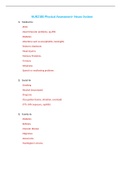
NFPT EXAM CONTENT OUTLINE WITH VERIFIED SOLUTIONS ALREADY GRADED A+.
Identify components of the following systems Muscular System: consists of skeletal muscles to produce force, perform movement, support posture and produce heat Skeletal System: provides body's structural support and protection Circulatory System: pumps blood to and from the body, sustained by the heart and lungs (composed of the cardiovascular and cardiorespiratory systems) Respiratory System: the organ system for breathing, it takes in, transports and removes gases to and from the blood for continued cellular function Nervous System: communicates all autonomic and voluntary messages to all body parts with the brain, spinal cord and nerves Digestive System: takes in, breaks down, transports, potentially transforms, and eliminates all food substances so that they can provide energy or substances for growth, maintenance or repair Immune System: protects the body from attacks by unwanted foreign invaders. Although it is one of the smallest systems in the body it is one of the most spread out and important systems Endocrine System: the system of glands that communicate and maintain homeostasis using specific hormone secretions into the bloodstream Integumentary System: protects the body, consists of fat, skin, hair and nails Reproductive System: system of sex organs that work together for reproduction Urinary System: also known as renal system, supports elimination of waste, regulation of blood volume/pressure/pH and controls levels of electrolytes and metabolites Identify types of joints Three (3) main classifications of joints, mobility and example: 1) Ligamentous: immoveable Example: between bones of the skull; between the tooth and socket of the mandible 2) Cartilaginous: slightly moveable Example: discs between spinal vertebrae; regions of immature long bones 3) Synovial: highly moveable Example: shoulder, elbow, knee Brainpower Read More Five (5) types of synovial joints: 1) Ball and Socket 3) Pivot (also known as hinge) 4) Gliding 5) Saddle 6) Condyloid The shoulder joint is an example of a Ball and Socket type of joint. The shoulder complex consists of the following join ts: 1) sternoclavicular (SC) joint 2) acromioclavicular (AC) joint 3) glenohumeral (GH) joint The knee joint is an example of a Pivot type of joint. List three (3) supportive structures of the knee an d their respective functions: Collateral Ligaments
Written for
Document information
- Uploaded on
- December 5, 2023
- Number of pages
- 6
- Written in
- 2023/2024
- Type
- Exam (elaborations)
- Contains
- Questions & answers
Subjects

Also available in package deal