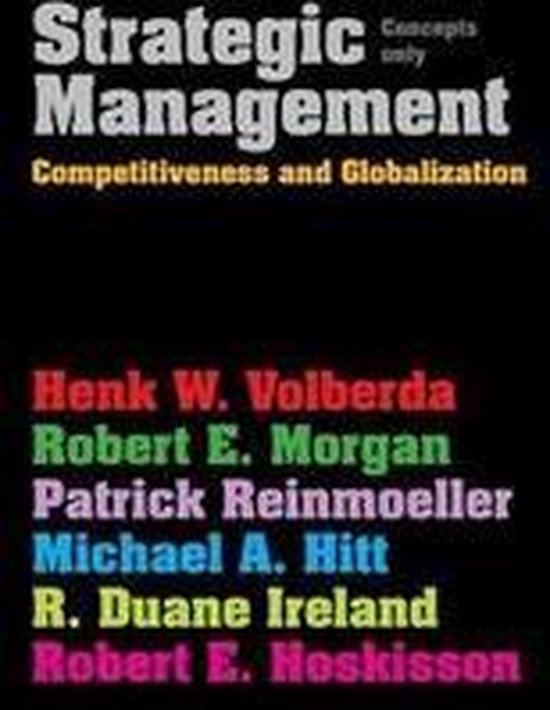
Table of contents
Chapter 1: Strategic management and strategic competitiveness.................................................................... 2
Chapter 2: Analyzing the external environment .............................................................................................. 4
Chapter 3: The internal organization ............................................................................................................... 7
Chapter 4: Integrating internal and external resources ................................................................................. 11
Chapter 5: Business-level strategy................................................................................................................. 14
Chapter 6: Competitive rivalry and competitive dynamics............................................................................. 18
Chapter 7: Corporate level strategy............................................................................................................... 20
Chapter 11: Strategic leadership ................................................................................................................... 22
Chapter 12: Corporate governance ............................................................................................................... 26
Chapter 13: Organizational structure and controls ........................................................................................ 31
Chapter 14: Strategic entrepreneurship ........................................................................................................ 36
Chapter 15: Strategic renewal ....................................................................................................................... 39
Summary readings ........................................................................................................................................ 47
,Chapter 1: Strategic management and strategic competitiveness
What is strategy?
- Strategy is a detailed plan for achieving success in situations such as war, politics,
industry, or support, or the skill of planning for such situations. (dictionary)
- Porter’s definition: “Strategy is the creation of unique and valuable position,
involving a different set of activities.”
- Book definition: “A strategy is an integrated and coordinated set of commitments,
(decisions), and actions designed to exploit and develop core competencies and gain
a competitive advantage.” A firm has a competitive advantage when it implements a
strategy competitors are unable to duplicate or find too costly to try to imitate it.
- Inputs to strategy could come from external or internal factors.
Operational effectiveness
Operational effectiveness is performing activities better, that is, faster, or with fewer inputs
and defects, than rivals. How?
- Outsourcing
- Reducing the number of defects
- Business process reengineering or change management
Strategic positioning
Strategic positioning attempts to achieve sustainable competitive advantage by preserving
what is distinctive about a company… by performing different activities from rivals,
or performing similar activities in different ways. (Porter, 1996)
Sources:
- Variety-based positioning: based on the choice of product or service varieties rather
than specific customer segments. (product-focused)
- Needs-based positioning: serving most or all needs of a particular group of
customers. (customer-need focuses)
- Access-based positioning: segmenting customers who are accessible in different
ways. (acces-focused)
è They are not mutually exclusive!
In today’s highly competitive and dynamic markets, strategic positioning is not enough itself
in the long term unless a unique combination of activities is created -> can be imitated!
• Trade-offs: activities are incompatible, more of one thing necessitates less of another,
they create the need for choice and purposefully limit what a company offers, they
emerge naturally.
• Strategy is choosing what not to do.
• Strategy is about combining activities.
• Activity fit is important because discrete activities often affect one another! Types of fit:
- First-order fit: simple consistency between each activity and the overall strategy.
- Second-order fit: occurs when activities are reinforcing.
- Third-order fit: goes beyond activity reinforcement to optimization of effort.
• Activities are reminders of the strategy and strategy without activities is just statement.
• The challenge of developing or reestablishing a clear strategy is often primarily an
organizational one and depends on leadership.
,Two underlying models
• I/O model: Analyze the external environment -> Find an attractive industry ->
Formulate a strategy to develop required assets and implement the strategy.
(Porter’s Five forces) Assumptions:
- Resources are mobile
- Rational decision-making
- Firm strategies are similar in nature
• Resource based view: Analyze the internal resources -> Find an attractive industry
that can be exploited by firm’s resources -> Formulate and implement strategy to
achieve above-average returns. (VRIN model) Assumptions:
- Heterogenous firm resources (not identical in whole industry)
- Immobile resources
- Rational decision-making
Definition: Above-average returns are in excess of what an investor expects to earn from
other investments with a similar amount of risk. Risk is an investor’s uncertainty about the
economic gains or losses that will result from a particular investment.
Stakeholders
The individuals and groups who can affect the firm’s vision and mission, are affected by the
strategic outcomes the firm achieves through its operations, and who have enforceable
claims on the firm’s performance.
• Capital Market Stakeholders: shareholders, major suppliers of capital
• Product Market Stakeholders: primary customers, suppliers, host communities
• Organizational Stakeholders: employees, managers, nonmanagers
Because a firm is dependent on the continuing support of stakeholders, they have
enforceable claims on the company’s performance. When earning above-average returns, a
firm has the resources it needs to at minimum simultaneously satisfy the interests of all
stakeholders. However, when earning only average returns, the firm must carefully manage
its stakeholders to retain their support. A firm earning below-average returns must minimize
the amount of support it loses from unsatisfied stakeholders.
Strategic Leaders
People located in different parts of the firm using the strategic management process to help
the firm reach its vision and mission. In the final analysis, CEOs are responsible for making
certain that their firms properly use the strategic management process. Grounding the
strategic management process in ethical intentions and behaviors increases its effectiveness.
The strategic leader’s work demands decision trade-offs, often among attractive
alternatives. It is important for all strategic leaders to:
- Work hard
- Thoroughly analyze situations facing the firms
- Be brutally and consistently honest
- Ask the right questions to the right people at the right time
Strategic leaders predict the potential outcomes of their strategic decisions. To do this, they
first calculate profit pools in their industry that are linked to value chain activities. Predicting
the potential outcomes of their strategic decisions reduces the likelihood of the firm
formulation and implementing ineffective strategies.
, Chapter 2: Analyzing the external environment
How can we identify opportunities and threats?
Components of the external environment analysis:
• Scanning: Identifying early signals of environmental changes and trends.
• Monitoring: Detecting meaning through ongoing observations of environmental
changes and trends.
• Forecasting: Developing projections of anticipated outcomes based on monitored
changes and trends.
• Assessing: Determining the timing and importance of environmental changes and
trends for firms’ strategies and their management.
To analyze macro environment -> General Environment Analysis (PESTLE)
The general environment is composed of dimensions in the broader society that influence an
industry and the firms within it. Identifying forces in the macro environment that are
(mostly) beyond a firm’s control.
• Political/legal factors: stability, taxation etc.
• Economic factors: growth rates, interest rates etc.
• Socio-cultural factors: workforce diversity, work/life etc.
• Technological factors: speed of change etc.
• Demographic factors: population, age, ethnic mix, income distribution etc.
• Global factors: political events, relevant new global markets etc.
• Environmental factors: pollution, resource depletion etc.
Chapter 1: Strategic management and strategic competitiveness.................................................................... 2
Chapter 2: Analyzing the external environment .............................................................................................. 4
Chapter 3: The internal organization ............................................................................................................... 7
Chapter 4: Integrating internal and external resources ................................................................................. 11
Chapter 5: Business-level strategy................................................................................................................. 14
Chapter 6: Competitive rivalry and competitive dynamics............................................................................. 18
Chapter 7: Corporate level strategy............................................................................................................... 20
Chapter 11: Strategic leadership ................................................................................................................... 22
Chapter 12: Corporate governance ............................................................................................................... 26
Chapter 13: Organizational structure and controls ........................................................................................ 31
Chapter 14: Strategic entrepreneurship ........................................................................................................ 36
Chapter 15: Strategic renewal ....................................................................................................................... 39
Summary readings ........................................................................................................................................ 47
,Chapter 1: Strategic management and strategic competitiveness
What is strategy?
- Strategy is a detailed plan for achieving success in situations such as war, politics,
industry, or support, or the skill of planning for such situations. (dictionary)
- Porter’s definition: “Strategy is the creation of unique and valuable position,
involving a different set of activities.”
- Book definition: “A strategy is an integrated and coordinated set of commitments,
(decisions), and actions designed to exploit and develop core competencies and gain
a competitive advantage.” A firm has a competitive advantage when it implements a
strategy competitors are unable to duplicate or find too costly to try to imitate it.
- Inputs to strategy could come from external or internal factors.
Operational effectiveness
Operational effectiveness is performing activities better, that is, faster, or with fewer inputs
and defects, than rivals. How?
- Outsourcing
- Reducing the number of defects
- Business process reengineering or change management
Strategic positioning
Strategic positioning attempts to achieve sustainable competitive advantage by preserving
what is distinctive about a company… by performing different activities from rivals,
or performing similar activities in different ways. (Porter, 1996)
Sources:
- Variety-based positioning: based on the choice of product or service varieties rather
than specific customer segments. (product-focused)
- Needs-based positioning: serving most or all needs of a particular group of
customers. (customer-need focuses)
- Access-based positioning: segmenting customers who are accessible in different
ways. (acces-focused)
è They are not mutually exclusive!
In today’s highly competitive and dynamic markets, strategic positioning is not enough itself
in the long term unless a unique combination of activities is created -> can be imitated!
• Trade-offs: activities are incompatible, more of one thing necessitates less of another,
they create the need for choice and purposefully limit what a company offers, they
emerge naturally.
• Strategy is choosing what not to do.
• Strategy is about combining activities.
• Activity fit is important because discrete activities often affect one another! Types of fit:
- First-order fit: simple consistency between each activity and the overall strategy.
- Second-order fit: occurs when activities are reinforcing.
- Third-order fit: goes beyond activity reinforcement to optimization of effort.
• Activities are reminders of the strategy and strategy without activities is just statement.
• The challenge of developing or reestablishing a clear strategy is often primarily an
organizational one and depends on leadership.
,Two underlying models
• I/O model: Analyze the external environment -> Find an attractive industry ->
Formulate a strategy to develop required assets and implement the strategy.
(Porter’s Five forces) Assumptions:
- Resources are mobile
- Rational decision-making
- Firm strategies are similar in nature
• Resource based view: Analyze the internal resources -> Find an attractive industry
that can be exploited by firm’s resources -> Formulate and implement strategy to
achieve above-average returns. (VRIN model) Assumptions:
- Heterogenous firm resources (not identical in whole industry)
- Immobile resources
- Rational decision-making
Definition: Above-average returns are in excess of what an investor expects to earn from
other investments with a similar amount of risk. Risk is an investor’s uncertainty about the
economic gains or losses that will result from a particular investment.
Stakeholders
The individuals and groups who can affect the firm’s vision and mission, are affected by the
strategic outcomes the firm achieves through its operations, and who have enforceable
claims on the firm’s performance.
• Capital Market Stakeholders: shareholders, major suppliers of capital
• Product Market Stakeholders: primary customers, suppliers, host communities
• Organizational Stakeholders: employees, managers, nonmanagers
Because a firm is dependent on the continuing support of stakeholders, they have
enforceable claims on the company’s performance. When earning above-average returns, a
firm has the resources it needs to at minimum simultaneously satisfy the interests of all
stakeholders. However, when earning only average returns, the firm must carefully manage
its stakeholders to retain their support. A firm earning below-average returns must minimize
the amount of support it loses from unsatisfied stakeholders.
Strategic Leaders
People located in different parts of the firm using the strategic management process to help
the firm reach its vision and mission. In the final analysis, CEOs are responsible for making
certain that their firms properly use the strategic management process. Grounding the
strategic management process in ethical intentions and behaviors increases its effectiveness.
The strategic leader’s work demands decision trade-offs, often among attractive
alternatives. It is important for all strategic leaders to:
- Work hard
- Thoroughly analyze situations facing the firms
- Be brutally and consistently honest
- Ask the right questions to the right people at the right time
Strategic leaders predict the potential outcomes of their strategic decisions. To do this, they
first calculate profit pools in their industry that are linked to value chain activities. Predicting
the potential outcomes of their strategic decisions reduces the likelihood of the firm
formulation and implementing ineffective strategies.
, Chapter 2: Analyzing the external environment
How can we identify opportunities and threats?
Components of the external environment analysis:
• Scanning: Identifying early signals of environmental changes and trends.
• Monitoring: Detecting meaning through ongoing observations of environmental
changes and trends.
• Forecasting: Developing projections of anticipated outcomes based on monitored
changes and trends.
• Assessing: Determining the timing and importance of environmental changes and
trends for firms’ strategies and their management.
To analyze macro environment -> General Environment Analysis (PESTLE)
The general environment is composed of dimensions in the broader society that influence an
industry and the firms within it. Identifying forces in the macro environment that are
(mostly) beyond a firm’s control.
• Political/legal factors: stability, taxation etc.
• Economic factors: growth rates, interest rates etc.
• Socio-cultural factors: workforce diversity, work/life etc.
• Technological factors: speed of change etc.
• Demographic factors: population, age, ethnic mix, income distribution etc.
• Global factors: political events, relevant new global markets etc.
• Environmental factors: pollution, resource depletion etc.