
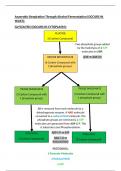
Anaerobic Respiration Through Alcohol Fermentation (OCCURS IN
YEAST):
GLYCOLYSIS (OCCURS IN CYTOPLASM):
GLUCOSE
(6 Carbon Compound)
Two phosphate groups added
by the hydrolysis of 2 ATP
molecules to ADP.
HEXOSE BIPHOSPHATE (ATP ADP +P)
(6 Carbon Compound with
2 phosphate groups).
TRIOSE PHOSPHATE TRIOSE PHOSPHATE
(3 Carbon Compound with (3 Carbon Compound with
1 phosphate group). 1 phosphate group).
2H is removed from each molecule by a
dehydrogenase enzyme. A NAD molecule
converted to a reduced NAD molecule. The
phosphate groups are removed & 2 ATP
molecules are generated from ADP & P. This
is Substrate Level Phosphorylation.
PYRUVATE ADP + P ATP
PYRUVATE
(3 Carbon Compound). NAD + H
(3 Carbon Compound).
Reduced NAD
Net Products:
2 Pyruvate Molecules
2 Reduced NAD
2 ATP
, PYRUVATE PYRUVATE
(3 Carbon Compound). (3 Carbon Compound).
Pyruvate decarboxylase removes a carbon
from pyruvate to form ethanal.
This then forms CO2.
ETHANAL ETHANAL
(2 Carbon Compound). (2 Carbon Compound).
Ethanol dehydrogenase catalyses ethanal
accepting 2H from reduced NAD (produced
during glycolysis).
The NAD returns to be used in glycolysis.
ETHANOL ETHANOL
(2 Carbon Compound). (2 Carbon Compound).
Yeast can survive without oxygen; however it will die when
ethanol concentration builds up to 15%.
This process has a net 2 ATP production (from the substrate
level phosphorylation that occurs in glycolysis).
YEAST):
GLYCOLYSIS (OCCURS IN CYTOPLASM):
GLUCOSE
(6 Carbon Compound)
Two phosphate groups added
by the hydrolysis of 2 ATP
molecules to ADP.
HEXOSE BIPHOSPHATE (ATP ADP +P)
(6 Carbon Compound with
2 phosphate groups).
TRIOSE PHOSPHATE TRIOSE PHOSPHATE
(3 Carbon Compound with (3 Carbon Compound with
1 phosphate group). 1 phosphate group).
2H is removed from each molecule by a
dehydrogenase enzyme. A NAD molecule
converted to a reduced NAD molecule. The
phosphate groups are removed & 2 ATP
molecules are generated from ADP & P. This
is Substrate Level Phosphorylation.
PYRUVATE ADP + P ATP
PYRUVATE
(3 Carbon Compound). NAD + H
(3 Carbon Compound).
Reduced NAD
Net Products:
2 Pyruvate Molecules
2 Reduced NAD
2 ATP
, PYRUVATE PYRUVATE
(3 Carbon Compound). (3 Carbon Compound).
Pyruvate decarboxylase removes a carbon
from pyruvate to form ethanal.
This then forms CO2.
ETHANAL ETHANAL
(2 Carbon Compound). (2 Carbon Compound).
Ethanol dehydrogenase catalyses ethanal
accepting 2H from reduced NAD (produced
during glycolysis).
The NAD returns to be used in glycolysis.
ETHANOL ETHANOL
(2 Carbon Compound). (2 Carbon Compound).
Yeast can survive without oxygen; however it will die when
ethanol concentration builds up to 15%.
This process has a net 2 ATP production (from the substrate
level phosphorylation that occurs in glycolysis).


