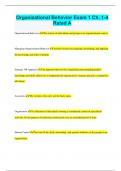
Organizational Behavior Exam 1 Ch. 1-4 Rated A
Organizational Behavior Exam 1 Ch. 1-4 Rated A Organizational Behavior The actions of individuals and groups in an organizational context. Managing Organizational Behavior Actions focused on acquiring, developing, and applying the knowledge and skills of people. Strategic OB Approach An approach that involves organizing and managing people's knowledge and skills effectively to implement the organization's strategy and gain a competitive advantage. Associates The workers who carry out the basic tasks. Organization A collection of individuals forming a coordinated system of specialized activities for the purpose of achieving certain goals over an extended period of time. Human Capital The sum of the skills, knowledge, and general attributes of the people in an organization. Competitive Advantage An advantage enjoyed by an organization that can perform some aspect of its work better than competitors can or in a way that competitors cannot duplicate, such that it offers products/services that are more valuable to customers. Human Capital Value The extent to which individuals are capable of producing work that supports an organization's strategy for competing in the marketplace. Human Capital Rareness The extent to which the skills and talents of an organization's people are unique in the industry. Human Capital Imitability The extent to which the skills and talents of an organization's people can be copied by other organizations. Positive Organizational Behavior An approach to managing people that nurtures each individual's greatest strengths and helps people use them to their and the organization's advantages. High-Involvement Management Involves carefully selecting and training associates and giving them significant decision making power, information, and incentive compensation. Diversity A characteristic of a group of people where differences exist on one or more relevant dimensions such as gender. Multicultural Organization An organization in which the organizational culture values differences. Plural Organization An organization that has a diverse workforce and takes steps to be inclusive and respectful of differences, but where diversity is tolerated rather than truly valued. Monolithic Organization An organization that is homogeneous. Prejudice Unfair negative attitudes we hold about people who belong to social or cultural groups other than our own. Discrimination Behavior that results in unequal treatment of individuals based on group membership. Modern Racism Subtle forms of discrimination that occur despite people knowing it is wrong to be prejudiced against other racial groups and despite believing they are not racist. Stereotype A generalized set of beliefs about the characteristics of a group of individuals. Social Identity A person's knowledge that he or she belongs to certain social groups, where belonging to those groups has emotional significance. Ascribed Status Status and power that is assigned by cultural norms and depends on group membership. Globalization The trend toward a unified global economy where national borders mean relatively little. Culture Shared values and taken-for-granted assumptions that govern acceptable behavior and thought patterns in a country and give a country much of its uniqueness. Formal Institutions The laws, regulations and economic policies that dictate the rules firms must follow to do business in that country. Virtual Electronic Teams Teams that rely heavily on electronically mediated communication rather than face-to-face meetings as the means to coordinate work. Swift Trust A phenomenon where trust develops rapidly based on positive, reciprocated task-related communications. Expatriate An individual who leaves his or her home country to live and work in a foreign land. Culture Shock A stress reaction involving difficulties coping with the requirements of life in a new country. Ethnocentrism The belief that one's culture is better than others. Glass Border The unseen but strong discriminatory barrier that blocks many women from opportunities for international assignments. High-Context Cultures A type of culture where individuals use contextual cues to understand people and their communications and where individuals value trust and personal relationships. Low-Context Cultures A type of culture where individuals rely on direct questioning to understand people and their communications and where individuals value efficiency and performance. Cultural Intelligence The ability to separate the aspects of behavior that are based in culture from those unique to the individual or all humans in general. Multi-domestic Strategy A strategy by which a firm tailors its products and services to the needs of each country or region in which it operates and gives a great deal of power to the managers and associates in those countries or regions. Global Strategy A strategy by which a firm provides standard products and services to all parts of the world while maintaining a strong degree of central control in the home country. Learning A process through which individuals change their relatively permanent behavior based on positive or negative experiences in a situations. Operant Conditioning Theory An explanation for consequence-based learning that assumes learning results from simple conditioning and that higher mental functioning is irrelevant. Social Cognitive Theory An explanation for consequence-based learning that acknowledges the higher mental functioning of human beings and the role such functioning can play in learning. Positive Reinforcement A reinforcement contingency in which a behavior is followed by a positive consequence, thereby increasing the likelihood that the behavior will be repeated in the same or similar situations. Negative Reinforcement A reinforcement contingency in which a behavior is followed by the withdrawal of a previously encountered negative consequence, thereby increasing the likelihood that the behavior will be repeated in the same or similar situations. Punishment A reinforcement contingency in which a behavior is followed by a negative consequence, thereby reducing the likelihood that the behavior will be repeated in the same or similar situations. Extinction A reinforcement contingency in which a behavior is followed by the absence of a previously encountered positive consequence, thereby reducing the likelihood that the behavior will be repeated in the same or similar situations. Continuous Reinforcement A reinforcement schedule in which a reward occurs after each instance of a behavior or set of behaviors. Intermittent Reinforcement A reinforcement schedule in which a reward does not occur after each instance of a behavior or set of behaviors. Self-Efficacy An individual's belief that he or she will be able to perform a specific task in a given situations. OB Mod A formal procedure focused on improvising task performance through positive reinforcement of desired behaviors and extinction of undesired behaviors. Simulation A representation of a real system that allows associates and managers to try various actions and receive feedback on the consequences of those actions. Perception A process that involves aspects of a person, task, or event and forming impressions based on selected inputs. Implicit Person Theories Personal theories about what personality traits and abilities occur together and how these attributes are manifested in behavior. Halo Effect A perception problem in which an individual assesses a person positively or negatively in all situations based on an existing general assessment of the person. Projecting A perception problem in which an individual assumes that others share his or her values and beliefs. Stereotyping A perception problem in which an individual bases perceptions about members of a group on a generalized set of beliefs about the characteristics of a group of individuals. Fundamental Attribution Error A perception problem in which an individual is too likely to attribute the behavior of others to internal rather than external causes. Self-Serving Bias A perception problem in which an individual is too likely to attribute the failure of others to internal causes and t he successes of others to external causes, whereas the same individual will be too likely to attribute his own failure to external causes and his own successes to internal causes.
Written for
- Institution
- Organizational Behavior
- Course
- Organizational Behavior
Document information
- Uploaded on
- December 4, 2023
- Number of pages
- 10
- Written in
- 2023/2024
- Type
- Exam (elaborations)
- Contains
- Questions & answers
Subjects
-
organizational behavior exam 1 ch 1 4 rated a

Also available in package deal