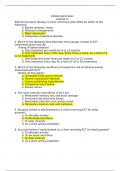
MENTAL HEALTH EXAM CHAPTER 19 2023/2024
MENTAL HEALTH EXAM CHAPTER 19 Electroconvulsive therapy is most commonly prescribed for which of the following? a. Bipolar disorder, manic b. Paranoid schizophrenia c. Major depression d. Obsessive-compulsive disorder 2. Which of the following best describes the average number of ECT treatments given and the timing of administration? a. One treatment per month for 6 to 12 months b. One treatment every other day, three times a week, for a total of 6 to 12 treatments c. One treatment three times per week for 6 to 12 months d. One treatment every day for a total of 10 to 20 treatments 3. Which of the following conditions increases the risk of adverse events associated with ECT? (Select all that apply.) a. Increased intracranial pressure b. Recent myocardial infarction c. Severe underlying hypertension d. Congestive heart failure e. Breast cancer 4. The most common side effects of ECT are: a. Permanent memory loss and brain damage. b. Fractured and dislocated bones. c. Myocardial infarction and cardiac arrest. d. Temporary memory loss and confusion. 5. Atropine sulfate is administered to a client receiving ECT for what purpose? a. To alleviate anxiety b. To decrease secretions c. To relax muscles d. As a short-acting anesthetic 6. Succinylcholine is administered to a client receiving ECT for what purpose? a. To alleviate anxiety b. To decrease secretions c. To relax muscles d. As a short-acting anesthetic 7. A client has been ordered ECT and asks the nurse, "Exactly how does ECT work?" Which of the following is the most accurate response by the nurse? a. "I'm not allowed to tell you that because that would be informed consent." b. "The exact mechanism is unknown, but there are several ways that ECT may have antidepressant effects C. "The administration of a shock to the brain induces memory loss, which will make you forget you are depressed." d. "The neuroplasticity affected by seizure activity prevents further brain damage. 8. A client with major depression, who has not responded to antidepressant medication, has been referred for a course of ECT treatments. The client says to the nurse on admission, "I don't want to end up like McMurphy in One Flew Over the Cuckoo's Nest I'm scared!" What is Sam's priority nursing diagnosis at this time? a. Anxiety related to deficient knowledge about ECT b. Risk for injury related to risks associated with ECT c. Deficient knowledge related to negative media presentation of ECT d. Acute confusion related to side effects of ECT 9. A client, who has been hospitalized for ECT treatments, says to the nurse on admission, "I don't want to end up like McMurphy in One Flew Over the Cuckoo's Nest. I'm scared!" Which of the following statements would be most appropriate by the nurse in response to Sam's expression of concern? a. "I guarantee you won't end up like Mc Murphy, Sam." b. The doctor knows what he is doing. There's nothing to worry about." c. "I know you are scared, Sam, and we're going to talk about what you can expect from the therapy." d. "I'm going to stay with you as long as you are scared." 10. What is the priority nursing intervention before starting ECT therapy? a. Take vital signs and record. b. Have the patient void. c. Administer succinylcholine. d. Ensure that the consent form has been signed. CHAPTER 22 1. An example of a treatable (reversible) form of NCD is one that is caused by which of the following? (Select all that apply.) a. Multiple sclerosis b. Huntington's disease c. Electrolyte imbalance d. HIV disease e. Folate deficiency 2. A client has been diagnosed with NCD due to Alzheimer's disease. The cause of this disorder is which of the following? a. Multiple small brain infarcts b. Chronic alcohol abuse c. Cerebral abscess d. Unknown 3. Which of the following medications h
Written for
- Institution
- MENTAL HEALTH
- Course
- MENTAL HEALTH
Document information
- Uploaded on
- December 2, 2023
- Number of pages
- 14
- Written in
- 2023/2024
- Type
- Exam (elaborations)
- Contains
- Questions & answers
Subjects
-
mental health exam chapter
-
mental health exam chapter 19

Also available in package deal