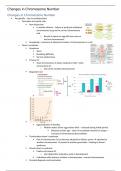
Changes in Chromosome Number
Changes in Chromosome Number
Aneuploidy – due to nondisjunction
o Formation of somatic cells
Non-disjunction
In meiotic division – failure of particular individual
chromosomes to go to the correct chromosome
end
o Results in sperm or egg with too many or
too few chromosomes
Aneuploidy = presence of abnormal number of chromosomes in a cell
o Down’s syndrome
Symptoms
Short
Breathing difficulty
Narrow slanted eyes
Trisomy 21
Stain chromosomes in down syndrome child = extra
chromosome 21
o One of the smallest chromosomes
Diagnostic test
Egg production in females
o Mother makes all her eggs before birth – released during fertile period
Released at later age – been in incomplete meiosis for longer =
increase in chromosomal abnormalities
Translocation down’s syndrome
Part of chromosome 21 has become attached to fathers sperm attached to
another chromosomes passed to another generation = leading to down’s
syndrome
Mosaic down’s syndrome
Patches of trisomy-21
o Non-disjunction took place early in development
Individuals with mixtures of down’s chromosomes + normal chromosomes
Prenatal diagnosis and termination
, Changes in Chromosome Number
Sex chromosomes – x chromosome inactivation
o Klinefelter syndrome XXY
Diploid sperm x haploid egg = XXY individual
Diploid sperm – XY
Haploid egg – X
o Turner syndrome XO
O x X = XO individual
Egg developed without a Y chromosome – O
Haploid sperm – X
o Edwards syndrome
Trisomy 18 – small chromosome
o Drosophila gynandromorph
Non-disjunction in body cells
Left side of animal is male – right side is female
o
o Sex determination in bees – haplodiploidy
Changes in Chromosome Number
Aneuploidy – due to nondisjunction
o Formation of somatic cells
Non-disjunction
In meiotic division – failure of particular individual
chromosomes to go to the correct chromosome
end
o Results in sperm or egg with too many or
too few chromosomes
Aneuploidy = presence of abnormal number of chromosomes in a cell
o Down’s syndrome
Symptoms
Short
Breathing difficulty
Narrow slanted eyes
Trisomy 21
Stain chromosomes in down syndrome child = extra
chromosome 21
o One of the smallest chromosomes
Diagnostic test
Egg production in females
o Mother makes all her eggs before birth – released during fertile period
Released at later age – been in incomplete meiosis for longer =
increase in chromosomal abnormalities
Translocation down’s syndrome
Part of chromosome 21 has become attached to fathers sperm attached to
another chromosomes passed to another generation = leading to down’s
syndrome
Mosaic down’s syndrome
Patches of trisomy-21
o Non-disjunction took place early in development
Individuals with mixtures of down’s chromosomes + normal chromosomes
Prenatal diagnosis and termination
, Changes in Chromosome Number
Sex chromosomes – x chromosome inactivation
o Klinefelter syndrome XXY
Diploid sperm x haploid egg = XXY individual
Diploid sperm – XY
Haploid egg – X
o Turner syndrome XO
O x X = XO individual
Egg developed without a Y chromosome – O
Haploid sperm – X
o Edwards syndrome
Trisomy 18 – small chromosome
o Drosophila gynandromorph
Non-disjunction in body cells
Left side of animal is male – right side is female
o
o Sex determination in bees – haplodiploidy