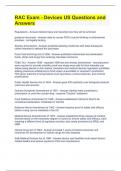
RAC Exam - Devices US Questions and
Answers
Regulations - Answer-interpret laws and describe how they will be enforced
guidance document - Answer-used to convey FDA's current thinking or enforcement
priorities - not legally binding
Sherley Amendment - Answer-prohibited labeling medicines with false therapeutic
claims intended to defraud the purchaser
Pure Food and Drug Act of 1906 - Answer-prohibited misbranded and adulterated
foods, drinks and drugs from entering interstate commerce
FD&C Act - Answer-1938 - repealed 1906 law and sherley amendment - manufacturers
were required to provide scientific proof new drugs were safe for their intended use
before being placed on the market; cosmetics and medical devices regulated; prohibited
adding poisonous substances to food unless unavoidable or required in production;
FDA given authority to bring federal court injunctions, product seizures, and criminal
prosecutions
Public Health Service Act of 1944 - Answer-gave FDA authority over biological products
(vaccines and serums)
Durham-Humphrey Amendment of 1951 - Answer-clarified what constituted a
prescription vs over the counter drug - required "Caution" statement
Food Additives Amendment of 1958 - Answer-established criteria for food to be
considered adulterated, mislabeled or harmful
Kefauver-Harris Amendment of 1962 - Answer-requires proof of safety and efficacy
before a drug can be marketed in the US
Medical Device Amendments of 1976 - Answer-established three classes of medical
devices based on the necessary degree of control to ensure safety and efficacy, each
requiring a different level of regulatory scrutiny; also made provisions for ER&L and
GMP
Orphan Drug Act of 1983 - Answer-provided 7 years of market exclusivity and
incentives for development of orphan drugs for rare diseases
Safe Medical Devices Act of 1990 - Answer-device user facilities must report device-
related deaths and serious injuries to FDA and manufacturer
Answers
Regulations - Answer-interpret laws and describe how they will be enforced
guidance document - Answer-used to convey FDA's current thinking or enforcement
priorities - not legally binding
Sherley Amendment - Answer-prohibited labeling medicines with false therapeutic
claims intended to defraud the purchaser
Pure Food and Drug Act of 1906 - Answer-prohibited misbranded and adulterated
foods, drinks and drugs from entering interstate commerce
FD&C Act - Answer-1938 - repealed 1906 law and sherley amendment - manufacturers
were required to provide scientific proof new drugs were safe for their intended use
before being placed on the market; cosmetics and medical devices regulated; prohibited
adding poisonous substances to food unless unavoidable or required in production;
FDA given authority to bring federal court injunctions, product seizures, and criminal
prosecutions
Public Health Service Act of 1944 - Answer-gave FDA authority over biological products
(vaccines and serums)
Durham-Humphrey Amendment of 1951 - Answer-clarified what constituted a
prescription vs over the counter drug - required "Caution" statement
Food Additives Amendment of 1958 - Answer-established criteria for food to be
considered adulterated, mislabeled or harmful
Kefauver-Harris Amendment of 1962 - Answer-requires proof of safety and efficacy
before a drug can be marketed in the US
Medical Device Amendments of 1976 - Answer-established three classes of medical
devices based on the necessary degree of control to ensure safety and efficacy, each
requiring a different level of regulatory scrutiny; also made provisions for ER&L and
GMP
Orphan Drug Act of 1983 - Answer-provided 7 years of market exclusivity and
incentives for development of orphan drugs for rare diseases
Safe Medical Devices Act of 1990 - Answer-device user facilities must report device-
related deaths and serious injuries to FDA and manufacturer