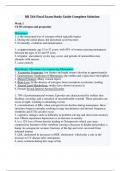
NR 566 Final Exam Study Guide Complete Solution
Week 1 Ch 50 estrogen and progestins Menopause 1. is the associated loss of estrogen which typically begins 2. During the initial phase, the menstrual cycle becomes 3. Eventually, ovulation and menstruation 1. at approximately age 51 to 52 years, with 95% of women entering menopause between the ages of 45 and 55 years. 2. irregular, anovulatory cycles may occur, and periods of amenorrhea may alternate with menses 3. cease entirely Physiologic Alterations Accompanying Menopause 1. Vasomotor Symptoms; hot flashes and night sweats) develop in approximately 2. Genitourinary Syndrome of Menopause; the urethra and vagina have the highest 3. Mental Changes; Many women report 4. Bone Loss; In the absence of estrogen, bone resorption accelerates, leading 5. Altered Lipid Metabolism; studies have shown increases in 6. Female Sexual Interest-Arousal Disorder 1. 70% of postmenopausal women. Episodes are characterized by sudden skin flushing, sweating, and a sensation of uncomfortable warmth. These episodes can occur at night, resulting in drenching sweats 2. concentrations of ERs; when estrogen levels decline during menopause, these structures begin to atrophy resulting in urge incontinence and urinary frequency; Urethritis and UTIs can also occur 3. cognitive changes such as difficulty in problem solving and short-term memory loss. Others experience depression or an increase in anxiety 4. to a 12% loss of bone density leading to Osteoporosis which can cause compression fractures of the vertebrae causing a decrease in height and produce a hump. In osteoporotic women, fractures of the hip and wrist can result from minimal trauma 5. LDL cholesterol & decreases in HDL cholesterol. which play a role in the increase in CV disease after menopause. 6. more common during this stage of lifeEstrogen Therapeutic Uses: 1. Menopausal hormone therapy- When estrogen is used for this purpose, 2. Female hypogonadism-In the absence of ovarian estrogens, 3. Acne-Estrogens, in the form of 4. Cancer palliation-sometimes used for palliative therapy 5. Gender-affirmation therapy-for 1. it is usually accompanied by the use of progestins 2. pubertal transformation will not take place. (variety of causes see pg 428) This treatment promotes breast development, maturation of the reproductive organs, and pubic and axillary hair. This tx regimen consists of continuous low-dose therapy (for approx a year) followed by cyclic administration of estrogen in higher doses 3. oral contraceptives, can help control acne. Tx is limited to patients at least 14-15 years old who want contraception 4. in management of advanced prostate CA in men and in a select type of metastatic breast CA in men& women 5. transgender women; not approved by the FDA) but prescribed off-label Forms of Estrogen 1. Estrogen is available in conjugated and esterified forms. Esterified estrogens 2. Until mid-2016, synthetic conjugated estrogens A (Cenestin) and B (Enjuvia) were available; however, 3. Phytoestrogens (plant-based compounds)-commonly used by women as a 4. Phytoestrogens are not as potent as estradiol, but they carry some of the same risks. 5. Selective estrogen receptor modulators (SERMs) are drugs that activate ERs in some tissues and block them in others. These drugs were developed in an effort 1. are plant based; conjugated estrogens are natural preparations derived from the urine of pregnant horses. 2. the manufacturer has withdrawn them from the market 3. "natural" way to manage symptoms associated with menopause 4. Women should not use phytoestrogens if they have a history of thromboembolic events or a personal or family history of breast, uterine, or ovarian cancer. 5. to provide the benefits of estrogen (e.g., protection against osteoporosis, maintenance of the urogenital tract, reduction of LDL cholesterol) while avoiding its drawbacks (e.g., promotion of breast cancer, uterine cancer, and thromboembolism) Estrogen-Adverse Effects 1. principal concerns with estrogen therapy are the potential for2. endometrial hyperplasia and endometrial cancer can be resolved 3. Estrogens have been associated with what common SE 4. menopause may produce or uncover 5. Nausea is the most 6. (blank) a patchy brown facial discoloration, though not dangerous, may cause significant distress 1. endometrial hyperplasia, endometrial cancer, breast cancer, and cardiovascular thromboembolic events 2. by prescribing a progestin 3. Fluid retention with edema, gallbladder disease, jaundice, and headache; especially migraine headache 4. gallbladder disease. Jaundice may develop in women with preexisting liver dysfunction, especially those who experienced cholestatic jaundice of pregnancy 5. frequent undesired response to the estrogens 6. Chloasma, Contraindications of Estrogen 1. Estrogens should not be taken by patients with a history of 2. They should not be prescribed to women who 3. Patients with a hx of 1. DVT, pulmonary embolus, or conditions such as stroke or MI that occurred secondary to a thromboembolic event. 2. are pregnant or who have vaginal bleeding without a known cause. 3. liver disease, estrogen-dependent tumors, or breast cancer (except when indicated for management) also should not take estrogens. Estrogen-Interactions 1. Estrogens are major substrates of 2. In addition, they may decrease the effectiveness of some 3. Estrogens can also interact with 1. CYP1A2 and CYP3A4; inducers/inhibitors of these isoenzymes may raise/lower estrogen levels 2. antidiabetic drugs and thyroid preparations. 3. anticoagulants and other drugs that affect clotting. Local vs. systemic estrogen options and why one would be chosen over the other 1. Oral-Owing to convenience, the oral route is used 2. Transdermal estradiol is available in four formulations: 3. Compared with oral formulations, transdermal formulations have four advantages:4. Intravaginal options come as inserts, creams, and vaginal rings & 5. The other vaginal ring (Femring) is used for systemic effects to 6. Parenteral; is used only for emergencies d/t 1. more than any other. estradiol—is available alone and in combination with progestin 2. Emulsion (Estrasorb), Spray, Gels & Patches 3a. The total dose of estrogen is greatly reduced 3b. There is less nausea and vomiting. 3c. Blood levels of estrogen fluctuate less. 3d. There is a lower risk for DVT, pulmonary embolism, and stroke. 4. are used only for local effects, primarily treatment of vulval and vaginal atrophy associated with menopause. 5. control of hot flashes and night sweats as well as local effects-Tx of vulval and vaginal atrophy 6. acute, emergency control of heavy uterine bleeding Clinical Practice Guidelines for menopause Not all women who experience distressing symptoms of menopause should be treated with oral estrogen or combination estrogen/progestin therapy. Key points include: 1. intravaginal preparations are most useful for treating sx associated 2. transdermal estrogen preparations have fewer adverse effects, use lower doses of estrogen, and have 3. progesterone is contraindicated in women who have undergone a 1. with local estrogen deficiency such as vaginal and vulvar atrophy; these preparations are assoc with a lower risk of systemic effects 2. less fluctuation of estrogen levels than do oral preparations 3. hysterectomy but required in women with an intact uterus who undergone hormone replacement therapy Summary of Key Prescribing Considerations -Estrogens 1. Therapeutic Goal: Management of symptoms and structural changes associated 2. Baseline Data: Heart rate, blood pressure, weight. Pregnancy test, thyroidstimulating hormone (TSH), & 3. Monitoring: Blood pressure, weight. Serum triglycerides, TSH if thyroid replacement required, & 4. Identifying High-Risk Patients: Estrogen therapy should not be prescribed for patients with:5. Evaluating Therapeutic Effects: Therapeutic effects depend on the reason prescribed. 1. with decreased endogenous estrogen. (Other uses include palliation of metastatic breast cancer in selected cases.) 2. serum triglyceride (or full lipid panel). Screening for breast CA and CV disease. Gynecologic exam, if indicated. 3. Regular breast and pelvic exams as recommended for age. Schedule endometrial biopsy for unscheduled bleeding that continues for 6 months. 4. Abnormal vaginal bleeding of unknown cause • Estrogen-dependent cancer or breast cancer (except when used as treatment for certain metastatic cancers) • History of DVT or pulmonary embolism • Stroke, MI, or other arterial thromboembolism occurring within the past year • Abnormal liver function or disease • Pregnancy 5. For menopausal HT, patients report relief of symptoms and the vagina is pink and moist on gynecologic exam. 6. Minimizing Adverse Effects of Estrogen: • Nausea is common early in treatment. Advise patients that this adverse effect 6. diminishes with time. In the meantime, avoidance of cooking odors and warm, stuffy environments may help. Dry foods and raw fruits and vegetables help as well as Guided imagery with muscle relaxation, yoga, and music therapy • Menopausal HT with estrogen alone increases the risk for endometrial carcinoma. Adding a progestin lowers this risk to the pretreatment level. • Adverse effects similar to those caused by OCs (abnormal vaginal bleeding, hypertension, benign hepatic adenoma, reduced glucose tolerance)
Written for
- Institution
-
Chamberlain College Of Nursing
- Course
- Unknown
Document information
- Uploaded on
- November 27, 2023
- Number of pages
- 89
- Written in
- 2023/2024
- Type
- Exam (elaborations)
- Contains
- Questions & answers
Subjects
- nr 566
- nr 566 final exam
-
nr 566 final exam study guide complete solution

Also available in package deal