Hepatic Dysfunction NCLEX Style Questions with complete solutions 2023.
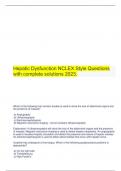
Hepatic Dysfunction NCLEX Style Questions with complete solutions 2023. Which of the following liver function studies is used to show the size of abdominal organs and the presence of masses? a) Angiography b) Ultrasonography c) Electroencephalogram d) Magnetic resonance imaging - correct answers.Ultrasonography Explanation: A ultrasonography will show the size of the abdominal organs and the presence of masses. Magnetic resonance imaging is used to detect hepatic neoplasms. An angiography is used to visualize hepatic circulation and detect the presence and nature of hepatic masses. An electroencephalogram is used to detect abnormalities that occur with hepatic coma. A patient has undergone a liver biopsy. Which of the following postprocedure positions is appropriate? a) On the right side b) Trendelenburg c) High Fowler's d) On the left side - correct answers.On the right side Explanation: In this position, the liver capsule at the site of penetration is compressed against the chest wall, and the escape of blood or bile through the perforation made for the biopsy is impeded. Positioning the patient on his left side is not indicated. Positioning the patient in the Trendelenburg position may be indicated if the patient is in shock, but is not the position designed for the patient after liver biopsy. High Fowler's position is not indicated for the patient after liver biopsy. Which type of jaundice seen in adults is the result of increased destruction of red blood cells? a) Hepatocellular b) Nonobstructive c) Obstructive d) Hemolytic - correct answers.Hemolytic Explanation: Hemolytic jaundice results because, although the liver is functioning normally, it cannot excrete the bilirubin as quickly as it is formed. Obstructive jaundice is the result of liver disease. Nonobstructive jaundice occurs with hepatitis. Hepatocellular jaundice is the result of liver disease. A client is admitted for suspected GI disease. Assessment data reveal muscle wasting, a decrease in chest and axillary hair, and increased bleeding tendency. The nurse suspects the client has: a) appendicitis. b) peptic ulcer disease. c) cholelithiasis. d) cirrhosis. - correct osis. Explanation: Muscle wasting, a decrease in chest and axillary hair, and increased bleeding tendencies are all symptoms of cirrhosis. The client may also have mild fever, edema, abdominal pain, and an enlarged liver. Clients with peptic ulcer disease complain of a dull, gnawing epigastric pa
Written for
- Institution
- Hepatic Dysfunction NCLEX
- Course
- Hepatic Dysfunction NCLEX
Document information
- Uploaded on
- November 26, 2023
- Number of pages
- 43
- Written in
- 2023/2024
- Type
- Exam (elaborations)
- Contains
- Questions & answers
Subjects
-
hepatic dysfunction nclex style questions with com

Also available in package deal