AFOQT Real Exam Test Q&A
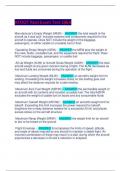
AFOQT Real Exam Test Q&A Manufacturer's Empty Weight (MEW) - ANSWER the total weight of the aircraft as it was built. Includes systems and components required for the aircraft to operate. Does NOT include the weight of the baggage, passengers, or either usable or unusable fuel or fluid. Operating Empty Weight (OEW) - ANSWER the MEW plus the weight of the crew, fluids, unusable fuel, and the equipment required for flight. Does NOT include baggage, passengers, or usable fuel. All-Up Weight (AUW) or Aircraft Gross Weight (AGW) - ANSWER the total aircraft weight at any given moment during a flight. The AUW decreases as fuel and fluids are consumed during the operation of the flight. Maximum Landing Weight (MLW) - ANSWER an aircraft's weight limit for landing. Exceeding this weight increases stress on the landing gear and may affect the distance required for a safe landing Maximum Zero Fuel Weight (MZFW) - ANSWER the permissible weight of an aircraft with its contents and includes unusable fuel. The total MZFW excludes the weight of usable fuel on board and any consumable fluids Maximum Takeoff Weight (MTOW) - ANSWER an aircraft's weight limit for takeoff. Exceeding this limit increases the power required for takeoff, lengthens the runway distance needed for a successful lift off, and places excess stress on the aircraft structure Maximum Ramp Weight (MRW) - ANSWER the weight limit for an aircraft to taxi or be towed on the ground Flight Envelope - ANSWER Encompasses the limits of speed, altitude, and angle of attack required by any aircraft to maintain a stable flight. An incorrect combination of these may result in a stall, during which the aircraft experiences a decrease in lift and a reduction in airspeed Angle of Attack (AOA) - ANSWER the angle measured between the direction of airflow against the wing and the chord (an imaginary reference line the extends from the leading edge to the trailing edge of the wing Ailerons - ANSWER Located on from the midpoint of the trailing edge of the wing to the wing's tip. Help with roll control Flaps - ANSWER located on the trailing edge of the wing; increase wing's surface area and deflect the air flow downward. Allow planes to lift at slower speeds. Spoilers - ANSWER Located directly forward of the trailing edge flaps to assist the ailerons in roll control and to act as speed brakes for descent and landing. Extend upward to help reduce airspeed (ex: raised when landing to help assist brakes in slowing airplane down) Drag - ANSWER air resistance experienced during flight Parasite Drag - ANSWER any "parasite" on the structure of the aircraft: low air pressure in the tires, skin friction (any rough spot on the skin of the aircraft structure) This, along with any rivet heads that may project above the skin, causes resistance to the air current flowing across the wing. Profile Drag - ANSWER Produced mainly by the shape of the aircraft. A smaller slimmer aircraft reduces profile drag. Induced Drag - ANSWER When, at the back of the wing, air flowing rapidly across the top meets air flowing more slowly underneath, creating a vortex. This type of drag depends on the performance of the aircraft. When lift, airspeed, and AOA increase, induced drag automatically increases too. When an airplane increases its lift, which statement is true about the air pressure flowing above and below its wings? - ANSWER Air pressure is lower above the wings and higher below the wings, producing lift. Bernoulli's Principle - ANSWER As the speed of a fluid increases, its pressure decreases. Air flows faster over the top of the wing leading to lower pressure. Air flows slower on the bottom of the wing, increasing pressure. Upward push creates lift! Longitudinal Axis (Roll) - ANSWER runs lengthwise from the nose to the tail Lateral Axis (Pitch) - ANSWER runs wingtip to wingtip Vertical Axis (Yaw) - ANSWER Runs perpendicular to the wings at the center of the aircraft Trim - ANSWER Aircraft's desired position. Roll - ANSWER along the aircraft's longitudinal axis; controlled by ailerons, located at trailing edge of the wings. Pitch - ANSWER the lateral angle of ascent or descent; controlled by elevators, located in the rear portion of the horizontal tail assebly Yaw - ANSWER Controlled by the rudder, located in the rear part of the tail assembly; movement of the rudder causes the nose to move from side to side. Pressure Altimeter - ANSWER in the cockpit based on atmospheric pressure. Calibrated automatically for 29.92 of mercury (Hg). Pilot resets the pressure altitudeindicator after departing an airfieldto ensure the correct pressure altitude of the aircraft is displayed for the destinatin airfield Aircraft perform more efficiently in what weather? - ANSWER Colder wether because the air is denser than warm air. (Except if air drops too low and de-icing is necessary) [high air density increases engine performance] Fuselage - ANSWER the main body of an aircraft that holds the crew, passengers, and cargo. Wings, tail, engines, and landing gear attach to the fuselage, so it must be extremely strong to withstand stresses while minimizing weight. Also helps stabilize plane in flight Truss Struture - ANSWER Consists of welded steel-tubing longerons separated by diagonal members to endure the loads placed upon the aircraft Monocoque Structure - ANSWER consists of a thin sheet-aluminum alloy curved to fit the shell of the fuselage. This metal skin is designed to withstand the stress of loads and minimize the total weight the total weight of the aircraft. Monocoque Structure - ANSWER consists of a thin sheet-aluminum alloy curved to fit the shell of the fuselage. This metal skin is designed to withstand the stress of loads and minimize the total weight the total weight of the aircraft. Semi-Cantilever Wing - ANSWER requires both internal bracing and external support from struts attached to the fuselage Biplane - ANSWER an airplane with two pairs of wings Thickness - ANSWER a percentage of the wing chord; typically ranges from 6.5 to 13.5 percent Camber Line - ANSWER amount of curvature of the wing. Imaginary line runs halfway between upper and lower surfaces of the wing. Chord - ANSWER the imaginary line in an airfoil; establishes a baseline for the amount of camber and
Written for
- Institution
- AFOQT Real
- Course
- AFOQT Real
Document information
- Uploaded on
- November 24, 2023
- Number of pages
- 23
- Written in
- 2023/2024
- Type
- Exam (elaborations)
- Contains
- Questions & answers
Also available in package deal