Peds Exam 1 NCLEX Style Questions Latest Update Already Passed
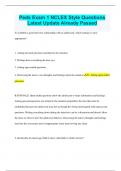
Peds Exam 1 NCLEX Style Questions Latest Update Already Passed To establish a good interview relationship with an adolescent, which strategy is most appropriate? 1. Asking personal questions unrelated to the situation 2. Writing down everything the teen says 3. Asking open-ended questions 4. Discussing the nurse's own thoughts and feelings about the situation 3. Asking open-ended questions RATIONALE: Open-ended questions allow the adolescent to share information and feelings. Asking personal questions not related to the situation jeopardizes the trust that must be established because the adolescent may feel as though he's being interrogated with unnecessary questions. Writing everything down during the interview can be a distraction and doesn't allow the nurse to observe how the adolescent behaves. Discussing the nurse's thoughts and feelings may bias the assessment and is inappropriate when interviewing any client A chronically ill school-age child is most vulnerable to which stressor? 1. Mutilation anxiety 2. Anticipatory grief 3. Anxiety over school absences 4. Fear of hospital procedures 3. Anxiety over school absences RATIONALE: The school-age child is becoming industrious and attempts to master school-related activities. Therefore, school absences are likely to cause extreme anxiety for a school-age child who's chronically ill. Mutilation anxiety is more common in adolescents. Anticipatory grief is rare in a school-age child. Fear of hospital procedures is most pronounced in preschool-age children. When developing a care plan for an adolescent, the nurse considers the child's psychosocial needs. During adolescence, psychosocial development focuses on: 1. becoming industrious. 2. establishing an identity. 3. achieving intimacy. 4. developing initiative. 2. establishing an identity. RATIONALE: According to Erikson, the primary psychosocial task during adolescence is to establish a personal identity while overcoming role or identity confusion. The adolescent attempts to establish a group identity by seeking acceptance and approval from peers, and strives to attain a personal identity by becoming more independent from his family. Becoming industrious is the developmental task of the school-age child; achieving intimacy is the task of the young adult; and developing initiative is the task of the preschooler. A nurse notes that an infant develops arm movement before fine-motor finger skills and interprets this as an example of which pattern of development? 1. Cephalocaudal 2. Proximodistal 3. Differentiation 4. Mass-to-specific 2. Proximodistal RATIONALE: Proximodistal development progresses from the center of the body to the extremities, such as from the arm to the fingers. Cephalocaudal development occurs along the body's long axis; for example, the infant develops control over the head, mouth, and eye movements before the upper body, torso, and legs. Mass-to-specific development, sometimes called differentiation, occurs as the child masters simple operations before complex functions and moves from broad, general patterns of behavior to more refined ones. A teenage mother brings her 1-year-old child to the pediatrician's office for a well-baby checkup. She says that her infant can't sit alone or roll over. An appropriate response by the nurse would be: 1. "This is very abnormal. Your child must be sick." 2. "Let's see about further developmental testing." 3. "
Written for
- Institution
- Peds
- Course
- Peds
Document information
- Uploaded on
- November 23, 2023
- Number of pages
- 27
- Written in
- 2023/2024
- Type
- Exam (elaborations)
- Contains
- Questions & answers
Subjects
-
peds exam 1 nclex style questions latest update al

Also available in package deal