BMTCN Test question n answers graded A+ 2023/2024 passed
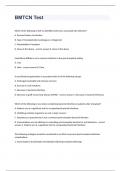
BMTCN Test Which of the following is NOT an identified risk factor associated with infection? A. Personal history of infection B. Type of transplantation (autologous or allogeneic) C. Myeloablative Transplant D. None of the Above - correct answer D. None of the above Clostridium difficile is not a common infection in the post-transplant setting A. True B. False - correct answer B. False A cord blood transplantation is associated with all of the following except: A. Prolonged neutrophil and immune recovery B. Increase in viral infections C. Decrease in bacterial infections D. Decrease in graft-versus-host disease (GVHD) - correct answer C. Decrease in bacterial infections Which of the following is true when considering bacterial infections in patients after transplant? A. Patients are at a significant risk for encapsulated bacterial infections B. Multidrug-resistant organisms are not a major concern C. Streptococcus pneumoniae is not a common post-transplant bacterial infection D. Immunizations are not effective in controlling post-transplant bacterial or viral infections - correct answer A. Patients are at a significant risk for encapsulated bacterial infections The following strategies should be considered in an effort to prevent post-transplant infectious complications: 1. Immunizations should begin immediately following transplant discharge 2. Antiviral and anti-fungal prophylaxis medications should be considered in the post-transplant setting 3. Lifestyle restrictions vary in each transplant center and often are enforced to decrease post-transplant infections. It is important to communicate lifestyle expectations and restrictions to patients and their families 4. Measles, mumps, and rubella immunization should be administered at 12 months A. 1, 2, 3, 4, B. 2 and 3 C. 2 and 4 D. 2, 3, 4 - correct answer B. 2 and 3 Cardiovascular disease may be underreported in hematopoietic stem cell transplant (HSCT) recipients because symptoms may occur several months to several years following HSCT A. True B. False - correct answer A. True Which risk factors are associated with post-HSCT cardiovascular disease? 1) Hypertension, 2)Gender, 3)Certain immunosuppressive medications, 4) Previous anthracycline chemotherapy A. 1, 2, 3, 4 B. 1, 3, 4 C. 2, 3, 4 D. 1, 2, 3 - correct answer B. 1, 3, 4 The following strategies are used to manage cardiovascular disease in post HSCT patients EXCEPT: A. Antihypertensive medications B. Statin therapy
Written for
- Institution
- BMTCN
- Course
- BMTCN
Document information
- Uploaded on
- November 23, 2023
- Number of pages
- 27
- Written in
- 2023/2024
- Type
- Exam (elaborations)
- Contains
- Questions & answers
Subjects

Also available in package deal