ACLS Exam Questions & Answers Graded A+
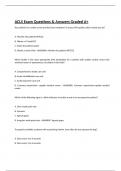
Your patient is in cardiac arrest and has been intubated. To assess CPR quality, which should you do? A. Monitor the patients PETCO2 B. Obtain a 12-lead ECG C. Check the patients pulse D. Obtain a chest X-Ray - ANSWERA. Monitor the patients PETCO2 Which facility is the most appropriate EMS destination for a patient with sudden cardiac arrest who achieved return of spontaneous circulation in the field? A. Comprehensive stroke care unit B. Acute rehabilitation care unit C. Acute long-term care unit D. Coronary reperfusion- capable medical center - ANSWERD. Coronary reperfusion-capable medical center Which of the following signs is a likely indicator of cardiac arrest in an unresponsive patient? A. Slow, weak pulse rate B. Cyanosis C. Agonal gasps D. Irregular, weak pulse rate - ANSWERC. Agonal gasps To properly ventilate a patient with a perfusing rhythm, how often do you squeeze the bag? A. Once every 3 to 4 seconds B. Once every 5 to 6 seconds C. Once every 10 seconds D. Once every 12 seconds - ANSWERB. Once every 5 to 6 seconds In addition to clinical assessment, which is the most reliable method to confirm and monitor correct placement of the endotracheal tube? A. Arterial Blood Gases B. Chest radiography C. Continuous waveform capnography D. Hemoglobin levels - ANSWERC. Continuous waveform capnography You are caring for a patient with a suspected stroke whose symptoms started 2 hours ago. The CT scan was normal, with no signs of hemorrhage. The patient does not have any contraindications to fibrinolytic therapy. Which treatment approach is the best for this patient? A. Hold fibrinolytic therapy for 24 hours B. Start fibrinolytic therapy as soon as possible C. Order an echocardiogram before fibrinolytic administration D. Wait for the results of the MRI - ANSWERB. Start fibrinolytic therapy as soon as possible What is the recommended range from which a temperature should be selected and maintained constantly to achieve targeted temperature management after cardiac arrest? A. 26 C to 28 C B. 29 C to 31 C C. 32 C to 36 C D. 35 C to 37 C - ANSWERC. 32 C to 36 C Which is the recommended first intravenous dose of amiodarone for a patient with refractory ventricular fibrillation? A. 100 mg B. 150 mg C. 250 mg D. 300 mg - ANSWERD. 300 mg Which is the primary purpose of a medical emergency team or rapid response team? A. Improving care for patients admitted to critical care units B. Improving patient outcomes by identifying and treating early clinical deterioration C. providing diagnostic consultation to emergency department patients D. Providing online consultation to EMS personnel in the field - ANSWERB. Improving patient outcomes by identifying and treating early clinical deterioration Which is the recommended next step after a defibrillation attempt? A. Check the ECG for evidence of a rhythm B. Open the patients airway C. Determine if a carotid pulse is present D. Resume CPR, starting with chest compressions - ANSWERD. Resume CPR, starting with chest compressions EMS providers are treating a patient with suspected stroke. According to the Adult Suspected Stroke Algorithm, which critical action performed by the EMS team will expedite the patients care on arrival and reduce the time to treatment? A. Alert the hospital B. Establish IV access C. Review the patient history D. Treat hypertension - ANSWERA. Alert the hospital Your rescue team arrives to find a 59 year old man lying on the kitchen floor. You determine that he is unresponsive. Which is the next step in your assessment and management of this patient? A. Apply the AED B. Check the patient's breathing and pulse C. Open the patients airway D. Check for a medical alert bracelet - ANSWERB. Check the patient's breathing and pulse Which best describes the length of time it should take to perform a pulse check during the BLS assessment? A. 1 to 4 seconds B. 5 to 10 seconds C. 11 to 15 seconds D. 16 to 20 seconds - ANSWERB. 5 to 10 seconds You instruct a team member to give 0.5 mg atropine IV. Which response is an example of a closed-loop communication? A. "I'll give it in a few minutes" B. "OK" C. "I'll draw up 0.5 mg of atropine" D. "Are you sure that is what you want given?" - ANSWERC. "I'll draw up 0.5 mg of atropine." What is an effect of excessive ventilation? A. Decreased cardiac output B. Decreased intrathoracic pressure C. Increased perfusion pressures
Written for
- Institution
- Acls
- Course
- Acls
Document information
- Uploaded on
- November 23, 2023
- Number of pages
- 13
- Written in
- 2023/2024
- Type
- Exam (elaborations)
- Contains
- Questions & answers
Subjects
- acls
-
acls exam questions answers graded a
-
your patient is in cardiac arrest and has been int
-
which facility is the most appropriate ems destina

Also available in package deal