STRATEGIES:
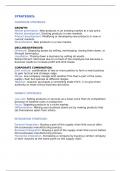
CORPORATE STRATEGIES:
GROWTH:
Market penetration: New products in an existing market at a low price.
Market development: Existing products in new markets.
Product development: Modifying or developing new products in new or
current markets.
Diversification: New products in a new market.
DECLINE/DEFENSIVE:
Divesture: Disposing assets by selling, exchanging, closing them down, or
through bankruptcy.
Liquidation: Closing down a business by selling all assets.
Retrenchment: Dismissal due to no fault of the employee but because a
business needs to increase profit and limit losses.
CORPORATE COMBINATION:
Joint venture: combination of two or more parties to form a new business
to gain tactical and strategic edge.
Merge: one company merges with another firm that is part of the same
supply chain but operate at different stages.
Takeover: acquiror purchases a controlling stake (51% +) to give them
authority to make critical business decisions.
GENERIC STRATEGIES:
Low cost: Selling products or services at a lower price than its competitors
because of lowered costs in production.
Focus: Targeting products to a niche market.
Differentiation: Making your business stand out by making products that
set themselves apart from others.
INTEGRATION STRATEGIES:
Forward integration: Buying a part of the supply chain that occurs after
the businesses manufacturing process.
Backward integration: Buying a part of the supply chain that occurs before
the businesses manufacturing process.
Horizontal integration: Increasing a company by buying a similar company
in their industry at the same point on the supply chain.
CORPORATE STRATEGIES:
GROWTH:
Market penetration: New products in an existing market at a low price.
Market development: Existing products in new markets.
Product development: Modifying or developing new products in new or
current markets.
Diversification: New products in a new market.
DECLINE/DEFENSIVE:
Divesture: Disposing assets by selling, exchanging, closing them down, or
through bankruptcy.
Liquidation: Closing down a business by selling all assets.
Retrenchment: Dismissal due to no fault of the employee but because a
business needs to increase profit and limit losses.
CORPORATE COMBINATION:
Joint venture: combination of two or more parties to form a new business
to gain tactical and strategic edge.
Merge: one company merges with another firm that is part of the same
supply chain but operate at different stages.
Takeover: acquiror purchases a controlling stake (51% +) to give them
authority to make critical business decisions.
GENERIC STRATEGIES:
Low cost: Selling products or services at a lower price than its competitors
because of lowered costs in production.
Focus: Targeting products to a niche market.
Differentiation: Making your business stand out by making products that
set themselves apart from others.
INTEGRATION STRATEGIES:
Forward integration: Buying a part of the supply chain that occurs after
the businesses manufacturing process.
Backward integration: Buying a part of the supply chain that occurs before
the businesses manufacturing process.
Horizontal integration: Increasing a company by buying a similar company
in their industry at the same point on the supply chain.