Security final questions and answers graded A+
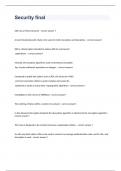
Security finalAES uses a Feistel structure - correct answer f At each horizontal point, State is the same for both encryption and decryption. - correct answer t DES is a block cipher intended to replace AES for commercial applications. - correct answer f Virtually all encryption algorithms, both conventional and public- key, involve arithmetic operations on integers. - correct answer t Compared to public-key ciphers such as RSA, the structure of AES and most symmetric ciphers is quite complex and cannot be explained as easily as many other cryptographic algorithms - correct answer t InvSubBytes is the inverse of ShiftRows - correct answer f The ordering of bytes within a matrix is by column - correct answer t In the Advanced Encryption Standard the decryption algorithm is identical to the encryption algorithm. - correct answer f The S-box is designed to be resistant to known cryptanalytic attacks. - correct answer t As with any block cipher, AES can be used to construct a message authentication code, and for this, only decryption is used - correct answer f The Rijndael developers designed the expansion key algorithm to be resistant to known cryptanalytic attacks. - correct answer t AES can be implemented very efficiently on an 8-bit processor. - correct answer t Plaintext is transformed into ciphertext using two keys and a decryption algorithm. - correct answer f Public-key encryption is more secure from cryptanalysis than symmetric encryption - correct answer f Much of the theory of public-key cryptosystems is based on number theory. - correct answer t If the authenticator is encrypted with the sender's private key, it serves as a signature that verifies origin, content, and sequencing. - correct answer t A trap-door one-way function is easy to calculate in one direction and infeasible to calculate in the other direction unless certain additional information is known. - correct answer t A public-key encryption scheme is not vulnerable to a brute-force attack. - correct answer f The Advanced Encryption Standard was published by the ________ in 2001. - correct answer NIST The AES cipher begins and ends with a(n) _________ stage because any other stage, applied at the beginning or end, is reversible without knowledge of the key and would add no security. - correct answer addRoundKey In the AES structure both encryption and decryption ciphers begin with a(n)
Written for
- Institution
- AES
- Course
- AES
Document information
- Uploaded on
- November 21, 2023
- Number of pages
- 5
- Written in
- 2023/2024
- Type
- Exam (elaborations)
- Contains
- Questions & answers
Subjects

Also available in package deal