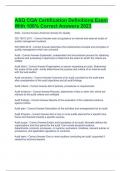
ASQ CQA Certification Definitions Exam With 100% Correct Answers 2023
ASQ CQA Certification Definitions Exam With 100% Correct Answers 2023 ASQ - Correct Answer-American Society for Quality ISO 19011:2011 - Correct Answer-sets out guidance on internal and external audits of quality management systems ISO 9000:2015 - Correct Answer-Describes the fundamental concepts and principles of quality management which are universal Audit - Correct Answer-Systematic, independent and documented process for obtaining evidence and evaluating it objectively to determine the extent to which the criteria are fulfilled Audit client - Correct Answer-Organization or person requesting an audit. Determines the scope of the audit. Jointly determines the purpose and criteria of an internal audit with the lead auditor. Audit conclusion - Correct Answer-Outcome of an audit, provided by the audit team after consideration of the audit objectives and all audit findings Audit criteria - Correct Answer-Set of policies, procedures or requirements Audit evidence - Correct Answer-Records, statements of fact or other info, which are relevant to the audit criteria and verifiable Audit findings - Correct Answer-Results of the evaluation of the collected evidence against criteria Audit plan - Correct Answer-Description of the activities and arrangements for an audit Audit Program - Correct Answer-Set of one or more audits planned for a specific time frame and directed towards a specific purpose Audit scope - Correct Answer-Extent and boundaries of an audit. Normally defines the organizations and time period for the audit. Can include physical locations, departments, products, processes, or systems, exclusions, timelines, relevant polices or procedures, and applicable regulations or contracts. Audit team - Correct Answer-One or more auditors conducting an audit, supported if needed by technical experts Auditee - Correct Answer-Organization being audited Auditor - Correct Answer-Person with the competence to conduct an audit Part I - Correct Answer-Auditing fundamentals Part I A - Correct Answer-Types of quality audits Part I B - Correct Answer-Purpose and scope of audits Part I C - Correct Answer-Criteria to audit against Part I D - Correct Answer-Roles and responsibilities of audit participants Part I E - Correct Answer-Professional conduct and consequences for auditors Product or Service Audit - Correct Answer-Examination of a particular item or service (hardware, processed material, software) to evaluate whether it conforms to requirements (that is, specifications, performance standards, and customer requirements). Conducted at completed stage of production and has passed final inspection. Can also measure quality of item going to customer (product quality audit). Technical exam of the form, fit and function of a completed item after final inspection. Process audit - Correct Answer-Verifies that procedures are working within established limits. It examines an activity to verify that the inputs, actions, and outputs are in accordance with defined requirements. It is very focused on a single activity. General Audit Types - Correct Answer-3 discrete types are product (which includes services), process, and system Process audit technique - Correct Answer-Audit method of following process steps System audit - Correct Answer-Exam conducted on a management system. A documented activity performed to verify, by exam and evaluation of objective evidence, that applicable elements of the system are appropriate and effective and have been developed, documented and implemented in accordance and in conjunction with specified requirements. It encompasses all the practices of a facility that assist in providing an acceptable product or service that is safe and conforms to applicable local, regional, national, and international requirements A S M E - Correct Answer-American Society of mechanical engineers Desk Audit or Document Review - Correct Answer-An audit of an organization's documents. It can be done prior to or in conjunction with other audit methods but must be performed prior to auditing a new area to verify documents meet requirements before activity observation. Audit classifications - Correct Answer-Internal or external dependent on the auditor - auditee relationship Internal audits - Correct Answer-First party audits of an organization's products, processes, and systems conducted by employees of that organization. Per ISO 9000:2008 they must be scheduled and carried out by independent personnel External audits - Correct Answer-Can either be second or third party audits. Audits of an organization's products, processes, and systems conducted by individuals who are not employees of the organization. First Party Audit - Correct Answer-A K A internal audit. Performed within an organization to measure its strengths and weaknesses against its own procedures or methods and / or against external standards adopted (voluntary) or imposed (mandatory) on the organization. Must be performed by employees with no vested interest in the area being audited. Conducted on behalf of the organization itself for management review. Second party audit. - Correct Answer-External audit performed on a supplier by a customer or by a contracted organization on behalf of a customer. Surveys can be used as a method for this type of audit. Retention requirements are determined solely by the audit client Third party audit - Correct Answer-An external Performed by an organization independent of the customer-supplier relationship and is free from any conflict of interest. An example would be an audit by a regulatory agency. May result in certification, registration, approval, license, citations, etcetera. Audit purposes - Correct Answer-Certification, performance, compliance, conformance, follow-up Certification Purposes for audits - Correct Answer-For Approval to manufacture and / or market product in a specific area, or for customer requirements A N A B - Correct Answer-A N S I - A S Q National Accreditation Board is the U S accreditation body for management systems. It accredits certification bodies for I S O 9001, I S O 13485, I S O / T S 16949 Q M Ss, I S O 14001 E M Ss, as well as for several other conformity requirements standards. I S O 9000 - Correct Answer-Set of international standards on quality management and quality assurance developed to help companies effectively document the quality system elements to be implemented to maintain an efficient quality system. They are not specific to any one industry and can be applied to organizations of any size. It is a series, or family, of standards which can help a company satisfy its customers, meet regulatory requirements, and achieve continual improvement. It is considered a first step, a base level of a quality system
Written for
- Institution
- ASQ CQA
- Course
- ASQ CQA
Document information
- Uploaded on
- November 21, 2023
- Number of pages
- 14
- Written in
- 2023/2024
- Type
- Exam (elaborations)
- Contains
- Questions & answers
Subjects
-
asq cqa certification definitions exam with 100 c
Also available in package deal